

Every hospitality leader in the United Kingdom knows how demanding it can be to handle busy shifts while ensuring every detail runs smoothly. The right POS hardware forms the backbone of successful restaurants, cafés, and hotels by making transactions fast and reducing costly errors. Understanding the fundamentals of modern POS hardware helps you choose devices that not only support efficient operations but also elevate customer experience for your business.
Table of Contents
- Defining POS Hardware and Its Role
- Types of POS Devices and Variations
- Core Features for Hospitality Operations
- Integrating Hardware with POS Software
- Common Mistakes and How to Avoid Them
Key Takeaways
| Point | Details |
|---|---|
| POS Hardware Integration | Seamless integration between POS hardware and software is essential for operational efficiency in the hospitality sector. Businesses should consider cloud synchronisation and modular compatibility when selecting systems. |
| Core Features for Operations | Advanced POS systems must include features like real-time inventory tracking, customer relationship management, and integrated payment methods to support hospitality operations effectively. |
| Common Implementation Mistakes | Key pitfalls include underestimating total costs, neglecting staff training, and choosing non-scalable systems, all of which can hinder successful POS adoption. |
| Investing in Quality | Businesses are advised to invest in modular, scalable POS hardware that can adapt to growth and integrate with existing systems for future flexibility. |
Defining POS Hardware and Its Role
Point of Sale (POS) hardware represents the critical physical infrastructure that enables businesses in the hospitality sector to process transactions, manage orders, and deliver seamless customer experiences. These sophisticated systems go far beyond traditional cash registers, emerging as comprehensive technological solutions that transform transaction management.
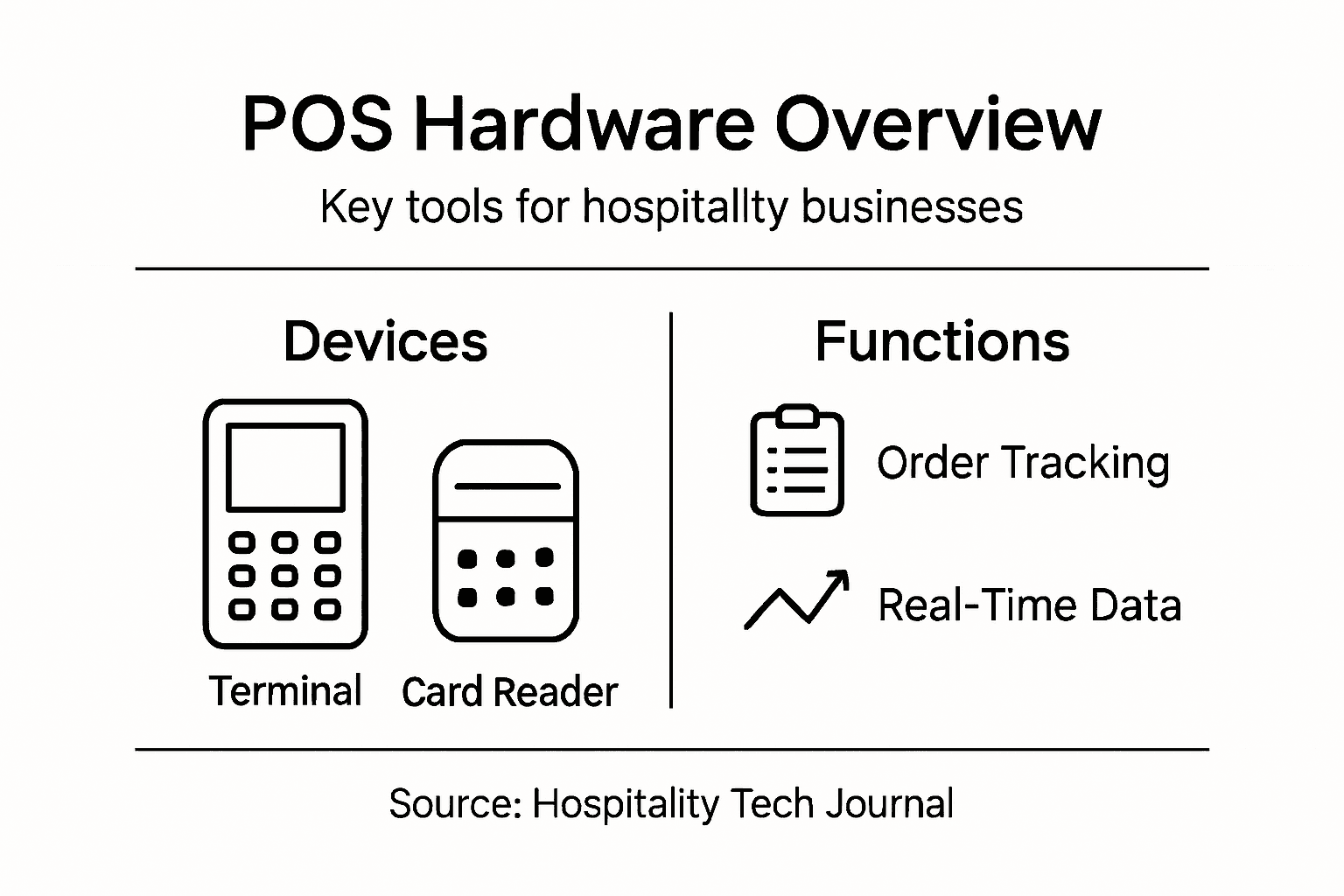
At its core, POS hardware includes several key components that work together to streamline business operations:
- Terminals: Centralised computing devices for processing transactions
- Barcode scanners: For rapid inventory and product tracking
- Card readers: Enabling multiple payment method acceptance
- Cash drawers: Secure cash management systems
- Receipt printers: Providing customers with transaction documentation
The modern hospitality POS hardware ecosystem is designed to support real-time data capture, enabling businesses to make informed decisions quickly. These integrated systems help restaurants, cafés, and other food service establishments reduce manual errors, accelerate service speed, and enhance overall operational efficiency.
By combining physical hardware with intelligent software, POS systems provide businesses with powerful tools for tracking sales, managing inventory, and understanding customer purchasing patterns. The hardware’s role extends beyond mere transaction processing – it becomes a strategic asset for business intelligence and performance monitoring.
Pro tip: Invest in modular POS hardware that can easily integrate with your existing systems and scale as your business grows.
Types of POS Devices and Variations
The hospitality industry has witnessed a remarkable evolution in POS hardware, with diverse device configurations designed to meet specific operational requirements. Modern POS systems are no longer confined to stationary countertop terminals but encompass a wide range of sophisticated technological solutions that adapt to different service environments.
Key types of POS devices include:
- Stationary terminals: Fixed computer systems for traditional checkout areas
- Mobile POS units: Handheld devices enabling tableside ordering and payments
- Touchscreen monitors: Interactive displays with intuitive user interfaces
- Wireless scanners: Portable inventory tracking and management tools
- Integrated system terminals: Comprehensive solutions combining multiple functionalities
Each device variation offers unique advantages for different hospitality settings. Restaurant point-of-sale systems might prioritise tableside ordering capabilities, while hotel reception desks could require more complex check-in and billing integrations. The flexibility of modern POS hardware allows businesses to select devices that precisely match their operational workflows and customer service strategies.

Here’s a quick comparison of major POS hardware types and their best-suited hospitality settings:
| Device Type | Typical Use Case | Ideal For |
|---|---|---|
| Stationary terminal | Standard checkouts | Hotels, large restaurants |
| Mobile POS unit | Flexible, tableside ordering | Cafés, casual dining |
| Touchscreen monitor | Fast, intuitive interaction | Quick-service outlets |
| Integrated system | Complete solution management | Resorts, event venues |
| Wireless scanner | Portable stock tracking | Pop-up bars, inventory |
Advanced POS hardware now incorporates cutting-edge technologies like biometric authentication, IoT connectivity, and cloud-based data synchronisation. These innovations transform POS devices from simple transaction processors into strategic business intelligence tools that provide real-time insights into sales performance, inventory management, and customer behaviour.
Pro tip: Carefully assess your specific business requirements before selecting POS hardware, considering factors like mobility, integration capabilities, and scalability.
Core Features for Hospitality Operations
Hospitality businesses require sophisticated POS systems with comprehensive operational capabilities that extend far beyond basic transaction processing. Modern POS hardware must seamlessly integrate multiple critical functions to support the complex ecosystem of hospitality service delivery.
Key core features for hospitality POS systems include:
- Payment gateway integration: Enabling multiple payment methods
- Real-time inventory tracking: Monitoring stock levels automatically
- Order management: Streamlining kitchen and service workflows
- Customer relationship management: Tracking customer preferences and history
- Reporting and analytics: Generating insights for business strategy
- Loyalty programme management: Supporting customer retention initiatives
Advanced POS systems now incorporate sophisticated technologies that transform operational efficiency. These include cloud-based synchronisation, mobile payment capabilities, and intelligent data analytics dashboards that provide granular insights into sales performance, customer behaviour, and operational bottlenecks.
The most effective hospitality POS solutions go beyond transactional processing, becoming strategic tools that support holistic business intelligence. By integrating features like QR code ordering, e-commerce connections, and comprehensive reporting, these systems enable businesses to make data-driven decisions that enhance both operational efficiency and customer experience.
Pro tip: Select a POS system that offers flexible integration capabilities and scalable features to accommodate your business’s evolving technological needs.
Integrating Hardware with POS Software
Successful hospitality businesses recognise that seamless POS system integration is fundamental to operational efficiency. Modern POS solutions require sophisticated synchronisation between physical hardware and intelligent software platforms to deliver comprehensive business management capabilities.
Key integration strategies include:
- Unified data ecosystem: Ensuring consistent information flow across all devices
- Cloud-based synchronisation: Enabling real-time updates and remote management
- Modular hardware compatibility: Supporting flexible system configurations
- Automated reporting: Generating instant performance insights
- Multi-platform connectivity: Linking terminals, mobile devices, and management systems
The integration process involves complex technical considerations that go beyond simple hardware-software connections. Enterprise-level POS systems now leverage advanced technologies like cloud computing and enterprise resource planning platforms to create robust, scalable solutions that can adapt to evolving business requirements.
Advanced integration techniques allow hospitality businesses to transform their technological infrastructure. By connecting payment terminals, inventory tracking systems, customer relationship management platforms, and financial reporting tools, organisations can create a holistic operational environment that supports strategic decision-making and enhances overall business performance.
To help you select a POS system, here is a summary of key hardware integration considerations and their operational impact:
| Integration Factor | Description | Business Benefit |
|---|---|---|
| Cloud synchronisation | Real-time remote updates | Fast data access |
| Modular hardware compatibility | Mix-and-match device options | Future-proof investment |
| Automated reporting | Instant performance analytics | Better decision-making |
| Multi-platform connectivity | Links devices and management | Unified operations |
Pro tip: Prioritise POS solutions with open API architectures that allow flexible integration and future technological adaptability.
Common Mistakes and How to Avoid Them
Hospitality businesses often encounter significant challenges when implementing POS systems, with critical implementation errors potentially undermining operational efficiency. Understanding and proactively addressing these common pitfalls is essential for successful technological integration.
Key mistakes to avoid include:
- Underestimating total cost of ownership: Overlooking long-term expenses beyond initial hardware purchase
- Neglecting staff training: Failing to provide comprehensive system education
- Ignoring technical support requirements: Not planning for ongoing maintenance and troubleshooting
- Choosing non-scalable systems: Selecting hardware that cannot adapt to business growth
- Insufficient security planning: Overlooking data protection and privacy protocols
The most critical aspect of POS system implementation involves thorough preparation and strategic planning. Businesses must conduct comprehensive assessments of their operational workflows, technology capabilities, and staff readiness before selecting and deploying any new system. This approach helps mitigate risks associated with technological transitions and ensures smoother operational integration.
Successful POS hardware implementation requires a holistic approach that balances technological capabilities with human factors. This means not only selecting robust hardware and software but also creating a supportive environment that encourages user acceptance, provides continuous training, and maintains flexibility for future technological adaptations.
Pro tip: Conduct a comprehensive pilot test with a small team before full-scale POS system implementation to identify and address potential challenges.
Discover POS Hardware Solutions That Drive Hospitality Efficiency
Understanding the challenges of seamless transaction management and scalable integration outlined in “POS Hardware Explained: Impact on Hospitality Efficiency” is crucial for hospitality businesses aiming to enhance service and operational speed. If you are looking to avoid common pitfalls like underestimating total costs or ignoring critical staff training while embracing modular hardware that grows with your business, the right combination of advanced POS terminals, barcode scanners, and integrated software solutions makes all the difference.
YCR Distribution specialises in providing hospitality-focused POS hardware and bespoke software such as SAMTOUCH and EZEEPOS that connect effortlessly to streamline order management, inventory tracking, and real-time reporting. With trusted brands like SAM4S and iMin, plus credit accounts and next-day delivery, YCR helps your business stay ahead by transforming your POS setup into a strategic asset.
Elevate your hospitality operations today with tailored POS systems designed for flexibility, reliability, and growth. Explore comprehensive solutions and expert support at YCR Distribution and experience the difference that the latest POS technology can make. Visit YCR’s website now to start upgrading your hospitality business with future-proof hardware and software that match your exact needs.
Frequently Asked Questions
What are the main components of POS hardware in the hospitality sector?
POS hardware includes terminals, barcode scanners, card readers, cash drawers, and receipt printers that work together to streamline transaction processing and enhance operational efficiency.
How does POS hardware improve customer experience in hospitality businesses?
By integrating various functionalities such as mobile ordering, real-time inventory management, and fast payment processing, POS hardware accelerates service, reduces errors, and provides insights into customer preferences, ultimately enhancing the overall experience.
What should I consider when selecting POS hardware for my hospitality business?
When selecting POS hardware, consider factors like mobile capabilities, integration with existing systems, scalability for future growth, and the specific operational needs of your establishment.
How can I avoid common mistakes when implementing a new POS system in my hospitality operation?
To avoid common mistakes, ensure thorough staff training, evaluate the total cost of ownership beyond initial hardware expenses, plan for ongoing technical support, and conduct pilot tests to identify potential challenges before full-scale implementation.