
Digital signage is revolutionising UK retail and hospitality, delivering measurable customer engagement and sales lift that static displays simply cannot match. These networked digital display systems deliver real-time, targeted content through LCD screens, LED panels, and interactive touchscreens, transforming how businesses communicate with customers. By enabling dynamic messaging that adapts to customer behaviour and operational needs, digital signage has become essential for competitive advantage.
Table of Contents
- Introduction To Digital Signage In Retail And Hospitality
- How Digital Signage Enhances Customer Engagement
- Operational Benefits For Retail And Hospitality Businesses
- Common Misconceptions About Digital Signage
- Technology And Trends Shaping Digital Signage In The Uk
- Implementing Digital Signage Solutions: Practical Steps For Uk Businesses
- Frequently Asked Questions
Key takeaways
| Point | Details |
|---|---|
| Sales impact | Digital signage boosts customer engagement by 30% and increases impulse purchases by 25%. |
| Cost efficiency | Cloud-based content management systems reduce operational costs by 25%. |
| Interactive power | Touchscreen displays enable self-service ordering and product exploration. |
| Energy savings | LED technology cuts energy consumption by 60% compared to traditional displays. |
| Operational control | Real-time remote management improves efficiency across multiple locations. |
Introduction to digital signage in retail and hospitality
Understanding what digital signage actually is helps you assess its fit for your business. At its core, digital signage is a networked system delivering dynamic content through electronic displays. Unlike printed posters, these systems connect to content management platforms that push updates instantly.
Three main display types dominate the UK market. Indoor LCD screens suit cafes, shops, and reception areas with bright, high-resolution content. Outdoor LED panels withstand weather and deliver visibility in direct sunlight for forecourts and high streets. Interactive touchscreens empower customers to browse menus, check stock, or place orders without staff intervention.
The real power lies in real-time, targeted communication. You can schedule breakfast menus for morning hours, switch to lunch offerings at midday, and highlight evening specials automatically. Weather-triggered content adjusts promotions based on conditions outside. Location-specific messaging tailors content to each store’s demographics.
Typical content includes promotional offers, product information, wayfinding maps, and queue management. Restaurants display dynamic menus with mouth-watering imagery. Retailers showcase new arrivals and seasonal campaigns. Hotels provide event schedules and local attraction guides.
Core components powering these systems include:
- Display hardware matching your environment and viewing distance
- Media players processing and rendering content locally
- Cloud-based content management software controlling all screens remotely
- Network connections enabling updates and monitoring
- Mounting solutions ensuring safety and optimal viewing angles
This infrastructure creates a flexible communication channel that evolves with your business needs. The initial investment pays dividends through reduced printing costs and increased sales effectiveness.
How digital signage enhances customer engagement
The engagement boost from digital signage is not theoretical. Research shows digital signage increases customer dwell time by up to 30% and impulse purchases by 25%. Customers naturally gravitate toward moving images and dynamic content, spending more time exploring your offerings.

Interactive flat panel displays take engagement further by putting control in customer hands. Touchscreen kiosks let diners customise orders, view nutritional information, and checkout independently. Retail browsers explore product catalogues, check specifications, and locate items without waiting for staff. This self-service capability reduces perceived wait times and empowers customers.
The content itself drives different engagement behaviours. High-quality product videos demonstrate features that static images cannot convey. Customer testimonials build trust through authentic stories. Limited-time countdown timers create urgency that prompts immediate action. Social media feeds display real-time customer posts, building community.
Key engagement strategies using digital signage include:
- Personalised welcome messages recognising loyalty program members
- Promotional updates highlighting deals relevant to browsing behaviour
- Educational content explaining product benefits and usage
- Entertainment during wait times reducing frustration
- Wayfinding reducing customer confusion in large venues
The UK’s customer engagement sales impact validates these strategies across sectors. Coffee shops see morning rush throughput improve with digital menu boards. Fashion retailers convert browsers to buyers with styled outfit suggestions. Hotels enhance guest experiences with curated local recommendations.
Pro Tip: Place interactive displays at natural decision points where customers pause to consider options. Queue areas, changing room entrances, and product display endpoints maximise engagement opportunity.
The psychological impact matters too. Digital content signals modernity and innovation, positioning your brand as current and customer-focused. This perception influences purchase decisions, particularly among younger demographics expecting digital experiences.
Operational benefits for retail and hospitality businesses
Beyond customer-facing advantages, digital signage streamlines back-of-house operations significantly. Cloud-based content management systems reduce management costs by 25% by eliminating manual updates across locations. One operator updates all screens simultaneously from any internet-connected device.
Real-time updates transform operational communication. Price changes go live instantly across all stores, eliminating the lag and errors of printed materials. Promotional campaigns launch simultaneously nationwide, ensuring consistent brand messaging. Emergency communications reach staff and customers immediately during incidents.
Reliability improvements deliver measurable value. Studies document a 90% reduction in screen downtime when businesses implement proper monitoring and maintenance protocols. This uptime ensures your investment consistently delivers returns rather than displaying error messages.
Operational benefits include:
- Fewer pricing errors from centrally managed updates
- Multi-site control from a single dashboard
- Staff communication through back-of-house displays
- Data collection on content performance and customer interaction
- Integration with operational efficiency software for coordinated systems
The time savings compound across your organisation. Marketing teams publish campaigns without coordinating with individual store managers. Operations managers adjust messaging based on inventory levels automatically. Finance teams implement price changes without printing and distributing new materials.
Labour allocation improves when digital displays handle routine customer queries. Self-service kiosks reduce front-of-house staffing needs during peak periods. Queue management systems optimise service flow, preventing bottlenecks. Staff focus on high-value customer interactions rather than answering repetitive questions.
Pro Tip: Schedule regular content audits every quarter to remove outdated materials and refresh messaging. Stale content undermines the dynamic advantage digital signage provides.
Cost recovery happens faster than many businesses expect. The combination of reduced printing expenses, lower labour costs, and increased sales typically delivers positive ROI within 12 to 18 months for well-planned implementations.
Common misconceptions about digital signage
Several myths prevent UK businesses from adopting digital signage despite clear benefits. The most persistent misconception is prohibitive cost and complexity. While early systems required significant investment, cloud-based platforms now reduce costs by 25%, making solutions accessible for small businesses. Modern systems require no technical expertise, with drag-and-drop interfaces anyone can master.
Another false belief limits digital signage to advertising only. Reality encompasses operational signage, wayfinding, customer service, entertainment, and brand building. Restaurants use kitchen display systems coordinating food preparation. Retail stores provide interactive product finders. Hotels offer event schedules and local guides.
Some retailers assume digital signage equals static signage with a screen. Data contradicts this: digital signage drives 30% more customer engagement than printed alternatives. The dynamic nature, interactivity, and real-time relevance create fundamentally different customer experiences.
| Feature | Static signage | Digital signage |
|---|---|---|
| Update speed | Days to weeks | Instant |
| Content variety | Single message | Multiple rotating messages |
| Interactivity | None | Touchscreen, responsive |
| Cost per update | Printing + distribution | Negligible |
| Customer engagement | Baseline | 30% higher |
| Energy efficiency | None | LED reduces 60% vs traditional |
Biggest myths versus realities about digital signage:
- Myth: Only large chains can afford it. Reality: Cloud platforms and flexible hardware suit any budget.
- Myth: Requires IT department management. Reality: User-friendly interfaces need no technical skills.
- Myth: Content creation is expensive and time-consuming. Reality: Templates and libraries enable quick professional results.
- Myth: Customers ignore digital displays. Reality: Motion and interactivity naturally attract attention.
- Myth: Installation disrupts business operations. Reality: Professional installation completes in hours with minimal impact.
The affordability misconception particularly holds back small businesses who would benefit most. Entry-level systems cost less than six months of printed material expenses while delivering superior results. Financing options and equipment leasing further reduce barriers.
Some hesitation stems from technology anxiety. Business owners worry about system failures, hacking, or content mishaps. Quality providers address these concerns through reliable hardware, secure cloud platforms, and comprehensive support. The technology has matured significantly, with enterprise-grade solutions now available at SME price points.
Technology and trends shaping digital signage in the UK
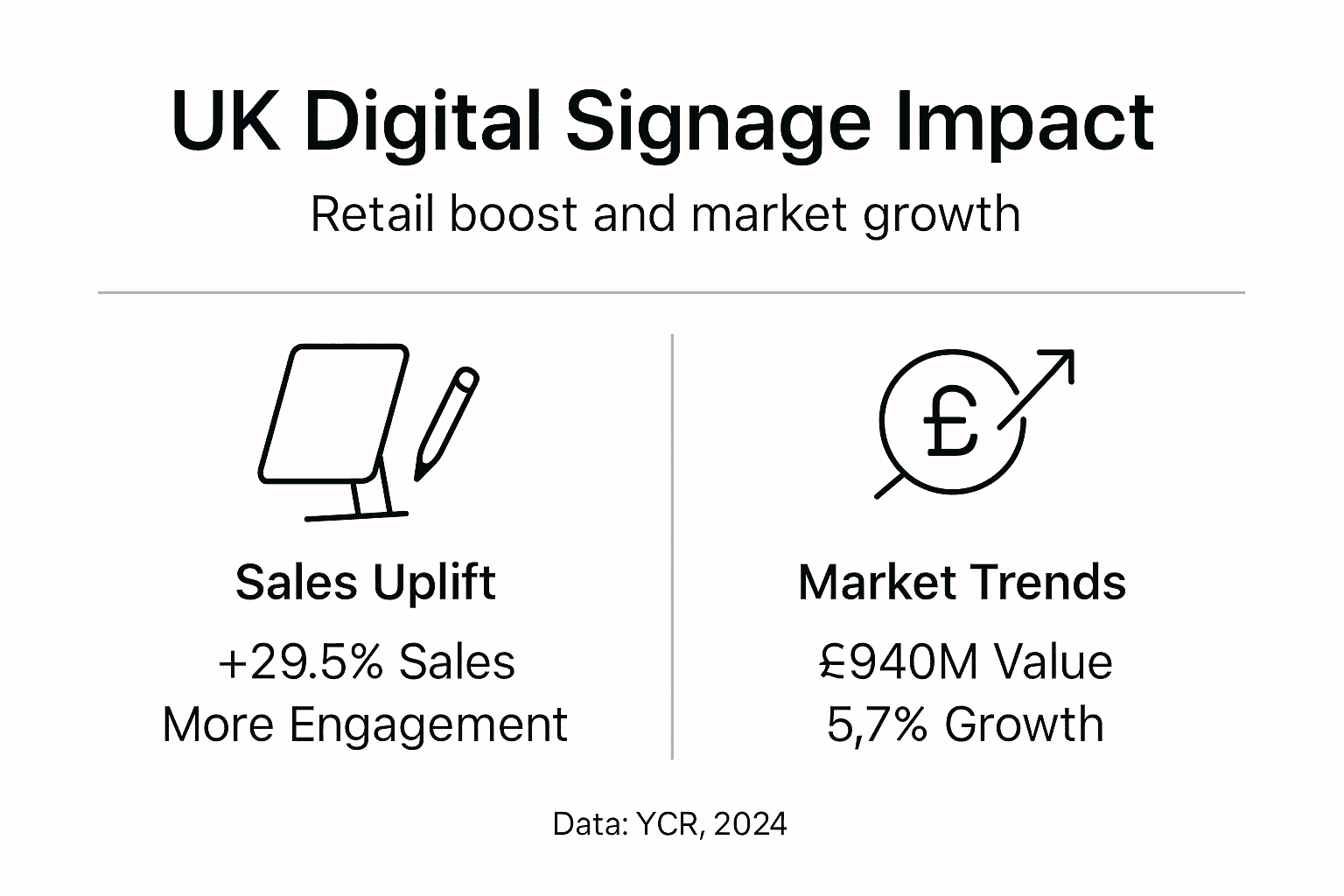
The UK digital signage market is growing at 5.7% annually, reaching £940 million in 2024 and accelerating into 2026. This growth reflects broader digital transformation across retail and hospitality, with businesses recognising signage as strategic infrastructure rather than optional marketing.
AI-powered personalisation represents the most significant emerging capability. Smart systems analyse customer demographics through camera sensors, adjusting content in real time. A family approaching a quick-service restaurant sees kids’ meal promotions. A business professional gets coffee and breakfast deals. This targeting dramatically improves conversion rates.
Sustainability concerns drive technology choices. LED signage reduces energy consumption by 60% compared to older display technologies, supporting UK net-zero commitments. Lower power requirements reduce operating costs while meeting corporate environmental goals. Many businesses highlight their sustainable signage in customer communications.
| Display type | Energy efficiency | Indoor suitability | Outdoor suitability | Typical cost range |
|---|---|---|---|---|
| LCD | Moderate | Excellent | Poor | £300 to £1,500 |
| LED | High (60% savings) | Good | Excellent | £800 to £5,000+ |
| Interactive touchscreen | Moderate | Excellent | Limited | £1,000 to £3,000 |
Emerging trends reshaping UK digital signage technology include:
- AI-driven content optimisation based on customer response data
- Voice-activated displays for hands-free interaction
- Augmented reality integration showing products in customer environments
- Facial recognition for loyalty program integration
- Mobile device integration enabling personal content experiences
- Programmatic advertising platforms monetising display networks
Cloud management has become standard rather than optional. Centralised control enables rapid response to market conditions, weather events, or supply chain disruptions. Multi-location businesses update messaging across their entire estate in minutes.
Interactive capabilities continue expanding beyond touchscreens. Gesture control lets customers browse without physical contact, addressing hygiene concerns that intensified during recent years. QR code integration bridges physical displays to mobile experiences, enabling detailed product exploration.
Data analytics transform digital signage from broadcast medium to feedback system. Businesses track which content drives engagement, what times see peak interaction, and how different demographics respond. This intelligence informs broader marketing strategies and product decisions.
The technology convergence matters most. Digital signage increasingly integrates with POS systems, inventory management, customer relationship platforms, and business intelligence tools. This integration creates coordinated customer experiences where signage reflects real-time business conditions.
Implementing digital signage solutions: practical steps for UK businesses
Successful implementation starts with clear objectives. Determine whether you prioritise customer engagement, operational efficiency, or both. Engagement-focused deployments emphasise customer-facing displays with compelling content. Operations-focused systems may include back-of-house communication and workflow displays.
Follow this deployment sequence:
- Assess your specific needs and define success metrics like dwell time, conversion rate, or operational cost reduction.
- Select appropriate hardware matching your environment: indoor LCD for controlled spaces, outdoor LED for weather exposure, interactive touchscreens for self-service.
- Choose a cloud-based content management system offering the control level and features you require.
- Plan content strategy including templates, update frequency, and responsibility assignments.
- Conduct a pilot installation at your highest-traffic location to test and optimise before wider rollout.
- Train staff on content updates, basic troubleshooting, and customer assistance with interactive features.
- Monitor performance data and refine content based on engagement metrics.
- Scale gradually to additional locations, applying lessons from your pilot.
Environment-specific hardware choices prevent costly mistakes. Indoor retail spaces typically use commercial-grade LCD displays offering excellent image quality at reasonable cost. Outdoor locations require weatherproof LED panels with high brightness overcoming direct sunlight. High-traffic interactive areas need durable touchscreens with anti-glare coatings.
Integration with existing systems multiplies value. Connect digital signage to your POS system so inventory levels trigger content changes. Link to your booking system so restaurants display accurate wait times. Coordinate with loyalty programs to welcome returning customers by name.
Pro Tip: Run a three-month pilot at your busiest location before full rollout. Measure specific KPIs like average transaction value, customer dwell time, and staff efficiency to quantify ROI and build confidence in broader deployment.
Prerequisites for smooth implementation include reliable internet connectivity at each location, adequate electrical infrastructure, secure mounting locations with optimal viewing angles, and staff buy-in through training. Address these fundamentals before installation day.
Content strategy determines long-term success more than hardware choices. Develop a content calendar with regular updates keeping displays fresh. Build a template library enabling quick professional-quality content creation. Assign clear responsibilities for content approval and publishing.
Maintenance planning prevents the abandoned-screen syndrome where initial enthusiasm fades into neglected displays showing outdated content. Schedule quarterly content reviews, monthly performance analysis, and regular hardware checks. Budget for content creation resources, whether in-house or outsourced.
Discover digital signage solutions with YCR
Your digital signage success depends on partnering with experienced providers who understand UK retail and hospitality requirements. YCR Distribution brings over 30 years of expertise as the UK’s largest independent POS value-added reseller, offering comprehensive digital signage solutions tailored to your specific operational needs.
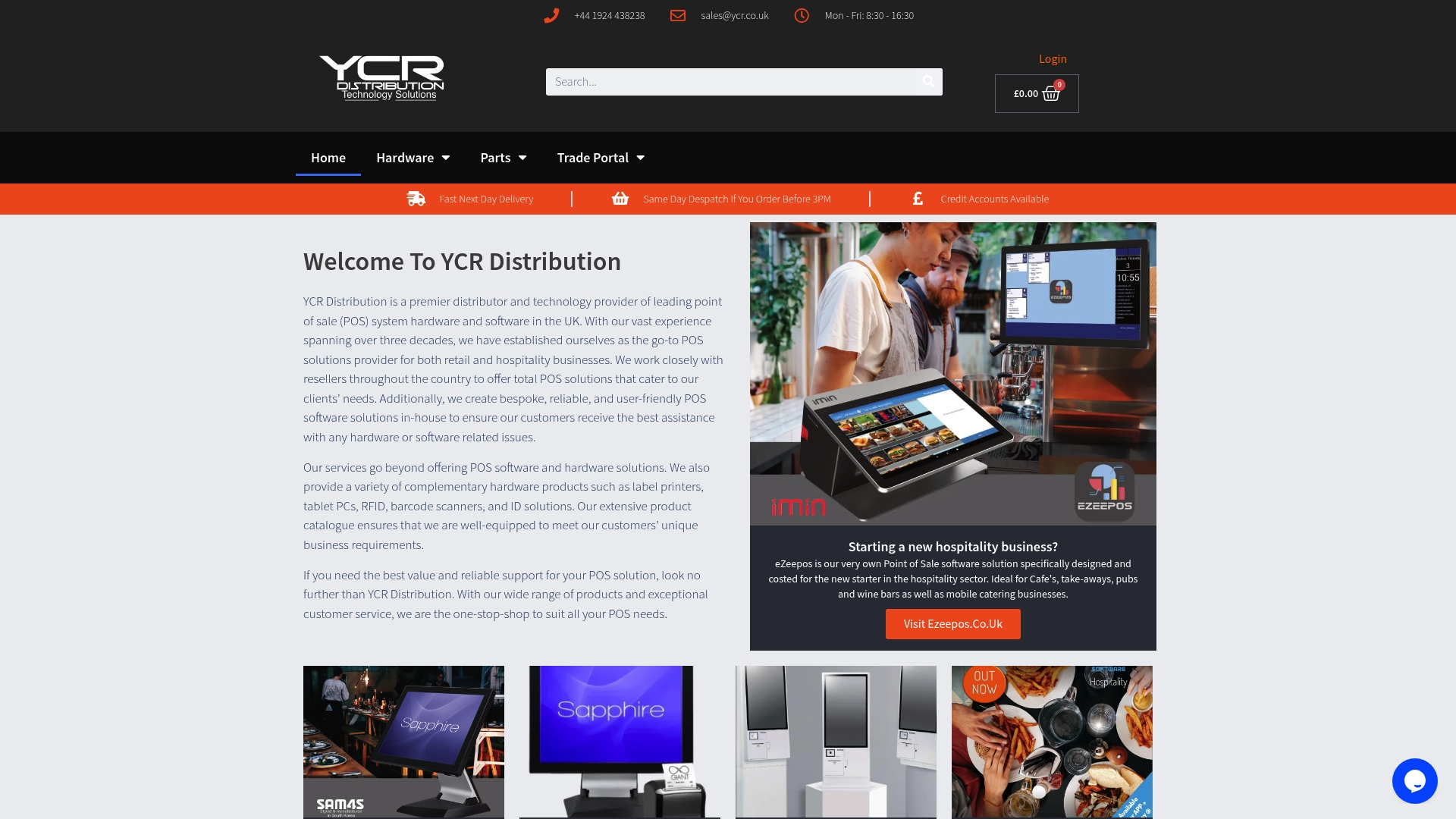
Our extensive range includes display hardware for every environment, from compact countertop screens to large-format outdoor LED panels. We supply commercial-grade equipment from trusted manufacturers, ensuring reliability and longevity. Whether you operate a single café or a nationwide retail chain, we provide scalable solutions matching your budget and growth plans.
Integration with your existing infrastructure maximises your investment. Our POS hardware and software solutions work seamlessly with digital signage, creating unified systems where customer-facing displays, payment processing, and operational management communicate efficiently. This integration eliminates data silos and enables coordinated customer experiences.
Benefits of partnering with YCR include:
- Expert consultation matching solutions to your specific business requirements
- Comprehensive product range from entry-level to enterprise systems
- Integration services connecting signage with existing POS and operational systems
- Ongoing technical support ensuring consistent performance
- Next-day delivery and same-day dispatch for urgent requirements
- Flexible credit accounts supporting cash flow management
Our team understands the unique challenges UK retail and hospitality businesses face. We help you navigate technology choices, plan deployments, and optimise ongoing operations. Contact us to discuss how digital signage can transform your customer engagement and operational efficiency.
Frequently asked questions
What types of digital signage are best for small UK retail shops?
Small retailers benefit most from indoor LCD displays ranging from 32 to 55 inches, offering excellent image quality at £300 to £800 per screen. Cloud-based content management systems eliminate the need for on-site servers, reducing costs further. Focus on high-traffic areas like entrances and checkout queues where customer dwell time enables message absorption.
How much can UK businesses save operationally with digital signage?
Businesses typically reduce operational costs by 25% through eliminated printing expenses, reduced labour for manual updates, and centralised multi-site management. Energy-efficient LED displays cut power consumption by 60% compared to older technologies. Most implementations achieve positive ROI within 12 to 18 months when accounting for both cost savings and increased sales.
Can digital signage integrate with existing POS systems?
Modern digital signage platforms integrate seamlessly with POS systems through APIs and standard protocols. This integration enables real-time inventory updates triggering content changes, loyalty program data personalising customer greetings, and sales data informing promotional strategies. Integration typically requires initial configuration but delivers ongoing value through automated coordination.
Is LED signage really more energy efficient than LCD?
LED technology reduces energy consumption by approximately 60% compared to traditional LCD backlighting, translating to significant cost savings over display lifetime. LED panels also offer superior brightness for outdoor applications and longer operational life, reducing replacement frequency. The higher initial cost typically recovers through energy savings within three to four years.
How quickly can I expect a sales uplift after installing digital signage?
Most businesses observe measurable improvements within the first month, with full impact developing over three months as content strategy optimises. Research documents average sales increases of 25% for impulse purchases and 30% longer customer dwell time. Results vary by implementation quality, content relevance, and display placement, making pilot testing valuable for establishing baseline metrics.
Recommended
- Why Use Digital Signage? 31.8% Sales Boost for UK Retail
- What Is Digital Signage? 30% More Engagement in UK Retail
- Role of Digital Signage – Impact on UK Retail Success
- Trade Digital Signage – YCR Distribution – UKs Largest Independent POS VAR.
- Top Photo Booth Trends 2026: 45% Higher Guest Engagement