
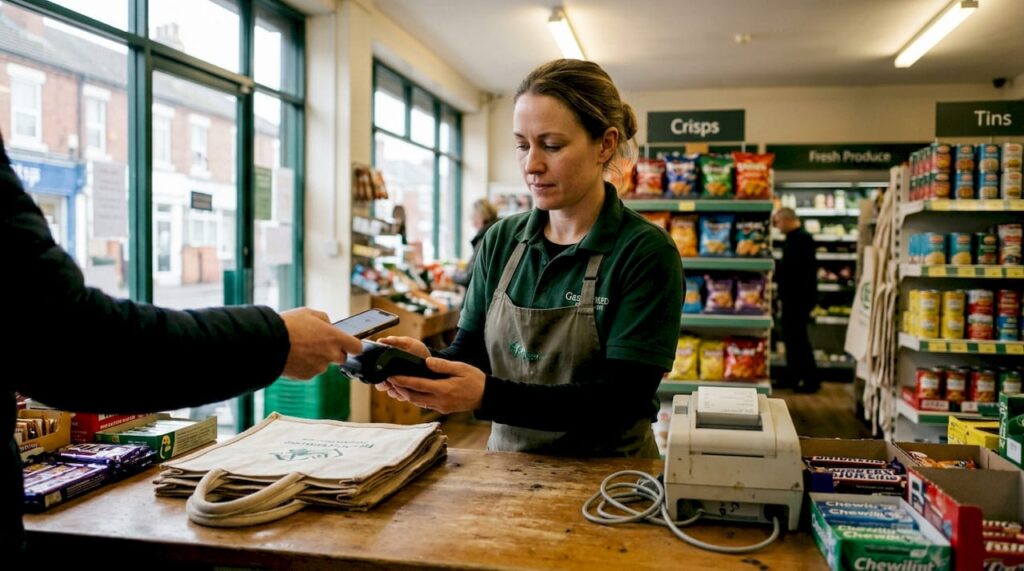
Contactless payments now account for over 60% of UK transactions, and that figure is only climbing. For UK retail and hospitality owners, this is not a distant forecast but a present reality reshaping how customers pay, how staff operate, and how businesses compete. Mobile point of sale systems sit at the centre of this shift, cutting queues, boosting order values, and giving teams the freedom to serve customers anywhere on the floor. This guide breaks down the key trends, practical considerations, and actionable steps you need to make confident decisions about mobile POS in 2026.
Table of Contents
- Mobile POS adoption and impact in 2026
- Core mobile POS trends shaping UK businesses
- Ensuring reliability: Connectivity, offline modes and edge cases
- The rise of AI-enhanced mobile POS
- Choosing and deploying mobile POS for your business
- Explore advanced mobile POS solutions for your business
- Frequently asked questions
Key Takeaways
| Point | Details |
|---|---|
| Widespread adoption | Over 60% of UK venues have adopted mobile POS for faster, more efficient operations. |
| Efficiency boost | Mobile POS reduces downtime, increases order value, and accelerates customer service. |
| Reliability matters | Offline-first systems and robust connectivity maximise uptime and business continuity. |
| AI and compliance | AI-driven inventory and strict compliance requirements shape the next generation of mobile POS. |
Mobile POS adoption and impact in 2026
The numbers tell a clear story. Over 60% of UK hospitality venues have already adopted mobile POS, and the operational results are striking. Businesses report downtime reductions of up to 80%, a 75% drop in technician call-outs, and order errors falling by as much as 40%. Average order values have risen by 21 to 30% in venues where staff take orders tableside rather than at a fixed terminal.
These are not marginal gains. When a busy restaurant reduces order errors by 40%, that translates directly into fewer comped meals, less food waste, and happier customers. When a retail shop cuts queue times, it converts browsers into buyers. Mobile POS is not simply a technology upgrade; it is an operational transformation.
| Metric | Traditional POS | Mobile POS |
|---|---|---|
| Order error rate | High | Reduced by up to 40% |
| Average order value | Baseline | Increased by 21 to 30% |
| System downtime | Standard | Reduced by up to 80% |
| Technician visits | Frequent | Reduced by up to 75% |
Businesses investing in leading retail POS hardware are seeing these results firsthand. The shift also aligns with broader POS trends for efficiency that are redefining what customers expect at the checkout. Understanding the POS role in retail has never been more important for owners planning their next investment.
“Mobile POS is no longer a premium add-on. For UK hospitality and retail, it is quickly becoming the baseline expectation from both staff and customers.”
Having established the scale and impact of mobile POS, we now turn to the core trends driving technology selection and innovation.
Core mobile POS trends shaping UK businesses
Contactless and NFC payments are the engine behind mobile POS growth. Transactions processed via NFC are 30% faster than traditional card dips, and NFC is predicted to handle 50% of all UK payments by the end of 2026. For a busy café or retail shop, shaving seconds off every transaction adds up to significantly shorter queues and higher throughput during peak hours.
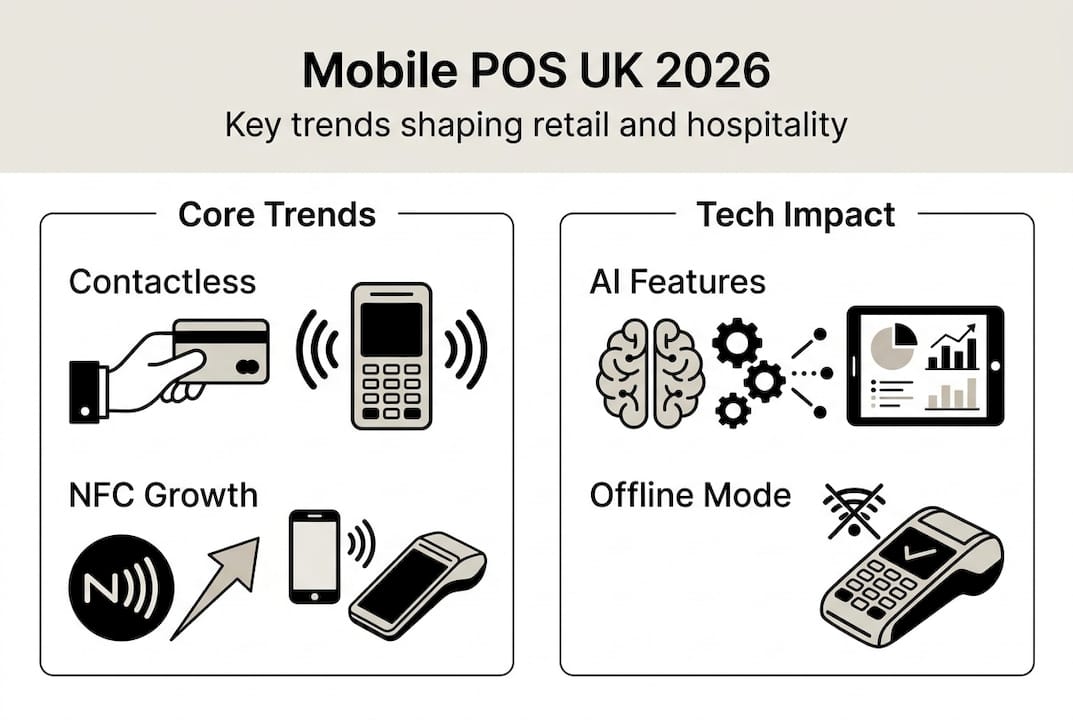
Compliance is also reshaping what mobile POS systems must deliver. The EU Accessibility Act and PCI DSS v4.0 now require real-time payment features and inclusive interfaces, meaning systems must be accessible to customers with disabilities and capable of processing instant payments without delay. This is not optional; it is a legal requirement that affects every UK business accepting card payments.
Key features to look for in a modern mobile POS system:
- NFC and contactless payment support
- Real-time transaction processing
- Accessible, inclusive interface design
- PCI DSS v4.0 compliance certification
- Cloud-based data synchronisation
- Offline payment capability
- Integration with existing stock and accounting software
Use a POS technology checklist when evaluating suppliers to ensure nothing critical is missed. Businesses that invest in integrated POS systems consistently report smoother operations and fewer compatibility headaches down the line.
| Feature | Basic mobile POS | Advanced mobile POS |
|---|---|---|
| NFC payments | Sometimes | Always |
| Offline mode | Rarely | Standard |
| Accessibility compliance | Partial | Full |
| Real-time sync | Limited | Full cloud sync |
| AI inventory tools | No | Yes |
Pro Tip: Prioritise systems with robust real-time processing and accessibility features from the outset. Retrofitting compliance later is far more costly than building it in from day one.
With an understanding of the essential technology trends, let us examine the challenges and solutions needed to ensure reliable service and uptime.
Ensuring reliability: Connectivity, offline modes and edge cases
Mobile POS systems are only as good as their uptime. The most common causes of failure are not dramatic hardware faults but mundane edge cases: weak WiFi signals, depleted batteries, card transaction limits, and outdated software. Each of these can bring a busy service to a halt at the worst possible moment.
Offline-first systems achieve 98% uptime by storing transaction data locally and syncing when connectivity is restored. This means a dropped WiFi signal during a Saturday lunch rush does not mean lost sales or frustrated customers. It means business continues as normal.
Steps to maximise mobile POS reliability:
- Audit your WiFi coverage across all service areas before deployment
- Invest in devices with all-day battery life or charging docks at service stations
- Set automatic software update schedules for overnight or off-peak hours
- Choose a system with offline transaction capability as a non-negotiable requirement
- Train staff on manual override procedures for edge-case scenarios
- Review card transaction limits with your payment processor regularly
| Risk factor | Impact | Mitigation |
|---|---|---|
| Weak WiFi | Transaction failures | Offline-first system |
| Battery depletion | Device shutdown | Charging docks, spare devices |
| Outdated software | Security gaps, bugs | Automated overnight updates |
| Card limits | Declined transactions | Regular processor review |
For venues with complex layouts, restaurant POS systems designed for multi-area coverage offer the best protection against connectivity gaps. Pairing them with robust hardware for reliability ensures your investment holds up under real-world pressure.
“The difference between a reliable mobile POS and an unreliable one is rarely the software. It is almost always the infrastructure around it.”
Pro Tip: Check battery health and run a software update check before every peak service period. Five minutes of preparation prevents hours of disruption.
Having tackled reliability concerns, we now look at the next wave: artificial intelligence and its role in shaping mobile POS capabilities.
The rise of AI-enhanced mobile POS
Artificial intelligence is moving from buzzword to practical tool within mobile POS. The most immediate impact is on inventory management. AI-driven predictive inventory now achieves 98% stock accuracy, meaning businesses can reduce over-ordering, cut waste, and avoid the frustration of running out of popular items mid-service.

Personalisation is the second major gain. AI analyses purchase patterns to suggest upsells, flag loyalty rewards, and tailor promotions to individual customers. For a hospitality business, this can meaningfully increase repeat visits and average spend per head.
Security has also improved sharply. Security breaches are down 40% since 2024 thanks to advanced encryption and PCI DSS compliance built into modern AI-enhanced systems. For businesses handling hundreds of card transactions daily, this is a significant risk reduction.
Benefits of AI integration in mobile POS:
- Predictive stock replenishment with near-perfect accuracy
- Personalised upsell and loyalty prompts at the point of sale
- Automated fraud detection and real-time security alerts
- Sales trend analysis to inform staffing and purchasing decisions
- Reduced manual data entry and human error
Experts tracking the future of POS technology describe the shift from checkout tool to full business operating system. Understanding the POS hardware benefits of AI-ready devices helps you plan for this evolution rather than scramble to catch up.
Pro Tip: Before committing to any AI-powered POS integration, verify that your data is fully portable. Vendor lock-in is a real risk, and switching costs can be significant if your data cannot be easily exported.
To help you apply these trends, let us summarise the practical steps for selecting and deploying mobile POS systems tailored for UK retail and hospitality.
Choosing and deploying mobile POS for your business
Selecting the right mobile POS system requires more than comparing spec sheets. The best outcomes come from matching hardware and software to your specific venue layout, customer flow, and growth plans.
Deployment checklist for UK retail and hospitality:
- Map your venue and identify all service zones requiring mobile coverage
- Confirm WiFi strength and consider mesh networking for large or multi-floor sites
- Shortlist systems that meet PCI DSS v4.0 and EU Accessibility Act requirements
- Test offline mode under realistic conditions before going live
- Verify that your chosen system integrates with your existing accounting and stock software
- Confirm data portability and migration support with the vendor before signing any contract
- Plan staff training for both standard operation and edge-case scenarios
Hybrid hardware setups, combining fixed terminals at high-volume points with mobile devices for tableside or floor service, offer the best of both worlds for multi-area venues. A fixed terminal at the bar handles speed during peak rounds, while mobile devices allow staff to take orders and process payments anywhere in the room.
| Venue type | Recommended setup | Key priority |
|---|---|---|
| Restaurant | Hybrid fixed and mobile | Tableside ordering |
| Retail shop | Mobile-first with fixed backup | Queue reduction |
| Café | Mobile-first | Speed and flexibility |
| Multi-site venue | Cloud-synced hybrid | Centralised reporting |
Use a detailed POS hardware checklist to evaluate each option against your specific requirements. This prevents costly oversights and ensures your system scales as your business grows.
Pro Tip: Always confirm that your vendor supports easy data migration if your needs change. Switching POS providers is far simpler when your historical sales data, customer records, and stock information can be exported cleanly.
Having covered the practical aspects, let us connect with specialist providers for reliable mobile POS solutions.
Explore advanced mobile POS solutions for your business
At YCR Distribution, we have spent over three decades helping UK retailers and hospitality businesses find the right POS technology for their specific needs. Whether you are upgrading an existing setup or building from scratch, our range covers everything from entry-level mobile terminals to fully integrated AI-ready systems.
Explore our full range of comprehensive POS hardware to find devices built for the demands of UK retail and hospitality. Our POS software solutions include SAMTOUCH and EZEEPOS, both designed to work seamlessly with mobile hardware. If you are new to the terminology or want to compare options, our POS hardware terminology guide is a practical starting point. Our team is ready to help you match the right solution to your business, with next-day delivery and same-day dispatch available across the UK.
Frequently asked questions
How do mobile POS systems improve transaction speed?
Mobile POS systems accelerate checkout by up to 30% through contactless and NFC payment processing, which significantly reduces queues and wait times during busy periods.
What is the biggest reliability risk for mobile POS systems?
Poor connectivity is the primary risk, but offline-first systems that store transactions locally and sync later achieve 98% uptime, making them the most dependable choice for busy venues.
How does AI enhance mobile POS solutions?
AI delivers 98% inventory accuracy through predictive stock management, while also improving personalisation at the point of sale and reducing security breaches through advanced encryption.
Are there compliance requirements for mobile POS systems?
Yes, UK businesses must meet EU Accessibility Act and PCI DSS v4.0 standards, which require inclusive interfaces and real-time payment processing capabilities in all mobile POS deployments.
Recommended
- Point Of Sale Trends 2026: Enhancing Retail Efficiency
- Why retail needs POS systems for better 2026 success
- Top 6 Retail POS Hardware Solutions in 2026 for UK Businesses
- POS technology checklist 2026: choosing the right system for UK retail
- Kundenservice-Trends 2026: Was für E-Commerce zählt | aLIVE Support