
TL;DR:
- Cloud-based POS stores data remotely, offering real-time insights and greater flexibility.
- It is more scalable, cost-effective, and easier to manage across multiple locations than traditional systems.
- Successful transition relies on staff training, internet reliability, and integrating with existing platforms.
Many UK business owners assume that upgrading their point of sale system means expensive hardware, lengthy installation, and weeks of disruption. That assumption is costing them. Cloud-based POS technology has quietly reshaped how restaurants, retailers, and hospitality operators run their day-to-day operations, offering flexibility and real-time insight that older systems simply cannot match. Whether you run a single café or a chain of retail outlets, understanding what cloud POS actually is, how it stacks up against traditional systems, and how to make the switch could be one of the most valuable decisions you make for your business this year.
Table of Contents
- Defining cloud-based POS: What it means for business
- Cloud POS vs local POS: Key differences and considerations
- Benefits of cloud POS for UK retail and hospitality
- Overcoming common challenges and planning your transition
- Is cloud POS right for your business? Making the decision
- Our perspective: What most guides miss about cloud POS adoption
- Explore modern POS solutions with YCR
- Frequently asked questions
Key Takeaways
| Point | Details |
|---|---|
| Flexible, modern solution | Cloud-based POS systems offer central management, mobility, and real-time updates for UK businesses. |
| Lower costs over time | Subscription models and reduced hardware needs mean cloud POS is often cheaper in the long run. |
| Plan for a smooth transition | Address internet reliability, staff training, and phased migration to ensure successful adoption. |
| Not always the best fit | Businesses without reliable connectivity or those needing heavy customisation may still prefer traditional POS. |
Defining cloud-based POS: What it means for business
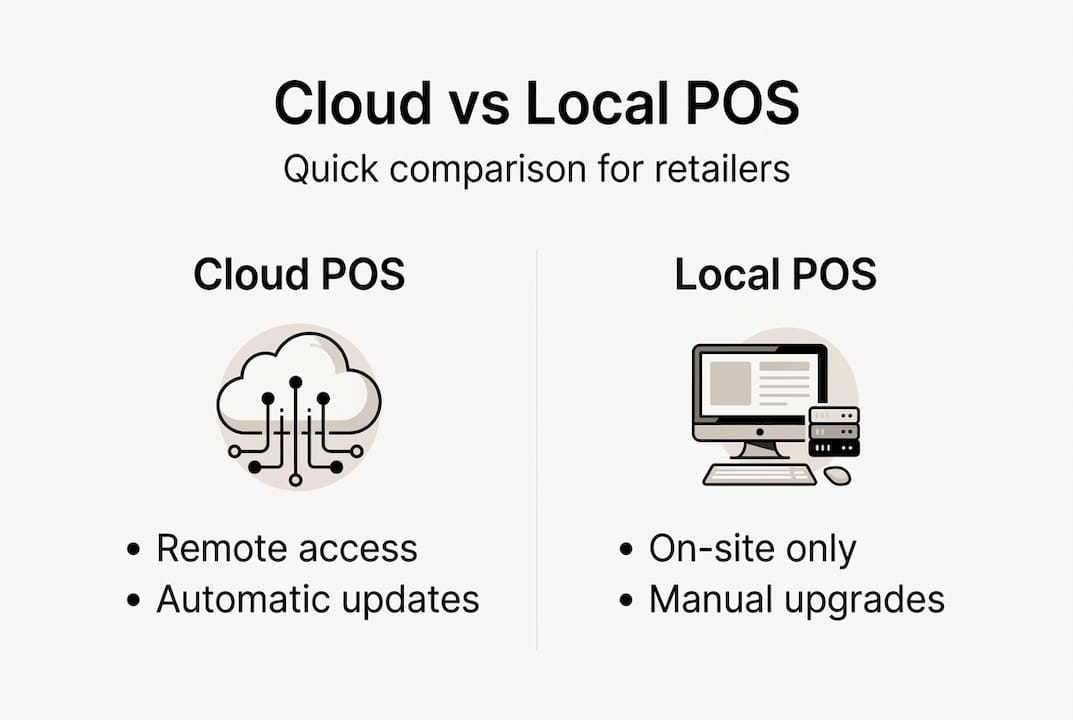
A cloud-based POS system stores your sales data, inventory records, and reporting on remote servers accessed via the internet, rather than on a local computer or server on your premises. Think of it like the difference between saving files on a USB stick versus saving them to Google Drive. The data is always there, always current, and accessible from wherever you are.
Unlike traditional on-premise systems, cloud POS does not require a dedicated server in the back office. Updates happen automatically overnight. New features roll out without you calling a technician. Your team can process transactions from a tablet on the shop floor, at a table in your restaurant, or from a pop-up stall at a market.
Key features that define a cloud-based POS include:
- Internet connectivity for real-time data sync across all devices
- Mobility so staff can serve customers anywhere on the premises
- Automatic software updates with no manual intervention required
- Centralised reporting giving you a single view across multiple sites
- Third-party integrations with accounting, loyalty programmes, and e-commerce platforms
The global cloud POS market is growing strongly, with hospitality and retail leading adoption. That growth is not accidental. Businesses are discovering that cloud POS helps them streamline UK operations in ways that older systems never could, from automating stock alerts to tracking customer behaviour in real time.
“The real power of cloud POS is not just in processing payments faster. It is in the data it generates and how quickly you can act on it.”
Pro Tip: When evaluating cloud POS options, ask specifically about integrations. A system that connects seamlessly with your existing accounting software, online ordering platform, or CRM will deliver far more value than one that operates in isolation. Understanding POS and retail efficiency starts with choosing a system that talks to the rest of your business.
Cloud POS vs local POS: Key differences and considerations
With the basics in mind, let us see how cloud-based POS actually compares to more familiar local systems.
| Feature | Cloud POS | Local (on-premise) POS |
|---|---|---|
| Data storage | Remote servers | Local hardware |
| Software updates | Automatic | Manual or via technician |
| Upfront cost | Lower | Higher |
| Ongoing fees | Monthly subscription | Varies |
| Scalability | High | Limited |
| Internet dependency | Required | Not required |
| Multi-site management | Centralised | Complex |
| Maintenance | Provider-managed | In-house or contracted |
Cloud POS suits businesses that are growing, operating across multiple locations, or wanting to reduce their IT burden. Cloud POS total cost of ownership tends to be lower for scaling businesses, though it does rely on a stable internet connection.
Cloud POS advantages:
- Lower initial investment
- Easy to scale as your business grows
- Accessible from any compatible device
- Automatic backups and security patches
Cloud POS disadvantages:
- Dependent on internet reliability
- Ongoing subscription costs
- Data lives off-site (though usually more secure)
Local POS advantages:
- Works without internet
- One-time licence cost possible
- Full control over data storage
Local POS disadvantages:
- Higher upfront hardware costs
- Manual updates and maintenance
- Difficult to manage across multiple sites
For a deeper look at your options, exploring the types of POS systems available for retail and hospitality will help you match the right technology to your specific environment. If you want to understand where the market is heading, reviewing modern POS system trends gives useful context for 2026 and beyond.
Benefits of cloud POS for UK retail and hospitality
Now let us get practical. What can UK retail and hospitality operators actually gain from making the move to cloud POS?

The global cloud POS adoption surge is driven largely by retail and hospitality needs, and it is easy to see why. These sectors demand speed, flexibility, and accuracy in equal measure.
For hospitality operators, cloud POS delivers:
- Tableside ordering that reduces errors and speeds up service
- Instant menu updates for seasonal changes or price adjustments
- Real-time covers and revenue data across all sites
- Integration with kitchen display systems and online booking platforms
For retail operators, the gains include:
- Live inventory tracking that prevents overselling
- Automated reorder alerts when stock runs low
- Customer purchase history for targeted promotions
- Seamless connection to e-commerce platforms
Here is a practical roadmap to unlocking these benefits:
- Assess your current setup and identify the gaps in your existing system
- Define your priorities (mobility, multi-site, integrations, cost)
- Request demos from at least two or three providers
- Plan your data migration carefully, including historical sales and stock records
- Train your team before go-live, not after
- Review performance at 30, 60, and 90 days post-launch
“Businesses that invest in staff training during a POS transition see significantly faster adoption and fewer errors in the first month.”
There are strong reasons to upgrade your POS beyond just keeping up with technology. Efficiency, customer experience, and profitability all improve when your system works for you rather than against you. Keeping an eye on POS trends in 2026 will also help you choose a platform that stays relevant.
Pro Tip: Always ask your provider whether their cloud POS integrates with loyalty programmes and e-commerce platforms. These connections often deliver the fastest return on investment for both retail and hospitality businesses.
Overcoming common challenges and planning your transition
Having outlined the advantages, it is important to address the practical challenges and offer actionable strategies for success.
The biggest concern most operators raise is internet reliability. Cloud POS real-time operation depends on connectivity, so a dropped connection at peak service can feel catastrophic. The good news is that most modern cloud POS platforms include an offline mode that continues processing transactions locally and syncs once the connection is restored.
| Challenge | Practical solution |
|---|---|
| Internet outages | Choose a system with offline mode; use a 4G backup router |
| Data migration | Work with your provider to export and map existing data before go-live |
| Staff resistance | Involve team leaders early; run hands-on training sessions |
| Security concerns | Confirm PCI DSS compliance and data encryption standards with your provider |
| Disruption during rollout | Phase the transition; pilot in one location before rolling out across sites |
Smart strategies for a smooth transition include:
- Choose a provider with proven UK hospitality or retail experience, not just a generic software company
- Plan your go-live date around a quieter trading period, not your busiest weekend
- Create a backup plan for connectivity issues before launch day
- Appoint an internal champion who leads staff engagement and troubleshooting
- Document your processes so new staff can onboard quickly post-transition
For retail POS success in 2026, preparation is everything. Businesses that treat the transition as a project rather than a plug-and-play installation consistently report smoother outcomes. Reviewing hospitality POS trends around security and efficiency will also help you ask the right questions of any provider.
Is cloud POS right for your business? Making the decision
With practical and technical factors covered, here is how to decide if cloud POS aligns with your business vision.
Cloud POS suits businesses looking for scalability and central management, while traditional POS remains a strong option for those who prioritise offline operation above all else. Neither is universally superior. The right choice depends on your specific circumstances.
Work through this checklist to guide your decision:
- Do you operate or plan to operate across more than one location?
- Is your current system limiting your ability to access real-time sales data?
- Are software updates and maintenance consuming significant time or budget?
- Do you need to integrate with online ordering, e-commerce, or loyalty platforms?
- Is your premises covered by a reliable broadband connection?
- Are you planning significant growth in the next two to three years?
If you answered yes to three or more of those questions, cloud POS is almost certainly the better fit. If internet reliability is a genuine concern or your operation is single-site with no growth plans, a hybrid or local system may serve you better.
Pro Tip: Never choose a POS system based on a brochure alone. Request a live demo using your actual business scenarios, whether that is a busy Friday dinner service or a January sale. Seeing the system under realistic pressure tells you far more than any features list. Businesses that invest in integrated POS efficiency consistently outperform those running disconnected, legacy setups.
Our perspective: What most guides miss about cloud POS adoption
Most articles about cloud POS focus on features, pricing tiers, and connectivity specs. Those things matter, but they are rarely what determines whether a transition succeeds or fails.
In our experience working with UK retail and hospitality businesses, the single biggest factor is cultural change. Staff who understand why the new system benefits them, not just how to use it, adopt it faster and use it more effectively. Businesses that treat cloud POS as purely an IT project, rather than a wider operational shift, consistently struggle in the first few months.
There is also an underappreciated opportunity hiding inside cloud POS data. Real-time sales and customer behaviour reporting allows operators to make rapid decisions, adjusting menus, running targeted promotions, or reallocating staff within days rather than weeks. Most businesses collect this data but never act on it. That is where the real competitive edge lies.
Staying informed through cloud POS industry insights will help you spot these opportunities before your competitors do. Make cloud POS transformation a business-wide project, and the returns will far exceed what any feature comparison table can promise.
Explore modern POS solutions with YCR
If you are ready to move forward, YCR Distribution makes it straightforward to find the right cloud-compatible POS solution for your retail or hospitality business.
With over three decades of UK experience, we offer a full range of hardware, software, and peripherals designed to work together seamlessly. Whether you need to explore POS software tailored for hospitality or retail, discover POS hardware from trusted brands like SAM4S and iMin, or see POS peripherals that complete your setup, our team is ready to help. We support businesses at every stage, from initial consultation through to installation and ongoing support.
Frequently asked questions
What does a cloud-based POS system do?
It securely manages and processes sales, payments, and inventory data in real time via the internet, with real-time updates and centralised management accessible from any compatible device.
Is cloud POS reliable for businesses without stable internet?
Cloud POS is internet-dependent, but many platforms offer offline modes; businesses in areas with unreliable connections may prefer hybrid or local systems as a more practical alternative.
What are the main benefits for UK hospitality and retail?
Key benefits include lower upfront costs, real-time business data, easier scaling, and faster updates, with global adoption driven by exactly these needs in retail and hospitality sectors.
How do I switch from a traditional POS to the cloud?
Choose a trusted provider with relevant sector experience, plan your data migration and staff training carefully, and phase the rollout to minimise disruption to your live trading environment.