
TL;DR:
- Modern POS systems are fully connected platforms managing payments, inventory, staff, and customer data.
- Cloud-based POS offers real-time access, remote management, and reduces downtime by up to 80 percent.
- Upgrading to advanced POS technology provides strategic advantages through better data use and customer experience.
Many UK retail and hospitality business owners still think of a point of sale (POS) system as little more than a glorified till. That perception is costing them. Modern POS technology has evolved into a fully connected business platform, managing everything from payments and inventory to staff performance and customer loyalty. Cloud-based POS systems now dominate the market, offering real-time data access, remote management, and 80% reduced downtime. If you are planning upgrades before 2026, understanding these core trends is not optional. It is the difference between running a reactive business and a genuinely competitive one.
Table of Contents
- The rise of cloud-based POS systems
- Contactless and diverse payment integrations
- Smart integrations: Digital signage, inventory, and analytics
- Preparing your business for POS technology upgrades
- The real value of staying ahead in POS technology
- Discover advanced POS solutions for your business
- Frequently asked questions
Key Takeaways
| Point | Details |
|---|---|
| Cloud POS dominance | Cloud-based systems now set the standard with real-time data and 80% less downtime. |
| Contactless is the norm | By 2026, nearly all UK retailers accept contactless and digital payments as standard. |
| Security advancements | End-to-end encryption reduces data breaches by 40% compared to legacy systems. |
| Integrated efficiency | Modern POS integrates inventory, analytics, and digital signage for streamlined operations. |
| Upgrade for advantage | Preparing early for new POS tech unlocks operational benefits and competitive edge. |
The rise of cloud-based POS systems
Cloud-based POS systems have fundamentally changed what business owners can expect from their technology. Unlike traditional, server-dependent setups, cloud systems store data remotely and securely, meaning you can access sales figures, inventory levels, and staff reports from any device, anywhere. That flexibility alone is a significant operational advantage for multi-site operators.
Understanding cloud-based POS explained helps clarify why so many UK businesses are making the switch. The benefits are not just technical. They are commercial.
Key advantages of cloud-based POS systems:
- Real-time access to sales and inventory data across all locations
- Automatic software updates with no manual intervention required
- Reduced reliance on expensive on-site servers and IT support
- Scalability to add new terminals or locations without major infrastructure costs
- Built-in data backup, reducing the risk of catastrophic data loss
The numbers back this up. Cloud-based systems reduce downtime by 80%, and the UK POS market is forecast to reach $1.49 billion by 2030, growing at a 9.4% compound annual growth rate. That growth reflects genuine demand from businesses seeing measurable returns.
| Feature | Legacy POS system | Cloud-based POS system |
|---|---|---|
| Data access | On-site only | Anywhere, any device |
| Software updates | Manual, often costly | Automatic and included |
| Downtime risk | High | Reduced by up to 80% |
| Scalability | Limited | Easily expandable |
| Upfront hardware cost | High | Lower with SaaS model |
For businesses reviewing POS benefits for UK retail, the table above illustrates why legacy systems are increasingly difficult to justify. The cost savings on IT maintenance alone often offset the investment within the first year.
Pro Tip: Always build internet redundancy into your setup. A 4G failover connection ensures your cloud POS keeps running even if your primary broadband drops. This is a simple safeguard that prevents lost sales during outages.
Businesses already exploring upgrading POS systems will find that cloud migration is far smoother than most anticipate, particularly with the right hardware and support partner in place.
Contactless and diverse payment integrations
Payments are where customer expectations have shifted most dramatically. Speed, convenience, and security are now non-negotiable. The days of customers fumbling for cash or waiting for chip-and-pin authorisation feel increasingly distant.
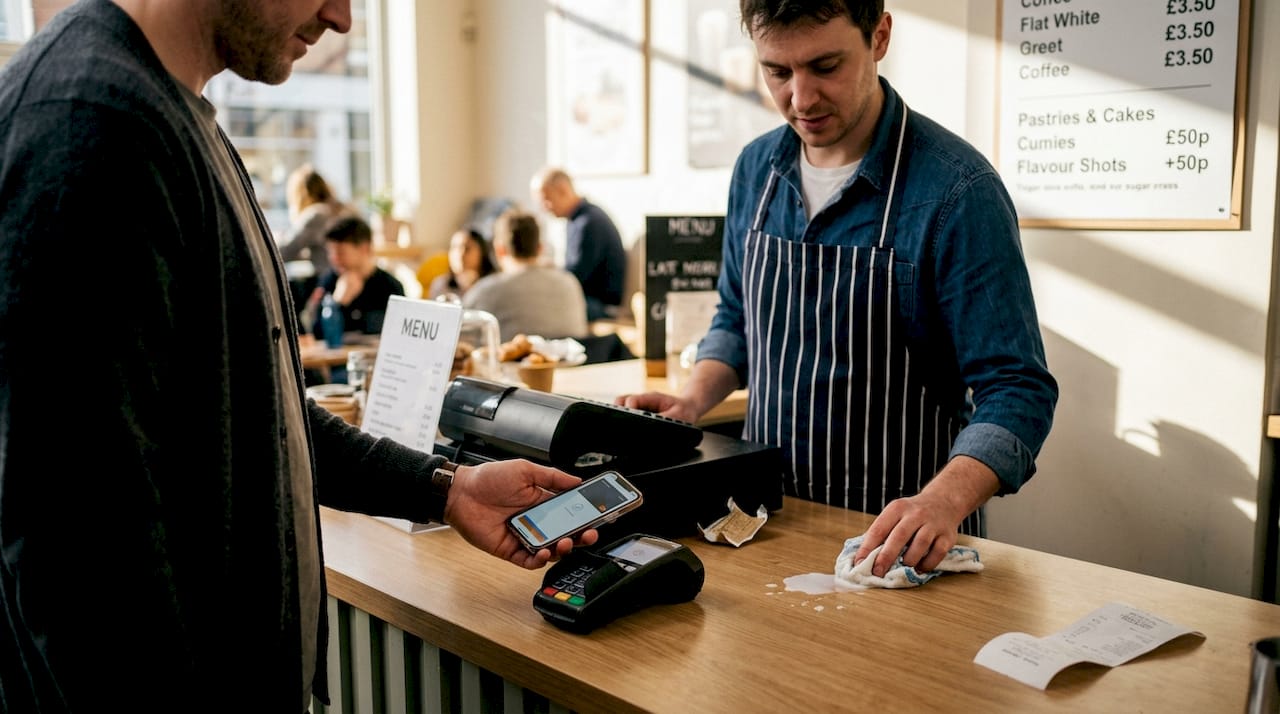
The scale of this shift is striking. Contactless payment acceptance has reached 96.5% across UK merchants in 2026, and data breaches are down 40% since 2024, largely due to end-to-end encryption becoming standard across modern POS platforms. These figures reflect a genuine transformation in how transactions are secured and processed.
Why diverse payment options matter for your business:
- Contactless cards and mobile wallets reduce queue times, directly improving customer throughput.
- End-to-end encryption protects sensitive card data from interception at every stage of the transaction.
- Mobile payment options such as Apple Pay and Google Pay appeal strongly to younger demographics.
- Accepting diverse payment methods reduces the risk of lost sales from customers without cash.
- Hygiene remains a consideration post-pandemic, with contactless reducing physical touchpoints.
The security improvements deserve particular attention. Older POS systems often relied on basic card readers with limited encryption. Modern systems integrated with 2026 POS trends use tokenisation (replacing card data with a unique code) and point-to-point encryption, making intercepted data essentially useless to fraudsters.
| Payment method | Speed | Security level | Customer preference |
|---|---|---|---|
| Traditional chip and PIN | Moderate | Standard | Declining |
| Contactless card | Fast | High (encrypted) | Very high |
| Mobile wallet (Apple Pay, Google Pay) | Very fast | Very high (tokenised) | Growing rapidly |
| QR code payment | Fast | High | Emerging |
Businesses investing in integrated POS efficiency will find that payment flexibility is not just a customer convenience feature. It directly affects revenue. A customer who cannot pay their preferred way is a customer who may not return.
Beyond speed and security, accessibility matters. Contactless options support customers with mobility challenges who may struggle with traditional keypads. That is a genuine inclusivity benefit that also broadens your potential customer base.
Smart integrations: Digital signage, inventory, and analytics
The most significant evolution in POS technology is not the terminal itself. It is what the terminal connects to. Today’s leading systems act as a central hub, linking sales data, stock management, staff scheduling, and marketing into a single, coherent view of your business.
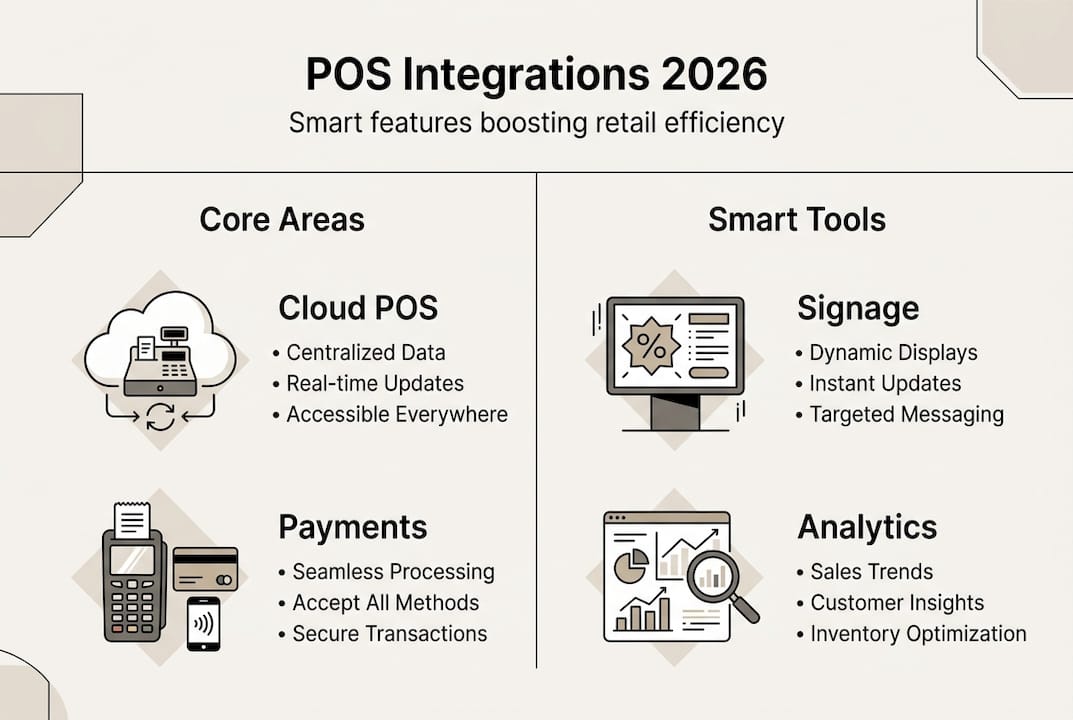
Digital POS solutions facilitate remote management and real-time data, meaning a restaurant owner can monitor table turnover from home, or a retail manager can spot a fast-selling product and reorder before stock runs out.
What smart POS integrations can manage from one interface:
- Live inventory tracking with automatic low-stock alerts
- Promotional pricing updates pushed instantly across all terminals
- Digital signage content updated remotely to reflect live offers or seasonal promotions
- Sales analytics dashboards showing peak hours, best-selling items, and staff performance
- Customer loyalty programme data linked directly to transaction history
The role of POS software in retail has expanded well beyond processing payments. It now shapes how businesses respond to trends in near real-time. A café noticing a spike in cold drink sales on warm afternoons can update its digital menu board instantly and push a limited-time offer, all from the same system.
“Digital POS unifies front and back of house like never before, giving operators the visibility they need to act quickly and profitably.”
Digital signage integration is particularly powerful for upselling. Static printed menus cannot compete with a dynamic display that highlights daily specials, shows product imagery, or promotes meal deals during quieter periods. The digital signage sales boost for UK retail and hospitality businesses is well documented, with targeted promotions consistently outperforming static alternatives.
Analytics dashboards also change how owners approach decisions. Rather than relying on gut instinct, you can identify which products underperform, which hours need more staff, and which promotions actually drive basket size. That is the kind of insight that modern POS impact delivers when implemented properly.
Preparing your business for POS technology upgrades
Understanding the trends is the first step. Translating them into a practical upgrade plan for your specific business is where most owners need structured guidance.
Remote management and real-time insights are now standard in leading POS solutions, but choosing the right system still requires careful requirements gathering before you commit to any hardware or software.
Step-by-step approach to planning your POS upgrade:
- Audit your current setup. List every gap in your existing system, including payment limitations, reporting blind spots, and integration failures.
- Define your must-have features. Prioritise real-time reporting, payment flexibility, and integration with your existing tools such as accounting software or booking systems.
- Assess your connectivity. Confirm your broadband reliability and plan for failover options before committing to a cloud-first solution.
- Evaluate vendor support. Choose a provider offering next-day hardware delivery, responsive technical support, and clear upgrade pathways.
- Plan staff training. Budget time and resource for training. A powerful system that staff cannot use confidently delivers no value.
- Set a review timeline. Agree on measurable outcomes at 30, 60, and 90 days post-installation to assess performance.
Businesses researching POS for retail success often underestimate the importance of change management. Staff buy-in is as important as the technology itself. Involve your team early, explain the benefits clearly, and address concerns before go-live day.
Pro Tip: Pilot your new POS system in a single location or one terminal before rolling out across the business. This surfaces unexpected issues in a controlled environment and gives you real-world data to refine your full deployment.
For businesses with mobile or pop-up operations, exploring mobile POS trends is equally worthwhile. Tablet-based and handheld POS solutions now offer the same capabilities as fixed terminals, with the added benefit of serving customers anywhere on the floor or at outdoor events.
The real value of staying ahead in POS technology
Here is what most articles on POS upgrades miss: the competitive advantage is not just operational. It is strategic. Businesses that adopt new POS capabilities early do not just run more efficiently. They gather better data, respond faster to market shifts, and build customer experiences that are genuinely harder to replicate.
The uncomfortable truth is that most business owners treat POS upgrades as a back-office expense rather than a growth investment. That mindset is precisely what separates businesses that thrive from those that merely survive. As one retail analyst put it, the fastest-growing retailers treat POS upgrades as core strategy, not back-office expense.
Analytics are the most consistently underused feature we see across UK retail and hospitality. Owners install capable systems and then never look beyond the daily sales total. The real value sits in the trend data, the basket analysis, and the customer behaviour patterns that inform smarter decisions over time. Understanding why UK businesses use POS systems at a strategic level, rather than purely transactional, is what separates genuinely high-performing operators from the rest. The technology is ready. The question is whether your business is ready to use it fully.
Discover advanced POS solutions for your business
If the trends covered in this article have prompted you to think seriously about your current setup, the next step is exploring the specific solutions that match your priorities.
At YCR Distribution, we supply advanced POS software and modern POS hardware built specifically for UK retail and hospitality businesses. Whether you need a full system overhaul or targeted upgrades to your payment or reporting capabilities, our team can guide you to the right solution. Browse our range of POS terminals and speak to our specialists about next-day delivery and same-day dispatch options to get your upgrade moving without delay.
Frequently asked questions
How secure are modern POS systems compared to older models?
Modern POS systems use end-to-end encryption and tokenisation as standard, contributing to a 40% reduction in breaches since 2024 compared to older, less protected systems.
What payment methods do customers expect UK retailers to accept in 2026?
Customers expect contactless cards, mobile wallets such as Apple Pay and Google Pay, and digital payment options as a baseline, with 96.5% of UK merchants now accepting contactless payments.
How do cloud-based POS systems improve business operations?
Cloud-based POS delivers real-time data access, remote management across multiple sites, and an 80% reduction in downtime, making daily operations significantly more reliable and visible.
How can UK businesses ensure smooth POS upgrades?
Start with a pilot in one location, invest in thorough staff training, and choose a provider with strong technical support and clear integration options to minimise disruption during the transition.