
TL;DR:
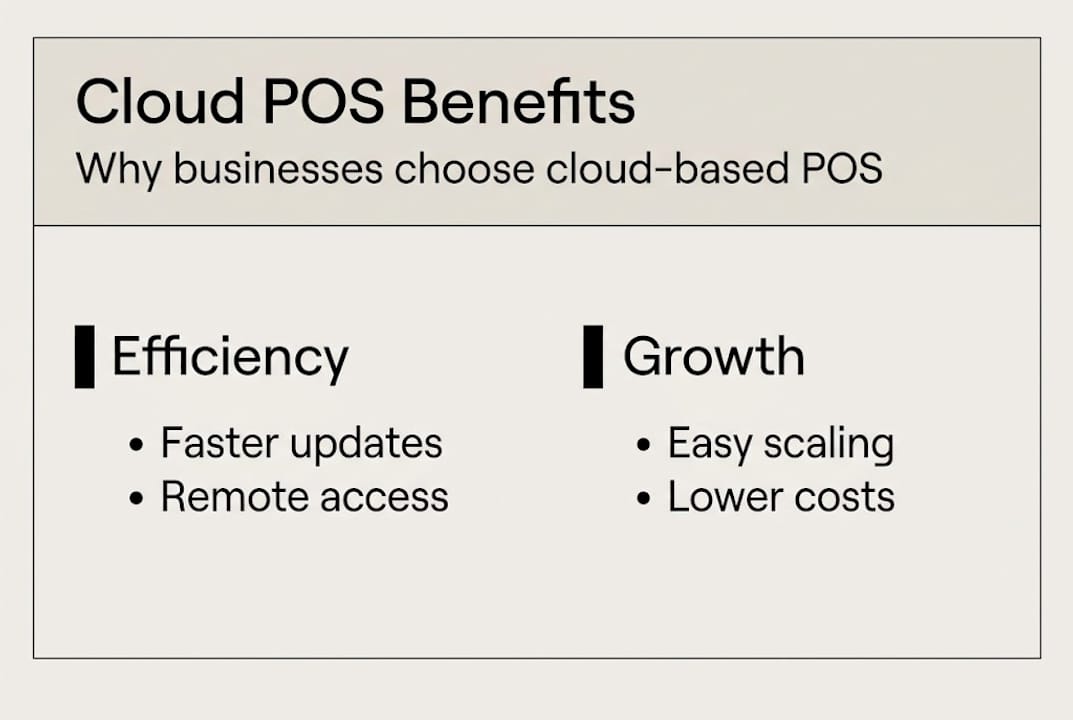
- Cloud POS offers real-time data access, automatic backups, and lower upfront costs.
- It enhances security with encryption, compliance, and automatic updates, surpassing on-premises systems.
- Cloud POS supports business growth through e-commerce, delivery integration, and flexible multi-site management.
Many business owners assume that upgrading to a cloud point of sale system means months of disruption, eye-watering costs, and handing control of sensitive data to some faceless server farm. The reality is quite different. Cloud POS has matured into a practical, affordable solution that UK retailers and hospitality operators are using right now to serve customers faster, make smarter decisions, and grow without the headaches of legacy technology. This guide will walk you through exactly what cloud POS is, why it outperforms traditional systems, how it keeps your data safe, and how to choose and implement the right solution for your business.
Table of Contents
- What is a cloud POS and how does it work?
- Key benefits: Why cloud POS stands out in retail and hospitality
- Security, compliance, and peace of mind
- Future-proofing: Scaling and adapting your POS for tomorrow
- How to choose and implement the right cloud POS
- Our perspective: Why most businesses underestimate cloud POS impact
- Ready to transform your POS?
- Frequently asked questions
Key Takeaways
| Point | Details |
|---|---|
| Greater business agility | Cloud POS enables flexible growth and quick response to market changes. |
| Enhanced security | Data is protected by robust encryption and compliant with UK regulations. |
| Improved customer experience | Serve customers faster and more accurately with real-time insights. |
| Lower IT overheads | Reduce upfront investment and ongoing maintenance with cloud solutions. |
| Future-proof strategy | Easily upgrade your POS to support new business models and trends. |
What is a cloud POS and how does it work?
A cloud POS is a point of sale system that stores its data and runs its core processes on remote servers accessed via the internet, rather than on a single computer or local server on your premises. Think of it like this: instead of your sales data living on one machine in your back office, it lives securely online and is accessible from any authorised device, anywhere, at any time.
Traditional on-premises POS systems require dedicated hardware, local servers, and manual software updates. If the machine fails, you can lose data. If you want to check yesterday’s sales from home, you simply cannot. Cloud-based POS explained shows how this shift boosts operational agility and remote access in ways that legacy systems never could.
Here is a quick comparison to make the difference concrete:
| Feature | Cloud POS | Legacy POS |
|---|---|---|
| Data storage | Remote, secure servers | Local machine or server |
| Software updates | Automatic, instant | Manual, often costly |
| Remote access | Yes, any device | No |
| Disaster recovery | Automatic backups | Manual backups required |
| Upfront cost | Lower (subscription model) | Higher (hardware and licences) |
| Scalability | Add locations easily | Complex and expensive |
The core advantages for UK SMEs are straightforward:
- Anywhere access: Check live sales, manage stock, or update your menu from your phone, tablet, or laptop.
- Real-time updates: Price changes, promotions, and menu edits push instantly to every till.
- Automatic backups: Your data is saved continuously, so a hardware failure never means lost records.
- Lower IT burden: No need for an in-house IT team to maintain servers or apply patches.
- Faster onboarding: New staff can learn a cloud POS interface quickly, reducing training time.
A common worry is that moving to the cloud means losing control over your own data. That is a myth worth addressing directly. Reputable cloud POS providers give you full ownership of your data, with the ability to export, audit, and control who accesses what.
Pro Tip: Before signing up with any provider, ask specifically about data ownership and export rights. A trustworthy supplier will have clear, straightforward answers.
For a broader overview of how modern POS technology works, the POS systems guide from Forbes Advisor is a solid starting point.
Key benefits: Why cloud POS stands out in retail and hospitality
Understanding the basics is one thing. Seeing how cloud POS translates into real, day-to-day improvements for a café, a retail shop, or a busy pub is where the argument becomes compelling.

The POS benefits for UK retail are well documented, and cloud POS improves efficiency and customer experience in ways that go beyond simply processing payments faster.
Here is how the benefits stack up:
| Traditional POS | Cloud POS |
|---|---|
| Static reporting, end-of-day only | Live analytics, accessible anytime |
| Costly hardware upgrades for new features | Feature updates included in subscription |
| Single-location data visibility | Multi-site dashboard in one view |
| High risk of data loss on hardware failure | Continuous, automatic data backup |
| Expensive IT support contracts | Minimal IT overhead |
Now consider what this looks like in practice:
- A café owner can see which drinks are selling fastest during the morning rush, adjust stock orders from their phone before lunch, and push a new seasonal menu to every till without touching a single machine.
- A retail shop manager can run a flash promotion across multiple locations simultaneously, track which products are underperforming in real time, and reward loyal customers through an integrated loyalty programme.
- A pub operator can manage table service, split bills, and monitor staff performance across a busy Friday evening, all from a tablet behind the bar.
The scalability factor is particularly significant. When you are upgrading your POS system, a cloud solution means adding a new till, a new site, or a new service line takes hours rather than weeks. Seasonal peaks, such as the Christmas rush or a summer festival, no longer require emergency hardware purchases.
Research into cloud POS business value consistently highlights reduced downtime and lower total cost of ownership as the two most cited reasons UK businesses make the switch. Staff productivity gains follow closely, because intuitive interfaces mean less time fumbling at the till and more time serving customers.
Security, compliance, and peace of mind
Security is the objection we hear most often. The instinct to keep data on-site feels safer, but it is actually the opposite of what the evidence shows.
Reputable cloud POS providers offer encrypted data and robust compliance controls that most small businesses could never replicate with a local server. Here is what good cloud POS security looks like in practice:
- End-to-end encryption: All data transmitted between your devices and the cloud is encrypted, making interception extremely difficult.
- Role-based user permissions: Staff only access the functions relevant to their role, reducing the risk of internal errors or misuse.
- Automatic software updates: Security patches are applied instantly across your entire system, closing vulnerabilities before they become problems.
- Continuous backups: Your data is replicated in multiple locations, so even a catastrophic hardware failure leaves your records intact.
- Audit trails: Every transaction and system change is logged, making it straightforward to investigate discrepancies.
For UK businesses, compliance is not optional. The key obligations include:
- UK GDPR and Data Protection Act 2018 requirements for customer data handling
- PCI DSS standards for payment card data security
- HMRC Making Tax Digital requirements for VAT-registered businesses
- Sector-specific food safety and allergen record-keeping for hospitality
“Cloud security has surpassed what most SMEs can achieve on-premises. The question is no longer whether the cloud is safe, but whether your local server is safe enough.”
The UK data protection guidance from the Information Commissioner’s Office makes clear that businesses are responsible for the security of the data they hold, regardless of where it is stored. A well-chosen cloud POS provider will support your compliance obligations, not complicate them.
For further reading on how retail POS software compliance works in practice for UK operations, it is worth reviewing how modern software handles these requirements automatically.
Future-proofing: Scaling and adapting your POS for tomorrow
Security brings confidence, but what about staying ahead as the market shifts? The hospitality and retail landscape in the UK is changing faster than at any point in recent memory. Consumer expectations, payment methods, delivery models, and regulatory requirements are all evolving simultaneously.
Cloud POS supports agile business growth and upgrades in a way that rigid, on-premises systems simply cannot match. The POS technology trends shaping 2026 and beyond all point in the same direction: flexibility, integration, and speed of adaptation.
Here are the opportunities that a cloud POS makes genuinely accessible:
- E-commerce integration: Connect your in-store and online inventory so stock levels update automatically across every channel.
- Delivery platform links: Integrate directly with delivery apps, reducing manual order entry and the errors that come with it.
- Loyalty and CRM tools: Build customer profiles, track purchase history, and run targeted promotions without third-party workarounds.
- Contactless and mobile payments: Accept every payment method your customers prefer, from tap-to-pay cards to digital wallets.
- Multi-site management: Open a new location and have it fully operational on your existing POS infrastructure within a day.
- Regulatory adaptability: When HMRC or food safety requirements change, software updates handle compliance automatically.
Seasonal peaks are a particular challenge for UK hospitality. A cloud POS lets you scale up capacity, add temporary tills, and onboard seasonal staff quickly, then scale back down without penalty. Understanding the types of POS systems available helps you choose a configuration that grows with your business rather than constraining it.
For a broader view of where future POS technology is heading, Gartner’s research offers useful context on the direction of travel for retail and hospitality technology.
Pro Tip: Schedule a quarterly review of your cloud POS features. Providers regularly release new tools, and many businesses leave useful functionality untouched simply because they have not checked what is available.
How to choose and implement the right cloud POS
With a clear understanding of benefits and growth potential, the practical question is how to select and roll out a cloud POS that genuinely fits your business. Choosing the right provider and smooth implementation are essential to getting real value from the investment.
Follow these steps to make a confident decision:
- Assess your needs: Map out your current pain points, the number of tills you need, the integrations you require, and your budget. Be specific.
- Shortlist providers: Focus on suppliers with proven experience in UK retail or hospitality, not generic software companies. Ask for sector-specific references.
- Request demos: A live demonstration with your actual use cases is far more revealing than a brochure. Test the interface under realistic conditions.
- Check support: Confirm response times, support hours, and whether you will speak to a real person when something goes wrong.
- Plan data migration: Understand exactly how your existing product data, customer records, and transaction history will transfer to the new system.
- Train your team: Budget time for proper staff training before go-live. A system is only as good as the people using it.
- Go live in stages: Where possible, pilot the new system on one till or one location before a full rollout.
Common mistakes to avoid:
- Choosing based on price alone, ignoring the total cost of ownership
- Skipping the demo and relying on online reviews
- Underestimating the time needed for staff training
- Failing to confirm integration compatibility with your existing accounting or stock software
- Not testing the system during a quiet period before a busy trading week
For independent guidance, the how to choose a POS system resource from Which? offers a useful consumer-focused perspective. Reviewing POS best practices for UK businesses will also help you avoid the most common implementation pitfalls.
Our perspective: Why most businesses underestimate cloud POS impact
After working with UK retailers and hospitality operators for over three decades, we have noticed a consistent pattern. Most business owners who switch to cloud POS describe it afterwards as transformative. Before the switch, they described it as an IT upgrade.
That gap in expectation is the real problem. When you frame cloud POS as software, you focus on features and price. When you frame it as a business strategy, you start asking different questions: How can live data change the decisions I make every day? How does remote access change what I can do when I am not on-site? How does staff empowerment through better tools change the customer experience?
The compounding benefits are what most businesses miss. Better data leads to smarter buying. Smarter buying leads to less waste. Less waste improves margins. Improved margins fund growth. None of that shows up in a feature comparison table, but it is exactly what POS systems transformation looks like in practice.
Pro Tip: Treat your cloud POS review as a business strategy session, not an IT maintenance task. The questions you ask will be entirely different, and so will the outcomes.
Ready to transform your POS?
If this guide has clarified what cloud POS can do for your business, the next step is finding the right hardware and software combination to make it a reality.
At YCR Distribution, we have spent over thirty years helping UK retailers and hospitality businesses find POS solutions that genuinely fit how they operate. Whether you are looking for POS software solutions tailored to your sector, guidance on types of POS hardware that will work with your setup, or specific advice on POS hardware for hospitality environments, we can point you in the right direction. Get in touch with our team to discuss your requirements and find a solution built for your business.
Frequently asked questions
Are cloud POS systems secure enough for my business?
Yes. Reputable cloud POS systems use encrypted connections and comply with UK data protection standards, and in most cases offer stronger security than ageing on-premises hardware.
Will switching to cloud POS disrupt my business operations?
Most transitions involve minimal downtime when planned properly. Smooth implementation and comprehensive migration support mean many businesses complete the switch without closing for a single hour.
Can a cloud POS help my business adapt to new trends?
Absolutely. Cloud POS supports agile growth and allows you to add integrations, payment methods, and new features as your business and customer expectations evolve.
Is cloud POS more cost-effective than traditional POS?
In most cases, yes. Cloud POS improves efficiency while reducing upfront hardware costs and ongoing IT expenditure, making it a more scalable and affordable choice for growing UK businesses.