
TL;DR:
- Choosing a POS system that matches your operational needs ensures smoother daily business functions.
- Square offers free basic software ideal for start-ups, but transaction fees can add up with high sales volume.
- Epos Now suits growing businesses needing UK support and multi-location scalability, while SumUp is best for mobile and pop-up traders.
Picking the right POS software for your shop or venue shouldn’t feel like reading a technical manual in a foreign language. Yet for many UK retail and hospitality owners, that’s exactly what it feels like: too many options, confusing pricing structures, and features that sound impressive until you try to use them daily. This guide cuts through that noise. We’ve pulled together the leading POS software examples used by UK businesses right now, with honest comparisons and a practical framework to help you shortlist with confidence, whether you run a café in Manchester, a boutique in Bristol, or a market stall in Edinburgh.
Table of Contents
- How to evaluate POS software for UK retail and hospitality
- Square: Flexible, low-cost POS for start-ups and independents
- Epos Now: Best for growing businesses and UK support
- SumUp: Simple, portable POS for mobile and pop-up businesses
- Quick comparison of top UK POS software
- Our verdict: What really matters in choosing POS software
- Explore POS hardware and software tailored for your business
- Frequently asked questions
Key Takeaways
| Point | Details |
|---|---|
| Match software to business size | Choose POS software with features and fees that suit your current operations and future growth plans. |
| Square ideal for small start-ups | Square is best for new or independent businesses due to its free entry, quick setup, and simple tools. |
| Epos Now supports expansion | Epos Now’s bundled hardware, UK support, and integrations fit businesses looking to scale. |
| SumUp excels for mobile venues | SumUp offers true flexibility for pop-ups and food trucks but is limited for advanced needs. |
| Prioritise ease and support | User-friendly setup and reliable UK-based service outweigh flashy features for most shops and venues. |
How to evaluate POS software for UK retail and hospitality
Before you start comparing names and prices, it pays to know what you actually need. A burger van and a multi-site clothing retailer are both looking for POS software, but they need completely different things. Getting this wrong costs time, money, and staff morale.
Start by mapping your operational needs. Do you require stock management? Table management for a seated dining area? Mobile checkout for a market stall? The clearer your list of must-haves, the easier shortlisting becomes. Reading up on choosing POS solutions is a solid starting point to frame your thinking.
Here are the core criteria to assess:
- Ease of use: How quickly can new staff learn the system? A complicated interface slows service and increases training costs.
- Cost structure: Factor in monthly software fees, hardware purchase or rental, and per-transaction charges. The headline price is rarely the full story.
- Scalability: Can the software grow with you? Adding a second location or an online shop shouldn’t require a complete system overhaul.
- Integrations: Does it connect with your accounting software, loyalty programmes, or e-commerce platform?
- Compliance support: UK businesses need VAT receipts and HMRC-compatible reporting. Confirm your shortlisted systems handle this properly.
- Technical support: UK-based support during trading hours is worth paying a premium for, particularly in fast-paced hospitality environments.
Understanding why POS matters for operational performance can also help you prioritise these criteria in context.
Pro Tip: Prioritise software that is proven in your specific industry. A system with glowing reviews from retail chains may perform poorly in a busy restaurant kitchen. Always ask for sector-specific references.
Expert UK POS comparisons confirm that the most common mistake UK owners make is choosing based on price alone, only to face hidden upgrade costs later. With selection criteria in mind, let’s explore real POS examples suited for UK retail and hospitality.
Square: Flexible, low-cost POS for start-ups and independents
Square is arguably the most recognisable name in accessible POS software for UK small businesses. Its appeal is straightforward: no monthly software fee, a card reader you can order online and set up the same afternoon, and a clean interface that requires almost no training.
Square’s free core software includes inventory tracking, kitchen display integration, online ordering links, and basic sales reporting. It’s a genuine all-rounder for businesses just starting out.
Key features at a glance:
- Free core software with no monthly contract required
- 1.75% transaction fee per card payment processed
- Inventory tools for tracking product levels in real time
- Kitchen display system (KDS) support for food service venues
- Mobile checkout via phone or tablet
- Online integration with Square’s own e-commerce tools
Square’s role in transforming business operations is well documented among UK independents. Cafés, pop-ups, and micro-retail shops particularly benefit because setup is fast and there’s no long-term commitment.

The limitation to understand: the 1.75% transaction fee adds up quickly. A shop processing £20,000 per month pays £350 in fees alone. At that volume, a fixed monthly software licence may actually be cheaper. Square’s advanced features, such as multi-location management or detailed staff permissions, are locked behind paid tier upgrades.
Pro Tip: Use Square’s free plan to test your operational workflows before committing to any paid POS solution. It’s an excellent way to identify what you genuinely need versus what looks good in a brochure.
For hospitality owners exploring how to optimise POS for hospitality, Square is a credible starting point but may need supplementing as your venue grows.
Best for: Cafés, independents, pop-up shops, new businesses testing operations.
Watch out for: Transaction fee accumulation at higher volumes, limited multi-site support.
Epos Now: Best for growing businesses and UK support
For owners who want a UK-based business behind their POS, Epos Now is a strong contender. The platform bundles software and hardware into a single package, which simplifies purchasing and removes the guesswork of compatibility.
Epos Now’s bundle pricing typically runs from £25 to £39 per month for software, with hardware starting from around £225. That’s genuinely competitive for a system that includes offline mode, UK telephone support, and over 100 integrations covering accounting tools like Xero and QuickBooks, e-commerce platforms, and loyalty programme add-ons.
Core strengths for growing businesses:
- UK-based customer support accessible during trading hours
- Offline mode so your POS keeps working even during internet outages
- 100+ third-party integrations for e-commerce, loyalty, and accounting
- Scalable licences for multiple tills or sites
- Dedicated retail and hospitality versions with relevant feature sets
When it comes to how to choose a POS system for a business planning to grow, having offline capability is often underrated. A connectivity drop during peak service can cripple a venue. Epos Now’s offline mode is a genuinely practical differentiator.
“Epos Now is the UK-based POS support leader for scaling businesses that need reliability and room to grow.”
The honest caveat: Epos Now has received mixed reviews around add-on costs. Some features that seem included at the base price require additional monthly charges once you dig into the setup. Read the contract carefully and ask specifically which integrations are included in your chosen plan.
Best for: Growing retail brands, expanding café chains, multi-location venues.
Watch out for: Add-on costs that can inflate the monthly spend beyond initial quotes.
SumUp: Simple, portable POS for mobile and pop-up businesses
Not every business needs a full-featured POS platform. If you run a food truck, sell at craft fairs, or operate a seasonal market stall, SumUp is likely the most practical tool available to you.
SumUp’s portable card readers require no monthly subscription. You pay per transaction, receive next-day payouts to your bank account, and the device fits in your jacket pocket. The learning curve is almost non-existent.
What SumUp does well:
- No monthly fees, purely pay-as-you-go
- Portable card readers that work via Bluetooth with a smartphone
- Next-day settlement to your bank account
- Simple sales reporting via the SumUp app
- Very low barrier to entry, ideal for sole traders
Understanding the different POS types available helps put SumUp in its proper context. It’s not competing with Epos Now or Square’s full feature set. It’s designed for low-volume, mobile, or casual trading scenarios where simplicity genuinely wins.
The trade-offs are real, though. SumUp lacks proper stock management, has no kitchen display integration, and won’t connect to an e-commerce platform. If your business starts growing and you need multichannel sales tracking, you’ll quickly outgrow it.
Pro Tip: Consider SumUp as a backup payment system or a testing tool for brand new ventures. It’s also excellent for pop-up events run by an established business that doesn’t want to risk its main hardware off-site.
Best for: Sole traders, food trucks, market stalls, seasonal or event-based selling.
Watch out for: Limited stock management and no multichannel integrations.
Quick comparison of top UK POS software
To help you decide at a glance, here’s how the three leading UK POS software platforms stack up.
| Feature | Square | Epos Now | SumUp |
|---|---|---|---|
| Monthly software fee | Free (paid tiers available) | £25 to £39/month | None |
| Transaction fees | 1.75% per card payment | Varies by payment processor | 1.69% per transaction |
| Hardware cost | From ~£19 (card reader) | From £225 (bundled) | From £39 (card reader) |
| Offline mode | Limited | Yes | Yes (basic) |
| Inventory management | Yes | Yes | Basic only |
| Kitchen display support | Yes | Yes | No |
| UK-based support | Online/chat | Phone and online | Online only |
| Best for | Cafés, independents | Growing/multi-site | Mobile, pop-ups |
| Key limitation | Fee cost at volume | Add-on charges | Limited advanced features |
As confirmed by leading POS software reviews, Square is a strong entry point for small UK retailers and hospitality venues, whilst Epos Now suits businesses with expansion plans. SumUp fills a specific gap for mobile and casual traders.
For a broader look at real-world applications, reviewing more POS software examples across hospitality formats is a useful next step when finalising your decision.
Quick shortlisting guide:
- New café or independent shop: Start with Square’s free plan
- Expanding retail brand or restaurant group: Evaluate Epos Now’s bundles
- Food truck, market stall, or sole trader: SumUp is almost certainly sufficient
- Multi-site or complex operations: Consider bespoke solutions with dedicated UK support
Our verdict: What really matters in choosing POS software
Here’s something the feature comparison tables won’t tell you: most businesses that struggle with their POS system didn’t choose the wrong software. They chose software that didn’t suit how their team actually works.
We’ve seen this pattern repeatedly. An owner researches every feature, picks the platform with the most integrations, and then watches staff avoid using it because the interface is confusing under pressure. The system technically does everything. In practice, it slows the team down.
The most successful POS implementations we observe have one thing in common: the software matched the team’s existing rhythm, not just the owner’s wish list. Reliability and ease of use outperform technical complexity on any busy Friday evening. UK-based support that picks up the phone at 7pm matters more than a feature you use twice a year.
Don’t chase every bell and whistle. Focus on hospitality POS success insights that centre on staff adoption and operational consistency. As we put it: it’s less about features and more about flawless, everyday service.
Explore POS hardware and software tailored for your business
Once you know which POS software direction suits your business, the next step is pairing it with hardware that performs reliably in your environment. A café counter, a retail shop floor, and a mobile market stall each have different requirements for terminals, printers, and payment readers.
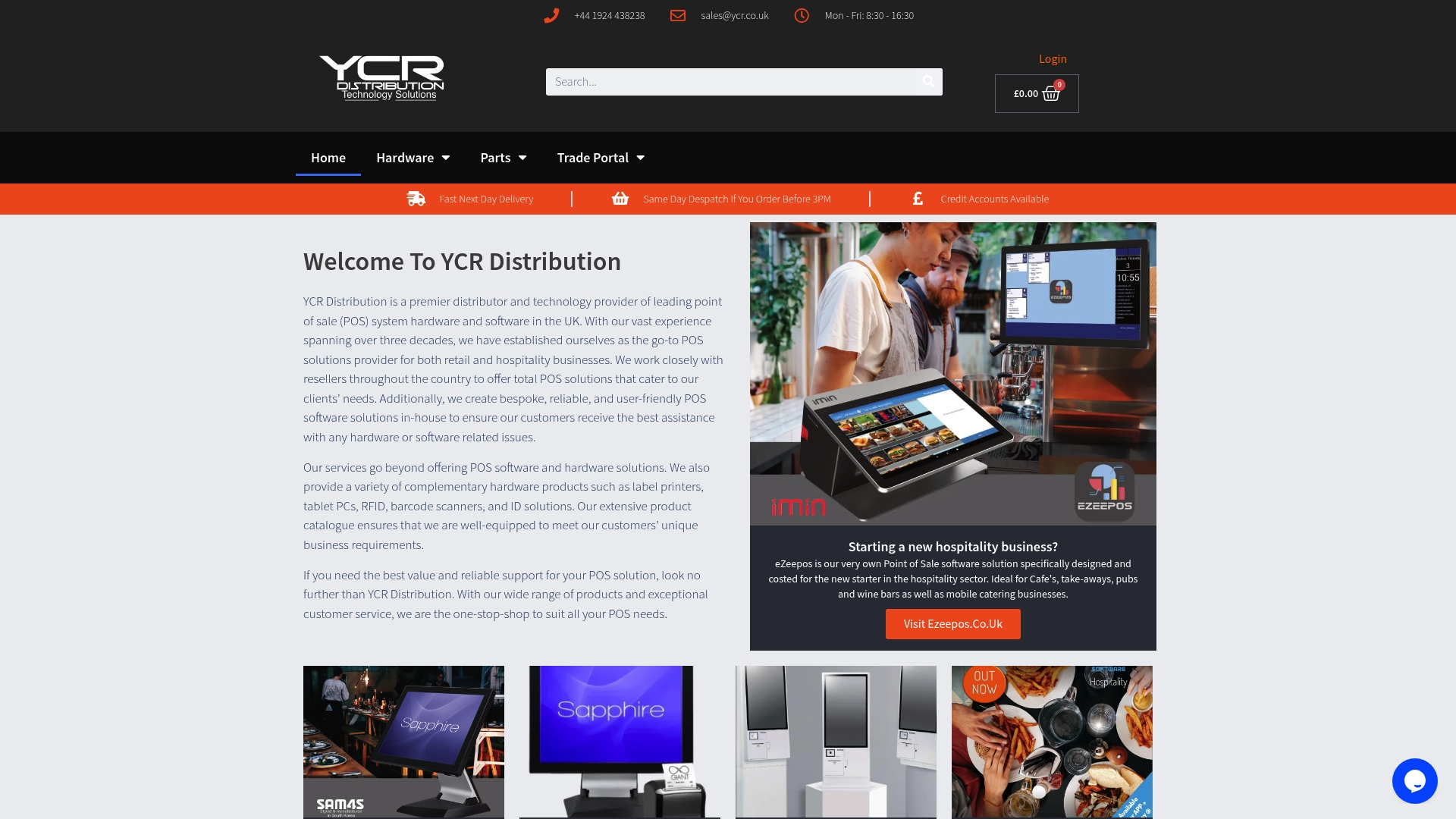
At YCR Distribution, we’ve spent over three decades helping UK retail and hospitality businesses source the right combination of hardware and software. Whether you need a full terminal setup or a portable reader solution, you can explore POS software options by sector, or browse POS hardware to match your operational environment. Our team offers same-day dispatch and UK-based guidance to help you move from decision to deployment without the usual delays.
Frequently asked questions
What is POS software and how does it help UK retail and hospitality businesses?
POS software manages sales, payments, and stock in real time, helping UK shops and venues deliver faster service, reduce errors, and easily track every transaction through one system.
Is Square POS really free?
Square does not charge for its basic POS software, but there is a 1.75% fee per transaction processed through the system, which can add up significantly at higher sales volumes.
Which POS system is best for a small pop-up or food truck in the UK?
SumUp is a top pick for mobile businesses due to its pay-as-you-go model and simplicity, though it lacks advanced stock management and multichannel features.
Are POS systems in the UK compatible with HMRC and VAT requirements?
Most major POS systems used in the UK are built to issue VAT receipts and support compliance with HMRC reporting requirements, though you should always confirm this with your provider before purchasing.