
TL;DR:
- Retailers often mistakenly believe POS compliance is only about secure card payments, but it also requires meeting tax and consumer protection obligations. Proper compliance involves integrating payment security, digital VAT record-keeping, and accurate price display into a unified POS system, not treating them as separate checklists. Regular review and updates are essential to maintain compliance, reduce risks, and ensure smooth business operations.
Most retail business owners assume POS compliance is simply about keeping card payments secure. Install the right payment terminal, tick the PCI DSS box, and you’re done. In reality, UK retailers face a set of overlapping legal, tax, and consumer obligations that all converge at the checkout. Miss one, and you could face HMRC penalties, failed VAT submissions, or consumer protection fines. This guide breaks down exactly what retail POS compliance means, which rules apply to your business, and what practical steps you need to take in 2026 to stay on the right side of every requirement.
Table of Contents
- The three pillars of retail POS compliance
- Tax and record-keeping: Making Tax Digital explained
- Consumer law: price display and retail obligations at POS
- Tools and tactics: how to achieve seamless POS compliance
- A retailer’s compliance blind spots: what most guides miss
- Simplify compliance with the right POS partner
- Frequently asked questions
Key Takeaways
| Point | Details |
|---|---|
| Compliance is multi-faceted | Retail POS systems in the UK must cover payment security, tax requirements, and consumer law obligations. |
| MTD-ready digital records | Using MTD-compatible POS software helps you avoid errors and keeps you compliant with HMRC’s requirements. |
| Price display is a legal must | Your POS must show total and unit prices according to UK law or risk serious penalties. |
| Unified approach prevents risk | Viewing compliance as an ongoing, integrated process reduces business risk and operational headaches. |
The three pillars of retail POS compliance
With misconceptions addressed, let’s break down what retail POS compliance actually encompasses.
Understanding the POS software importance is far easier once you recognise that compliance is not a single obligation but a cluster of three distinct domains, all of which intersect at your checkout. The MTD VAT complete guide describes it clearly: retail POS compliance covers “(1) payment security (e.g., PCI DSS, and payment authentication where relevant), (2) tax/VAT record-keeping (e.g., MTD-compatible digital records), and (3) consumer-facing retail rules (e.g., price labelling). The POS is often where multiple obligations meet, so gaps can become operational risk.”
| Compliance domain | Key requirement | Who enforces it |
|---|---|---|
| Payment security | PCI DSS standards, Strong Customer Authentication | Card schemes, FCA |
| Tax and VAT records | Making Tax Digital, digital capture of sales data | HMRC |
| Consumer law | Price Marking Order 2004, unit pricing | Trading Standards |
The danger of treating these as three separate checklists is that the overlaps get ignored. For example, a retailer might have a fully PCI-compliant payment terminal but use an old cash register that generates paper totals, meaning their MTD obligations are completely unmet. Or a business may keep digital VAT records but display prices incorrectly on shelf labels, falling foul of consumer law. Neither issue is picked up by the other domain’s checklist.
Key areas where retailers commonly fall short include:
- Assuming payment security covers all compliance obligations
- Using disconnected systems that break the digital link required for MTD
- Failing to display unit prices for qualifying products
- Not reviewing compliance requirements when upgrading hardware
Properly optimising payment workflows means building a system where all three domains are covered by design, not patched together after the fact.
Tax and record-keeping: Making Tax Digital explained
Tax compliance is often overlooked at the checkout. Here’s how it directly shapes your POS requirements.

For UK retailers registered for VAT, MTD record-keeping is now a core obligation: “POS compliance also includes HMRC ‘Making Tax Digital’ (MTD) record-keeping requirements (so POS data must be captured digitally in MTD-compatible ways).” In plain terms, your POS system must record your sales figures digitally, and those records must be linked electronically to your VAT return submission. Writing down your till totals at the end of the day and retyping them into a spreadsheet is no longer acceptable.
The MTD VAT guide is explicit about this: “a common ‘gotcha’ is ensuring that the figures you keep and submit are genuinely digital and properly linked to the submission method (rather than re-typing totals across tools).” This digital link requirement catches many retailers off guard, particularly those who have upgraded their payment terminals but kept legacy back-office processes.
What data your POS must capture digitally
| Data field | MTD requirement | Why it matters |
|---|---|---|
| Daily gross takings | Must be recorded digitally per trading day | Foundation for VAT calculation |
| VAT amount collected | Must be digitally recorded | Required for accurate VAT return |
| Sales by VAT rate | Separate records for standard, reduced, zero | Ensures correct liability reporting |
| Refunds and adjustments | Must be captured and linked | Affects net VAT figure |
Here is a straightforward process for achieving MTD compliance at your POS:
- Confirm your VAT registration status and whether MTD for VAT applies to you (it currently applies to all VAT-registered businesses).
- Select an MTD-compatible POS software that records all required data fields automatically without manual re-entry.
- Establish a digital link from your POS to your accounting or VAT submission software, either natively or via a recognised bridging tool.
- Test the link end-to-end before your next VAT return, checking that figures flow correctly without any manual intervention.
- Store digital records for at least six years, as HMRC can request these during an audit.
Pro Tip: The simplest way to guarantee MTD compliance is to use a POS system whose role of POS software includes built-in accounting integration. When your sales data flows directly into MTD-compatible accounting software, you eliminate re-entry errors entirely.
Old cash registers are the most common culprit for MTD failures. They produce paper rolls, not digital records, so the only way to use them for MTD is to manually type figures into another system. That immediately breaks the digital link HMRC requires. Retailers still using legacy tills should treat POS hardware for MTD as an investment in compliance, not just an operational upgrade. The benefits of compliance include faster, more accurate VAT submissions and far less stress at quarter end.
Consumer law: price display and retail obligations at POS
Alongside tax records, consumer rights at checkout shape what your till must display.
Consumer price presentation rules are often absent from compliance conversations, but they carry real enforcement risk: “Retail POS compliance can include consumer-price presentation rules that affect what you show at the point of sale, including rules on displaying selling price (and unit price where applicable).” The Price Marking Order 2004 (PMO) is the primary legislation here, and it places clear duties on retailers.
Key principle: Every product offered for retail sale in the UK must have its selling price clearly indicated, inclusive of VAT, in a way that is unambiguous, easily identifiable, and clearly legible.
The PMO requirements that affect your POS system most directly include:
- Selling price display: The final price including VAT must be shown for all products. Your POS screen and any customer-facing receipt must reflect this.
- Unit pricing: For products sold by weight, volume, length, or area, you must also display a price per unit of measurement (e.g., per kilogram or per litre). This applies both in-store and in online retail.
- Consistency between shelf and till: If a product is labelled at one price on the shelf and a different price rings up at the till, Trading Standards can take action. Your POS database must stay synchronised with your physical labelling.
- Online equivalence: Retailers selling through an integrated online channel must apply the same price marking rules. Your POS software should ideally manage pricing across both channels from a single source.
Non-compliance with the PMO carries financial penalties and, perhaps more damaging for independent retailers, reputational harm. Trading Standards officers conduct spot checks, and a single pricing discrepancy can trigger a wider audit of your operation. Upgrading your POS for compliance is one of the most effective ways to close this gap, because modern POS software can automate price updates across shelf edge labels, customer-facing displays, and receipts simultaneously.
The practical implication for your system is that price management needs to be centralised. Retailers who manage prices in a spreadsheet and update their POS and labels separately are always at risk of a mismatch. A compliant POS setup treats pricing as a single digital source of truth.
Tools and tactics: how to achieve seamless POS compliance
Equipped with the requirements, how do you put compliance into practice across your retail operation?
MTD-compatible software allows simplified daily gross takings recording in ways that satisfy both HMRC and your own reporting needs. The good news is that a well-chosen POS system can handle most compliance obligations automatically, provided you set it up correctly and review it regularly.
Follow this process to build a genuinely compliant POS operation:
- Audit your current setup. List every point where data is captured, processed, or transferred in your checkout flow. Identify any manual steps, paper records, or disconnected systems.
- Map each step to a compliance domain. Ask whether each touchpoint satisfies payment security, MTD record-keeping, and consumer law requirements. Look for gaps.
- Select or upgrade to a unified POS system. Choose software that covers all three compliance domains natively. Review POS software examples that are designed for UK retail, where MTD integration and price management are built in rather than bolted on.
- Establish digital links. Connect your POS to your accounting software without any manual data-transfer steps. Verify that VAT figures flow through automatically.
- Configure price management centrally. Ensure all pricing, including VAT-inclusive selling prices and unit prices, is managed from your POS database and pushed out to all display points.
- Train your team. Staff who understand why price accuracy and digital record-keeping matter are far less likely to create compliance gaps through workarounds or shortcut behaviours.
- Schedule quarterly compliance reviews. Build a recurring check into your business calendar to confirm that software updates, new products, and changing regulations have not created new gaps.
Pro Tip: When your POS provider releases a software update, treat it as a potential compliance event. New regulations often prompt updates to MTD-compatible software and payment authentication standards. Always read the release notes and confirm that any compliance-related changes have been applied correctly.
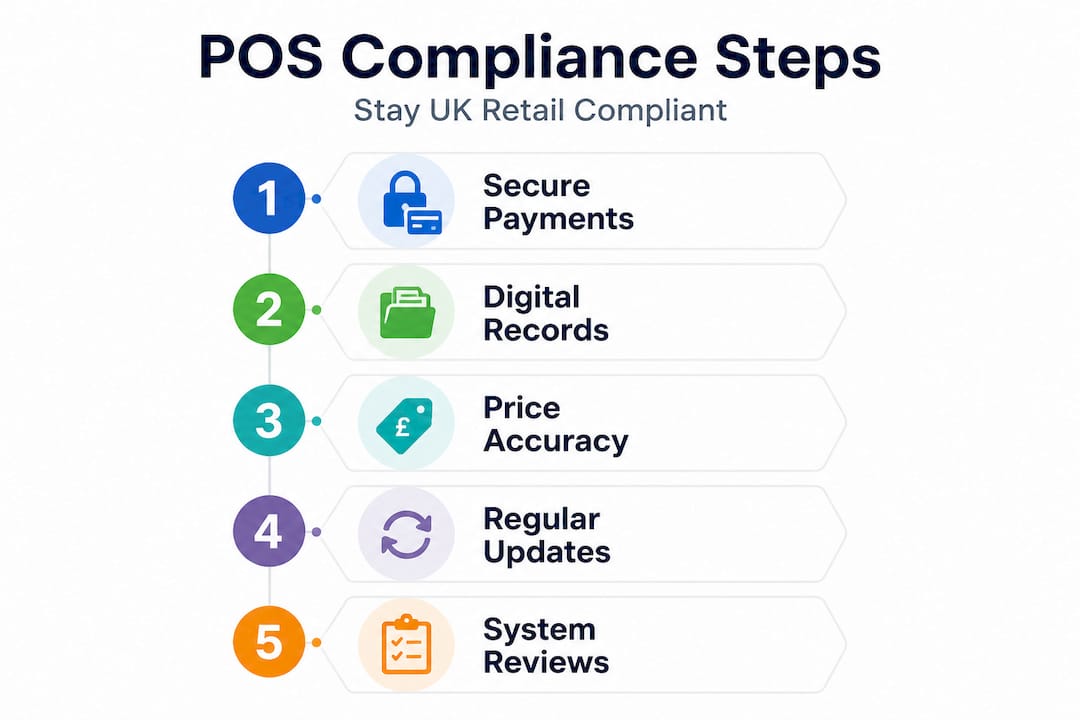
Your checklist for a compliant POS system should cover: MTD-compatible digital record-keeping with automatic digital links, VAT-inclusive price display on all customer-facing screens and receipts, unit pricing functionality for qualifying products, PCI DSS-compliant payment processing, and centralised price management to prevent shelf-to-till discrepancies.
A retailer’s compliance blind spots: what most guides miss
Most compliance guides hand you a checklist and call it done. Tick the payment security box. Tick the MTD box. Tick the price marking box. But in practice, retail compliance failures rarely come from ignoring a single obligation entirely. They come from the cracks between obligations, the places where one system ends and another begins.
We have seen retailers who passed a PCI DSS audit but whose VAT figures were being manually re-entered into their accountancy software every quarter, a clear MTD digital-link failure waiting to be discovered by HMRC. We have also seen businesses with excellent digital VAT records whose customer-facing receipt software was rounding prices differently to their shelf labels, creating a consumer law exposure they were entirely unaware of.
The uncomfortable truth is that compliance at the point of sale is inherently systemic. Payment data, tax data, and consumer-facing price data all originate from the same transaction. When your POS system is fragmented across multiple tools that do not communicate properly, every transaction creates a small compliance risk. Multiply that across thousands of daily transactions and the cumulative exposure becomes significant.
Treating compliance as a one-time setup task is another dangerous habit. Regulations change. MTD is expanding in scope. Payment authentication standards are updated. Consumer price marking guidance gets revised. A POS system that was fully compliant in 2023 may have gaps in 2026 if it has not been updated or reviewed.
The businesses that stay genuinely compliant treat their POS as a living system, regularly reviewed, updated, and tested against current requirements. The business benefits of compliance are real: fewer HMRC queries, faster VAT returns, stronger customer trust, and reduced risk of Trading Standards intervention. But those benefits only materialise when compliance is built into the operation permanently, not treated as a project to be completed and forgotten.
Simplify compliance with the right POS partner
Navigating three overlapping compliance domains is genuinely complex. The right POS partner makes it manageable by embedding compliance capabilities directly into your hardware and software from day one.

At YCR Distribution, we supply MTD-ready POS solutions designed specifically for UK retail. Whether you need POS software that integrates directly with your accounting tools, hardware that supports compliant payment processing and customer-facing price display, or a fully integrated retail POS solution that covers all three compliance domains in a single system, we can help you build a setup that works. With next-day delivery and same-day dispatch, getting compliant quickly has never been more straightforward.
Frequently asked questions
What is meant by retail POS compliance in the UK?
Retail POS compliance means your point-of-sale system meets UK tax, payment security, and consumer law requirements, covering secure payments, digital VAT records, and price display rules simultaneously.
What records does my POS need for Making Tax Digital?
Your POS must capture daily gross takings and VAT information digitally, using MTD-compatible software that links records to your VAT submission automatically without any manual re-entry.
Do I need to display all prices at my point of sale?
Yes, UK law requires displaying selling prices including VAT and, where applicable, unit prices, both in-store and online.
What happens if my POS system is not compliant?
Non-compliance risks HMRC fines, failed VAT submissions, and Trading Standards penalties or consumer complaints for incorrect or missing pricing at the point of sale.
Recommended
- Step-by-step retail POS upgrade guide for UK stores
- Retail POS benefits: streamline your UK business in 2026
- POS hardware checklist for UK retail and hospitality 2026
- POS technology checklist 2026: choosing the right system for UK retail
- Marketplace Compliance Explained: Boost CPG Profits & Cut Risk – Reddog Consulting Group