

Retail technology glossary: key terms explained

TL;DR:
- In 2026, retail and hospitality businesses need to understand core technology terms like POS, SaaS, OMS, and ERP to make informed decisions. AI now forms the infrastructure for demand forecasting, personalization, and supply chain automation, significantly boosting revenue. Connecting and aligning technology systems prevents fragmentation, enhances data quality, and enables a cohesive, data-driven store operation.
Running a retail or hospitality business in 2026 means navigating a growing maze of technology terms that can leave even experienced owners scratching their heads. This retail technology glossary cuts through that confusion. Whether you are evaluating your first POS system, exploring AI-driven tools, or trying to understand what your IT supplier is actually proposing, knowing the right retail technology terms gives you real decision-making power. From SaaS and OMS to RFID and connected stores, the definitions and context here are built specifically for UK retailers and hospitality operators who need practical clarity, not textbook theory.
Table of Contents
- Understanding core retail technology terms
- How artificial intelligence is reshaping retail tech
- Connecting your retail tech stack for efficiency
- The connected store: a modern retail operating model
- Glossary of essential retail technology terms and tools
- An overlooked truth about retail technology adoption
- Explore specialised POS hardware and software solutions with YCR
- Frequently asked questions
Key Takeaways
| Point | Details |
|---|---|
| Retail technology basics | Understanding core terms like POS, OMS, and SaaS is crucial for managing retail operations effectively. |
| AI as infrastructure | AI has become central to retail tech, improving revenue through enhanced customer and operational capabilities. |
| Connected systems matter | Integrating retail technology systems enables real-time decisions and maximises AI investment value. |
| Connected store benefits | The connected store model unifies operations to improve customer experience and enterprise efficiency. |
| Practical implementation | Using expert solutions like YCR’s POS hardware and software helps UK businesses apply retail technology successfully. |
Understanding core retail technology terms
Every conversation about retail technology starts with a handful of terms that appear constantly in supplier proposals, software demos, and trade publications. Getting these right is not just useful academically. It protects you from buying tools that do not fit together.
Here are the core retail technology terms you will encounter most often:
- POS (Point of Sale): The system where a transaction is completed. This includes the hardware (till, screen, receipt printer) and the software processing the sale. The role of POS software extends well beyond processing payments. Modern POS platforms manage stock levels, loyalty programmes, staff permissions, and sales reporting in real time.
- SaaS (Software as a Service): Cloud-based software delivered by subscription rather than installed on your own servers. SaaS delivers software such as ERP, OMS, and POS via cloud subscriptions managed by IT teams, meaning you access it through a browser or app with no hosting burden on your side.
- OMS (Order Management System): Software that tracks and manages orders across every sales channel, whether that is your shop floor, website, or marketplace listings. As of 2026, an OMS is crucial for managing omnichannel order fulfilment in UK retail, particularly as customer expectations for click-and-collect and next-day delivery continue to rise.
- ERP (Enterprise Resource Planning): A broader platform that connects finance, procurement, HR, and inventory into one system. Retailers use ERPs when they outgrow separate tools and need a single source of operational truth.
- IT team: In retail technology discussions, this refers to whoever manages your systems, whether that is an in-house team, a single IT-savvy employee, or an outsourced support provider.
Understanding these five terms alone will make most vendor conversations significantly more productive.
How artificial intelligence is reshaping retail tech
AI is no longer a feature bolted onto retail software as a selling point. By 2025, it had become the infrastructure underneath modern retail operations, and understanding retail technology in 2026 now requires understanding AI’s role within it.
AI has become infrastructure in retail tech, powering product discovery, demand forecasting, and supply chain decisions well beyond what basic systems could handle a few years ago. The practical applications are broader than most shop owners realise:
- Shopping assistants: Conversational tools on websites and apps that guide customers to the right product without staff involvement.
- Personalised recommendations: Algorithms that surface relevant products based on a customer’s past purchases or browsing behaviour, increasing average basket size.
- Supply chain automation: AI that predicts stock shortfalls before they happen and automatically triggers replenishment orders.
- Dynamic pricing: Tools that adjust prices based on demand, competitor activity, and stock levels in real time.
- Advertising optimisation: AI-driven ad platforms that allocate your marketing budget to the highest-performing channels automatically.
The revenue impact is measurable. In 2025, 89% of retailers using AI reported increased revenue, a figure that underlines why AI capabilities are now a baseline requirement rather than a premium add-on.
“AI has moved from a nice-to-have experiment to a core part of how retail businesses operate, compete, and grow.”
For a deeper look at where this is heading, the retail technology trends shaping the next few years are worth reading alongside this glossary. You can also explore AI in eCommerce examples that show exactly how businesses are applying these tools to boost sales today.
Connecting your retail tech stack for efficiency
Knowing individual tools is one thing. Making them work together is where most UK retailers and hospitality operators run into trouble.
A “tech stack” simply means the collection of software and hardware your business runs on. The problem is that many businesses accumulate tools over time without a plan, ending up with a stock system that does not talk to their POS, a loyalty programme that cannot read customer data from their OMS, and an accounting package that requires manual exports. This fragmented approach is expensive and it directly limits how well AI can function within your business. Retail CIOs risk wasted AI spend without data flow visibility across the technology stack, because AI tools are only as useful as the data they can access.
A practical three-phase approach to modernising your tech stack:
- Align and assess: Map every system you currently use and identify where data gets stuck. Which tools do not connect? Where are staff manually re-entering information? This audit tells you where the real cost is hiding.
- Design and evaluate: Decide on your ideal architecture. What should connect to what? Which systems are worth keeping, replacing, or retiring? Prioritise based on business impact rather than technology novelty.
- Plan and commit: Build a phased rollout with clear business outcomes at each stage. Do not try to replace everything at once. A single well-executed integration often delivers more value than a full platform switch.
Pro Tip: Before purchasing any new retail technology, ask the supplier one specific question: “How does this system share data with other platforms?” If they cannot give you a clear answer about APIs or integration options, that tool risks becoming another isolated island in your stack.
| Phase | Key activity | Business benefit |
|---|---|---|
| Align and assess | Audit existing systems and data flows | Identifies hidden inefficiencies and cost |
| Design and evaluate | Map ideal architecture and evaluate tools | Reduces technical debt before it accumulates |
| Plan and commit | Phased rollout with defined outcomes | Protects budget and ensures measurable ROI |
Understanding future-proof retail technology and staying informed about point of sale trends will help you make integration decisions that age well.
The connected store: a modern retail operating model
The connected store is not a product you buy. It is a model for how your business operates when all your technology, data, and people work together rather than in separate compartments.
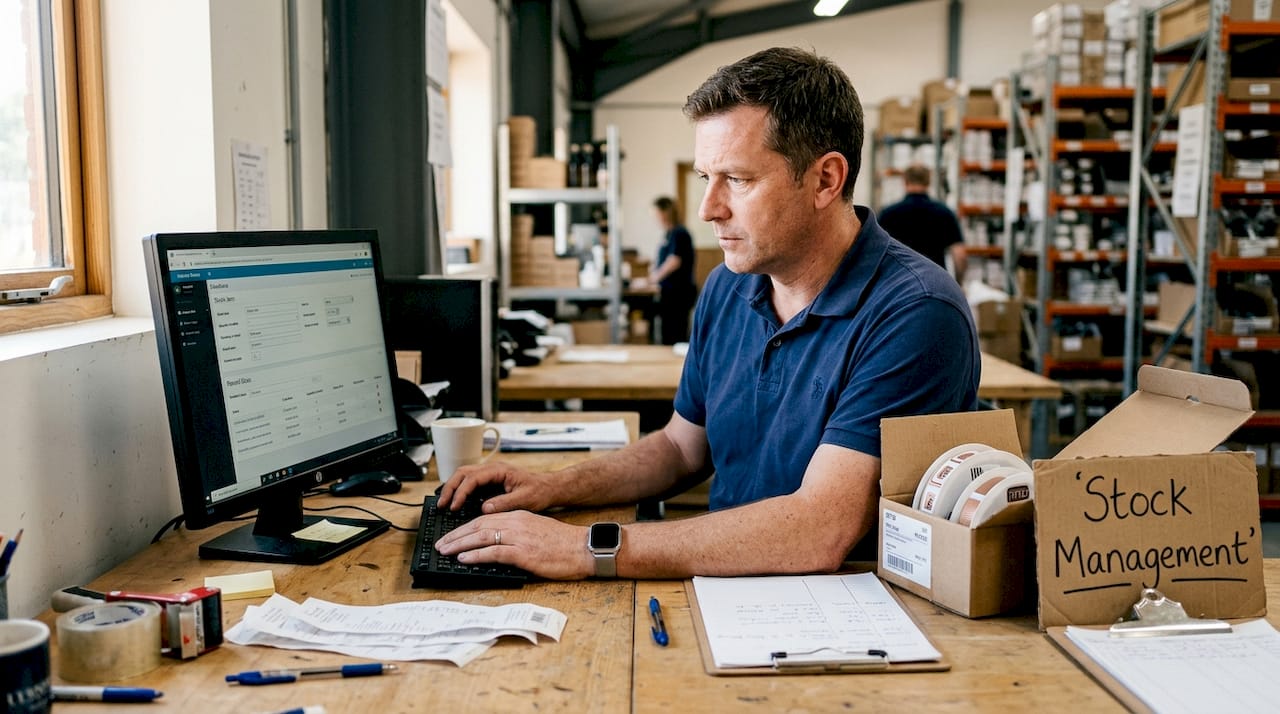
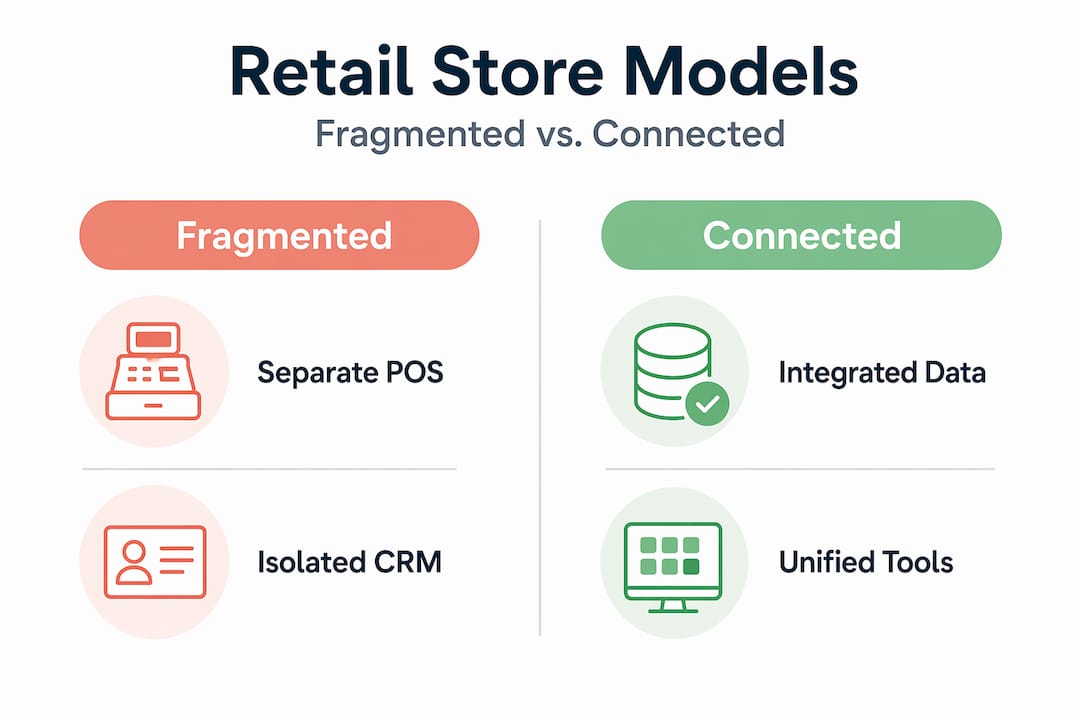
The connected store operating model turns store signals into actionable intelligence by connecting customer, associate, and enterprise capabilities. In practice, this means your shop floor staff have access to live inventory data, your managers can see real-time performance across locations, and your customer-facing tools are informed by the same data as your back-office systems.
| Traditional fragmented model | Connected store model |
|---|---|
| POS, stock, and CRM are separate tools | All systems share a unified data layer |
| Reports are generated manually after the fact | Live dashboards visible across the business |
| Staff make decisions without full information | Associates have real-time data at the point of service |
| Customer experience varies by channel | Consistent experience across in-store, online, and app |
| AI tools operate on incomplete data sets | AI draws on clean, connected data for accurate outputs |
The stages of building a connected store typically move from a live data environment (where systems are integrated and data flows in real time) through a layered intelligence phase (where AI and analytics tools begin extracting value from that data) and into a continuous improvement cycle (where insights feed back into operations automatically).
Pro Tip: The biggest barrier to a connected store is not technology budget. It is data quality. Before adding any new system, audit whether your existing data is clean, consistent, and reliably categorised. Dirty data fed into a connected stack produces unreliable outputs.
The rise of mobile POS trends in UK hospitality and retail is a key part of this connected model, enabling staff to serve customers and access data from anywhere on the shop floor or restaurant floor.
Glossary of essential retail technology terms and tools
To apply everything covered so far, here is a practical retail terminology guide covering the terms most relevant to UK retail and hospitality operations.
- POS (Point of Sale): The hardware and software combination used to process sales transactions. Found in every retail and hospitality environment.
- OMS (Order Management System): Manages fulfilment across all sales channels. Critical for businesses selling both in-store and online.
- SaaS: Cloud-hosted software accessed by subscription. Covers most modern POS, ERP, and OMS platforms.
- ERP (Enterprise Resource Planning): Connects finance, HR, procurement, and operations in a single platform.
- CDP (Customer Data Platform): Collects and unifies customer data from every touchpoint into a single profile used for personalisation and marketing.
- RFID (Radio Frequency Identification): Uses radio signals to track stock without scanning individual barcodes. Common in clothing retail for rapid stocktaking.
- ESL (Electronic Shelf Labels): Digital price tags on shelving units that can be updated remotely, eliminating manual label changes and pricing errors.
- API (Application Programming Interface): The technical bridge that allows different software systems to share data. When a supplier says their POS “integrates with” your accounting software, an API is doing the work.
- KPI (Key Performance Indicator): A measurable target used to track business performance. In retail, common KPIs include conversion rate, average transaction value, and stock turnover.
| Term | Primary use | Who uses it most |
|---|---|---|
| POS | Sales processing and reporting | Operations, Front-of-house |
| OMS | Omnichannel order fulfilment | Operations, Logistics |
| ERP | Business-wide resource management | Finance, IT, Procurement |
| CDP | Customer data and personalisation | Marketing, IT |
| RFID | Inventory tracking and stocktaking | Operations, IT |
| ESL | Automated shelf pricing | Operations, Procurement |
| API | System integration | IT, Development |
Explore the full range of retail point of sale options and specialist POS software to see how these terms translate into real products for your business.
An overlooked truth about retail technology adoption
After years working closely with UK retailers and hospitality businesses, one pattern is impossible to ignore. The businesses that struggle most with technology are not the ones that bought the wrong tools. They are the ones that bought the right tools in the wrong order, without a clear sense of how each piece would connect to the next.
AI is the most visible example of this problem right now. Investment in AI-powered retail tools has accelerated sharply, but retail technology success depends on aligning business outcomes with coherent systems, not just adding more tools. An AI recommendation engine built on top of a fragmented stock system will recommend the wrong products. An AI pricing tool fed inconsistent cost data will make decisions that erode margin rather than protect it.
The uncomfortable truth is that governance matters as much as technology. Who owns each system? Who checks data quality? Who has authority to change integrations? Without answers to these questions, even the best-architected tech stack quietly deteriorates.
The businesses that get the most from their technology investment do two things consistently. First, they define the business outcome they want before choosing a tool. Not “we want to use AI” but “we want to reduce out-of-stocks by 20% before summer.” Second, they build in a review process so that each stage of their roadmap is assessed against real results before the next phase begins.
Starting with future-proof retail technology thinking means asking whether each purchase fits your architecture, not just whether it solves an immediate problem.
Explore specialised POS hardware and software solutions with YCR
Understanding retail technology terms is the first step. Choosing the right hardware and software to act on that understanding is where the real work begins.
YCR Distribution has supplied UK retail and hospitality businesses with trusted POS solutions for over three decades. From terminals and barcode scanners to digital signage and bespoke software, the range is built around what real businesses actually need, not what looks impressive in a brochure. Whether you are running a single café or managing a multi-site convenience chain, the POS software solutions and retail point of sale systems available cover everything from simple transaction processing to full inventory and customer management. If you want to get to grips with the hardware side before you commit, the POS hardware terminology guide is a useful next step.
Frequently asked questions
What is an Order Management System (OMS) in retail?
An OMS is software that manages order fulfilment across online and in-store sales channels. It handles fulfilment for omnichannel retail, ensuring orders placed through any channel are processed, tracked, and delivered accurately.
How does AI improve retail business revenue?
AI improves revenue by personalising customer experiences, automating inventory decisions, and optimising pricing in real time. In 2025, 89% of retailers reported that AI-based solutions increased their revenue directly.
Why is connecting retail technology systems important?
Connected systems allow data to flow between your POS, stock management, and customer tools in real time, which is what makes AI effective. Disconnected point solutions obscure your architecture and limit both AI readiness and return on investment.
What is a connected store in retail?
A connected store is an operating model that integrates customer-facing technology, staff tools, and back-office systems into a unified, data-driven environment. The connected store model links customer, associate, and enterprise capabilities so that every part of the business operates from the same information.
How do SaaS solutions benefit retail businesses?
SaaS gives retail businesses access to powerful software such as ERP, OMS, and POS without the cost of hosting or maintaining servers. SaaS delivers via cloud subscription, making it faster to deploy and easier to update than traditional on-premise software.