
Step-by-step restaurant workflow: a UK manager’s guide

TL;DR:
- Implementing a documented, SOP-based restaurant workflow ensures consistent operations and food safety compliance. Integrating POS technology facilitates task accountability, inventory management, and real-time oversight. Regular reviews and staff feedback are essential for maintaining effective procedures and operational success.
Running a restaurant without a clear step-by-step restaurant workflow is like doing mise en place blindfolded: everyone is busy, but nothing is consistent. UK restaurant managers face this daily — staff unsure of priorities, food safety logs incomplete, and closing tasks done differently on every shift. A practical restaurant workflow built around documented SOPs (standard operating procedures, meaning written instructions for every key task) and integrated POS technology can close that gap, turning reactive fire-fighting into predictable, repeatable operations.
Table of Contents
- Preparing for a smooth restaurant workflow
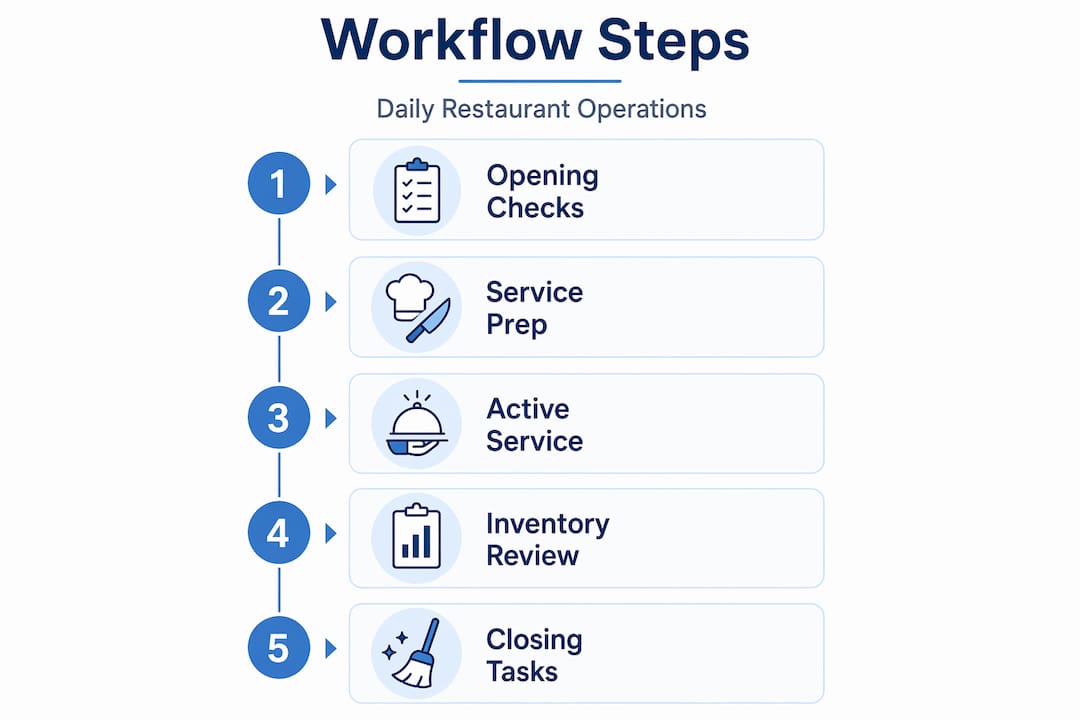
- Executing daily workflows: opening, service, and closing step by step
- Managing inventory and procurement workflows efficiently
- Ensuring consistency: documenting workflows and accountability
- Food safety workflows: temperature monitoring and corrective actions
- Why documented workflows alone don’t guarantee restaurant success
- Streamline your restaurant workflow with integrated POS solutions
- Frequently asked questions
Key Takeaways
| Point | Details |
|---|---|
| Documented SOPs | Clear and comprehensive SOPs are the foundation for consistent restaurant operations. |
| Assign accountability | Task ownership and tracking completion ensure workflows are followed reliably. |
| Integrated POS systems | POS technology connects orders, inventory, and reporting for seamless workflow management. |
| Food safety compliance | Regular temperature monitoring with documented corrective actions is essential for HACCP adherence. |
| Regular SOP review | Quarterly updates keep workflows relevant as menus, staff, and technology evolve. |
Preparing for a smooth restaurant workflow
Before you can run a shift well, you need to design one. A restaurant operation guide that actually works in the real world starts with two things: knowing who does what, and writing it down clearly enough that a new supervisor on their second week could follow it without asking questions.
Define roles before you define tasks. Front of house (FOH) and back of house (BOH) teams often operate in silos, with each side assuming the other has covered something. Your first step is a simple RACI matrix: who is Responsible, who is Accountable, who is Consulted, and who is Informed for each key workflow area. This removes the most common source of operational inconsistency overnight.
A restaurant operations plan must begin with clear objectives, organisational structure, SOPs, and technology selection to ensure reliable daily execution. That technology piece matters more than most managers initially expect. Your POS system choice directly shapes how your team captures orders, manages covers, and closes shifts. Selecting hardware and software before writing your SOPs means you build procedures around your actual tools rather than retrofitting them later.
Key preparation steps for your restaurant workflow:
- Map every operational area: opening, service, closing, food safety, inventory, and financials
- Write a one-page SOP for each area, with named role accountability
- Choose POS software that matches your service style (table service, quick service, or hybrid)
- Run a POS implementation process alongside SOP training, not after it
- Schedule at least two practice runs before live service begins
| Workflow area | SOP owner | POS integration needed |
|---|---|---|
| Opening checks | Duty manager | Cash drawer, till login |
| Order taking | FOH supervisor | Order management module |
| Food safety logs | Head chef | Digital temperature logging |
| Stock counts | Sous chef / manager | Inventory management module |
| Cash reconciliation | Duty manager | End-of-day reporting |
Pro Tip: Do not write SOPs in isolation. Walk the floor with your team and document what actually happens, then refine from there. Procedures written at a desk rarely survive contact with a busy Friday service.
Executing daily workflows: opening, service, and closing step by step
This is where the dining process outline becomes tangible. Each phase of the day carries distinct tasks, and each task needs a clear owner and a sign-off mechanism.
Opening workflow
- Unlock premises and deactivate alarm
- Check fridge and freezer temperatures and log readings
- Inspect all equipment (fryers, grills, ovens, dishwasher) for faults
- Check sanitiser concentrations and restock cleaning stations
- Count and confirm cash float against the previous night’s record
- Brief the opening team on covers, specials, and any operational notes
- Confirm online orders are live and POS terminals are connected
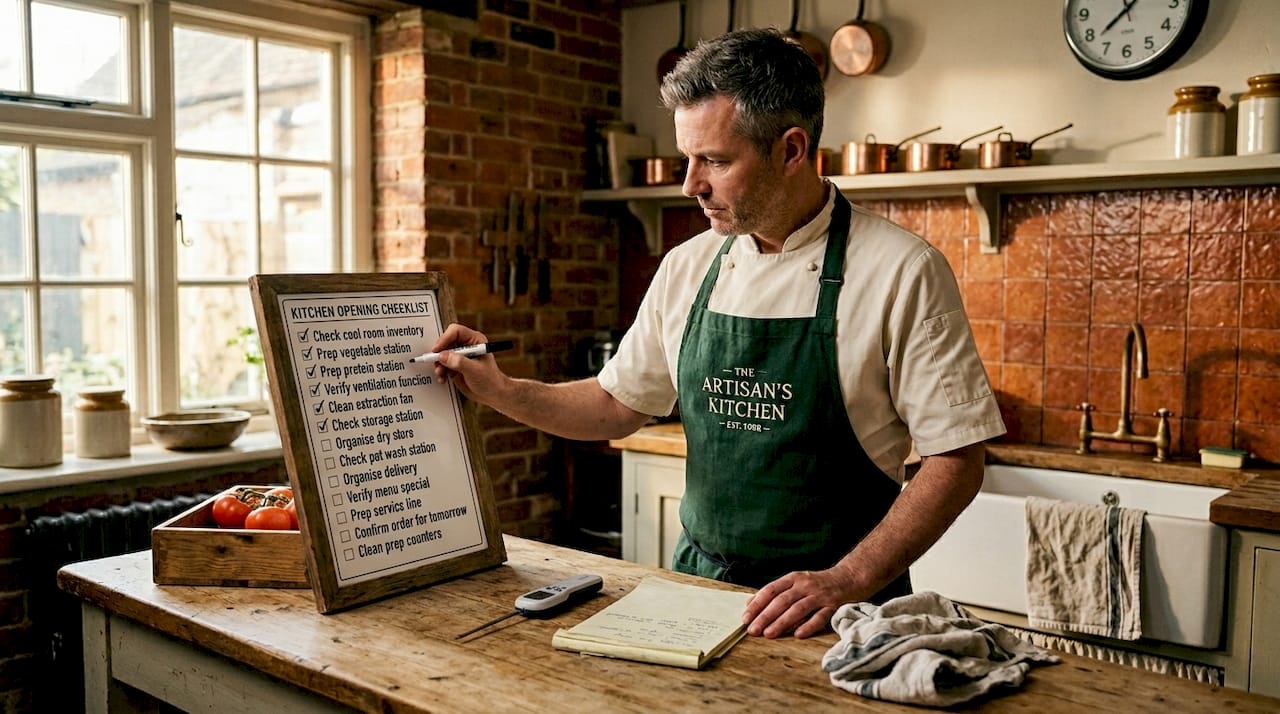
UK opening and closing workflows should cover equipment checks, temperature logs, sanitisation, FIFO stock rotation (first in, first out), waste disposal, cash reconciliation, and site security. Printing laminated checklists and attaching them to clipboards at each station costs almost nothing and removes the single biggest cause of missed tasks: forgetting.
Service workflow
During service, efficient restaurant procedures depend on communication between FOH and BOH. Managing restaurant orders efficiently means orders sent through a POS reach the kitchen display immediately, reducing verbal shouting and the errors that come with it. Mid-service temperature checks on hot-held food should happen every two hours as a minimum, and each check must be logged.
Closing workflow
- Complete waste disposal and separate recycling according to local council requirements
- Deep clean all food preparation surfaces and equipment
- Reconcile cash against POS end-of-day report
- File completed food safety logs in the dedicated folder for that date
- Secure all entry points and set the alarm
| Task | FOH responsibility | BOH responsibility |
|---|---|---|
| Equipment checks | POS, card machines, displays | Cooking equipment, dishwasher |
| Temperature logs | Hot-held display units | Fridges, freezers, cooking batches |
| Cleaning | Tables, bar, toilets | Kitchen surfaces, equipment |
| Cash / reports | Till reconciliation | Food waste records |
| Security | Front of house lock-up | Back door, walk-in locks |
“A checklist is not a sign that your team cannot be trusted. It is a sign that you take consistency seriously enough to prove it.”
Pro Tip: Daily restaurant workflows that use digital checklists tied to your POS login create automatic timestamps, which are genuinely useful during an Environmental Health Officer (EHO) inspection.
Managing inventory and procurement workflows efficiently
Inventory is where most UK restaurants silently lose money. The stepwise food service process for stock management is not complicated, but it does require discipline and the right tools.
The procurement workflow, step by step:
- Review current stock levels against a par list (the minimum quantity you need before reordering)
- Identify shortfalls and flag any items approaching expiry
- Raise purchase orders with approved suppliers based on forecasted covers
- Receive deliveries, checking quantities and condition against the purchase order
- Inspect temperatures of chilled and frozen goods on arrival and reject non-compliant items
- Store correctly using FIFO rotation and update inventory records immediately
- Match supplier invoices against purchase orders and flag discrepancies before approval
The restaurant procurement process includes defining requirements, selecting suppliers, ordering, receiving, stock control, and invoice matching, and each of these steps can be aided by software that automates purchase orders and flags variances automatically.
What restaurant inventory management software handles for you:
- Real-time stock level visibility across all ingredients
- Automatic low-stock alerts based on sales velocity
- Supplier price tracking to identify cost creep
- Waste logging tied to financial reporting
- Integration with your POS for true food cost calculations
| Procurement step | Manual approach | Technology-assisted approach |
|---|---|---|
| Stock counting | Paper sheets, weekly | Live POS integration, daily |
| Ordering | Phone or email to supplier | Automated PO from system |
| Invoice matching | Manual comparison | Software flags discrepancies |
| Waste tracking | Paper log | Linked to menu and cost reports |
Connecting your restaurant inventory management directly to your POS is one of the highest-return changes an independent UK restaurant can make, because it turns guesswork into data.
Pro Tip: Schedule your supplier orders based on your POS sales data from the same period last year. A Tuesday order for a Saturday wedding cover should look very different from a standard weekend order.
Ensuring consistency: documenting workflows and accountability
Writing an SOP is the easy part. Getting twelve people across two shifts to follow it, without a manager standing over them, is the hard part. Best practices for restaurant workflow documentation go well beyond formatting.
What makes an SOP actually work in practice:
- Written so the next shift supervisor can execute it without phoning the head chef
- Includes a named role (not just “staff”), a frequency, and a sign-off box
- Separate documents for FOH and BOH to avoid confusion about scope
- Filed in a physical folder and accessible digitally from a tablet at each station
- Reviewed as a team, not just issued from management
“The key to effective SOPs is accountability: assigning tasks, tracking completion, and linking compliance to managerial metrics.”
SOP compliance tied to operational KPIs (key performance indicators, such as waste percentage, customer complaint rates, and kitchen ticket times) gives managers something measurable to work with in appraisals and briefings. If your food waste is rising, the first question should be: which SOPs were not followed this week?
Bespoke POS software built for hospitality can enforce workflow adherence by requiring specific steps before a function unlocks, such as confirming a cash float before opening the till for service. That kind of friction is intentional and useful.
Pro Tip: Schedule a quarterly SOP review with your supervisors. Menu changes, new equipment, or staff turnover all make existing procedures outdated faster than most managers expect.
Food safety workflows: temperature monitoring and corrective actions
Temperature monitoring is not optional in the UK. It is a core requirement of HACCP (Hazard Analysis and Critical Control Points), the food safety management system that EHOs will inspect. Your food safety workflow needs to be airtight.
Temperature logging workflow:
- At opening: check and log all fridge temperatures (target 1°C to 4°C)
- At mid-morning: second fridge check, plus freezer log (target below minus 18°C)
- During service: probe and record cooking temperatures for every high-risk batch (poultry must reach 75°C)
- During service: check hot-held food every two hours (minimum 63°C)
- At closing: final fridge log, confirm freezer still within range
- If any reading is out of range: document the corrective action taken immediately
HACCP temperature monitoring requires fridge checks at least twice daily, freezer checks once daily, and cooking temperature logging for every high-risk food batch. Missing a single log does not just create a hygiene risk; it creates a compliance gap that inspectors notice immediately.
What your temperature logs must include:
- Date and time of each check
- Location (which fridge, freezer, or batch)
- Actual reading recorded
- Name of the person who checked
- Corrective action taken if out of range, with a second reading confirming resolution
Food safety documentation failures most commonly involve missing records and a lack of documented corrective actions, which are precisely the two things EHOs scrutinise most closely during unannounced inspections.
“A temperature log with no corrective action recorded is not evidence of a safe kitchen. It is evidence of a team that did not know what to do next.”
Pro Tip: Digital temperature logging systems that timestamp readings automatically remove the temptation to backfill records. They also generate inspection-ready reports in seconds rather than hours.
Why documented workflows alone don’t guarantee restaurant success
Here is the uncomfortable reality that most restaurant management guides skip past: the majority of UK restaurants that fail at operational consistency already have written SOPs. The documents exist. The failure is in execution, oversight, and culture.
Many operators invest a weekend writing procedures, then place them in a folder that nobody opens again until an EHO visit is announced. Creating a restaurant workflow plan is the beginning of the work, not the end of it.
What actually makes workflows stick is accountability tied to metrics. When a manager can see on a dashboard that the closing checklist was not completed on Tuesday, and can name the supervisor on shift, the conversation changes. It moves from “why is this a problem” to “here is what we will do differently tomorrow.”
Technology integration is the connective tissue that most independent UK operators are still missing. Scheduling, inventory, order management, and task completion should not live in four separate apps, a spreadsheet, and a paper folder. Connected POS systems bring these functions together, giving managers real-time visibility rather than a retrospective picture at month end.
The other piece that rarely features in how-to guides is frontline feedback. Your chefs and floor staff know which SOPs are impractical within the first week of following them. Build a simple mechanism for them to flag this, act on it, and update the procedure. A workflow that nobody believes in will be quietly ignored within a month.
Pro Tip: Invest in change management when introducing new workflows, not just training on tasks. Explain the why behind each procedure. Staff who understand the reason behind a rule follow it far more consistently than those who see it as bureaucracy.
Streamline your restaurant workflow with integrated POS solutions
Running tighter operations starts with having the right tools in place, not after the problems appear.
At YCR Distribution, we supply UK restaurant managers with the POS hardware and software they need to turn good intentions into consistent daily practice. Our POS software solutions connect order management, inventory control, and reporting so your workflow data is always visible in one place. From POS terminals and kitchen printers to bespoke hospitality software built around your service style, every product we offer is selected to support how a real UK restaurant actually operates. Our team can also walk you through the full POS implementation process so your technology and your SOPs work together from day one, not against each other.
Frequently asked questions
What are the essential steps in a restaurant’s daily workflow?
A restaurant’s daily workflow covers opening preparations, service management, closing tasks, inventory control, and food safety checks, with each phase requiring named owners and completed sign-offs.
How often should temperature checks be performed in UK restaurants?
Fridge temperatures must be logged at least twice daily, freezer temperatures once daily, and cooking temperatures recorded for every high-risk food batch, with any out-of-range reading followed immediately by a documented corrective action.
Why is accountability important in restaurant workflows?
Accountability ensures SOPs are followed consistently by assigning tasks to named individuals, tracking completion, and linking compliance to management metrics, which turns documented procedures into actual daily behaviour.
Can POS systems help enforce restaurant workflows?
Yes, integrated POS platforms connect scheduling, inventory, order management, and reporting, giving managers the visibility they need to identify where workflows are breaking down and respond before small gaps become costly problems.
How often should restaurant SOPs be reviewed and updated?
SOPs should be reviewed at least quarterly, and immediately whenever there are menu changes, new equipment, significant staff turnover, or recurring operational issues that suggest a procedure is no longer fit for purpose.