
Network security in POS systems: a 2026 guide

Network security in POS systems is defined as the set of controls, protocols, and architectural measures that protect payment data and prevent unauthorised access within retail and hospitality networks. The Payment Card Industry Data Security Standard (PCI-DSS), governed by the PCI Security Standards Council, sets the baseline every business must meet. Yet compliance alone does not equal security. 80% of retailers faced cyberattacks in the previous year, with half of those attacks targeting POS systems directly. That figure tells you exactly where attackers focus their effort, and it tells you where your defences need to be sharpest.
What are the main network security risks facing POS systems today?
POS systems sit at the intersection of customer-facing operations and sensitive financial data. That makes them a high-value target, and the attack surface is wider than most business owners realise.
RAM-scraping malware is the most destructive threat specific to POS environments. It reads unencrypted card data from a terminal’s memory at the precise moment a card is swiped or tapped, before encryption can occur. The malware is often silent for weeks before exfiltration begins.

Flat or shared networks compound every other risk. When a POS terminal sits on the same network segment as staff laptops, guest Wi-Fi, or back-office systems, a single compromised device gives an attacker a path to payment data. Network segmentation, covered in the next section, is the direct fix for this.
The most common risks are not sophisticated zero-day exploits. They are reused passwords, shared administrator accounts, and unpatched third-party tools left running long after a maintenance visit. These mundane failures account for the majority of successful breaches.
Key threats to understand:
- RAM-scraping malware targeting terminal memory during card processing
- Flat network exposure allowing lateral movement from any compromised device
- Unpatched systems where vendors delay updates to avoid operational disruption
- Shared admin credentials giving attackers persistent, hard-to-detect access
- Insider threats from staff with excessive system privileges
- Third-party vendor access left open after maintenance windows close
The retail POS security checklist from Ycr highlights credential reuse and shared accounts as the most frequently overlooked weaknesses during security reviews. These are fixable today, without a large budget.
How does network segmentation improve POS security and PCI-DSS compliance?
Network segmentation is the practice of isolating your POS environment into its own dedicated network zone, separate from every other system in your business. The isolated zone is called the Cardholder Data Environment (CDE). Segmentation using VLANs or hardware isolation reduces the scope of your PCI-DSS audit, which directly cuts the cost and complexity of achieving compliance.
The practical architecture looks like this. POS terminals sit on a dedicated VLAN. Firewalls and access control lists (ACLs) restrict all communication in and out of that VLAN to only what is explicitly required. Guest Wi-Fi runs on a completely separate segment. Corporate systems, including email and HR software, never share a network path with payment terminals.
| Factor | Flat network | Segmented network |
|---|---|---|
| PCI-DSS audit scope | Entire business network | CDE only |
| Lateral movement risk | High: one breach reaches all systems | Low: breach contained within segment |
| Guest Wi-Fi exposure | Shared with POS traffic | Fully isolated |
| Compliance complexity | High | Significantly reduced |
| Incident containment | Difficult | Contained to one zone |
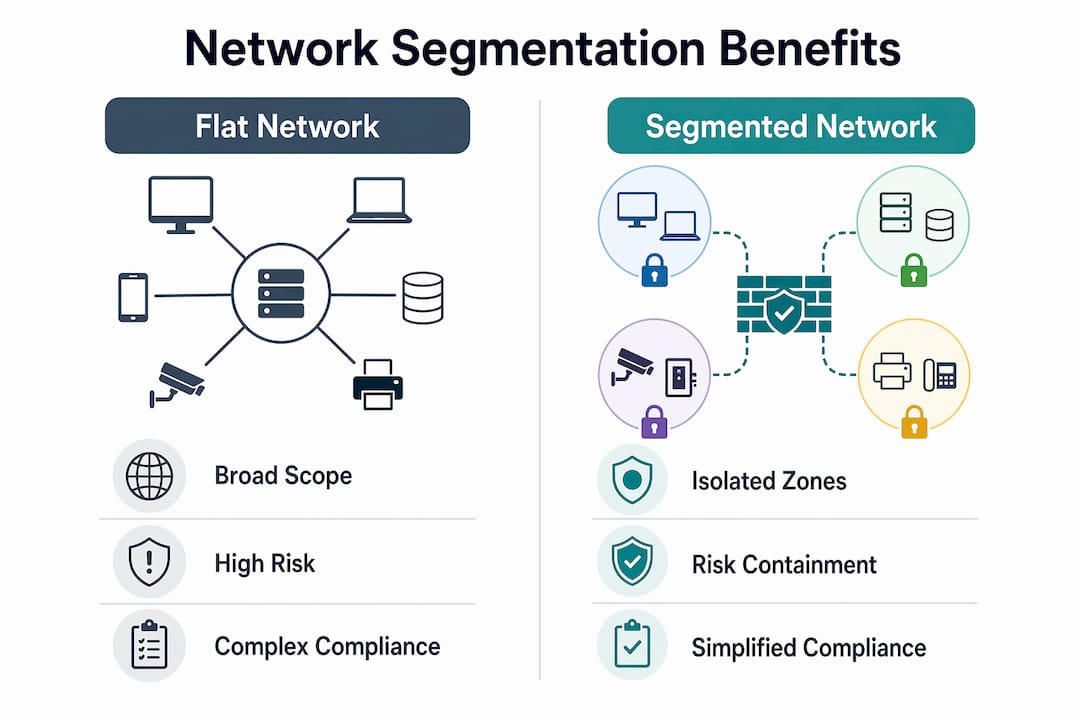
The compliance benefit is real but secondary. The primary benefit is containment. If an attacker does reach one terminal, segmentation stops them moving to your stock management system, your staff records, or your accounting software.
Pro Tip: Treat your guest Wi-Fi as a hostile network. Route it through a completely separate internet connection if possible, or at minimum enforce strict firewall rules that prevent any traffic from reaching the POS VLAN.
For businesses with multiple sites, consistent segmentation policy across every location is the hardest part to maintain. Cloud-managed firewall platforms make this significantly more manageable for small IT teams.
What encryption and authentication methods secure data transmission in POS networks?
Encryption and authentication are the two controls that protect payment data even when other defences fail. Together they form the last line of protection for cardholder information in transit.
Point-to-Point Encryption (P2PE) and TLS tunnels between POS devices and payment gateways ensure that card data is unreadable during transmission. P2PE encrypts data at the point of card interaction, before it ever touches your network. TLS protects the channel through which that data travels to the payment processor.
Protocol version matters. TLS 1.2 is the current minimum acceptable standard. TLS 1.0 and 1.1 contain known vulnerabilities and must be disabled on every device and gateway in your environment. Many older POS terminals still support these deprecated protocols by default.
Authentication controls to implement:
- Multi-Factor Authentication (MFA) for all administrative and remote access to POS systems
- Unique credentials per user with no shared administrator accounts
- Deny-by-default firewall rules that block all traffic not explicitly permitted
- Least privilege enforcement so each user and device accesses only what it needs
- Port and protocol restrictions closing all unused ports on POS network segments
Pro Tip: Audit your open ports quarterly. POS environments accumulate open ports over time as vendors request access for maintenance and never close them. Each open port is an unguarded entry point.
Zero-trust and identity-driven access models go further by continuously validating every user and device, not just at login but throughout each session. This approach eliminates the risk of shared credentials being misused by an insider or an attacker who has stolen a valid password. For securing POS transactions in high-volume retail environments, identity-based access is the direction the industry is moving.
How to manage third-party and vendor access risks in POS networks?
Third-party vendor access is the single most underestimated risk in POS network security. 30% of retail breaches in 2024 involved third-party vendor compromises, nearly double the figure from the previous year. That growth rate signals a deliberate shift in attacker strategy: target the vendor, reach the retailer.
The problem is structural. Vendors need access to install, update, and maintain POS software and hardware. That access, if left unmanaged, becomes a permanent open door into your payment environment.
A practical vendor access framework follows five steps:
- Apply least privilege from the start. Grant vendors access only to the specific systems they need, for the specific duration of the maintenance window. Never grant broad network access.
- Use a jump host or bastion server. Route all vendor sessions through a single controlled access point that logs every action. This creates a full audit trail and limits the blast radius if a vendor account is compromised.
- Set time-limited credentials. Vendor accounts should expire automatically after the maintenance window closes. Do not rely on manual revocation.
- Revoke credentials immediately post-maintenance. Immediate revocation after maintenance is the single most effective control against lingering vendor access being exploited weeks later.
- Review vendor security posture annually. Ask vendors for their own security certifications, patch management policies, and incident response procedures. Contractually require them to meet your security standards.
For further context on how vendor-originated breaches develop, the Ycr guide on retail POS data security covers the most common entry points and how to close them.
What practical steps maintain ongoing POS cybersecurity?
Ongoing security is an operational discipline, not a one-time project. The controls you put in place today degrade without active maintenance.
Patching is the most critical ongoing task. Emergency patching for critical network-reachable vulnerabilities should happen within 24–72 hours of a patch release. Lower-risk patches can be deferred to overnight maintenance windows to avoid disrupting trading hours. The key is a written policy that defines these thresholds, not ad hoc decisions.
Continuous monitoring catches what patching misses. Many POS terminals cannot run traditional antivirus, so network-layer monitoring using hardware gateways becomes the primary detection mechanism. Anomaly detection tools flag unusual traffic patterns, such as a terminal attempting to communicate with an external IP it has never contacted before.
Practical ongoing measures:
- Centralised, cloud-managed security platforms (such as SASE architectures) let small IT teams enforce consistent policies across every retail or hospitality site from a single console
- Quarterly vulnerability scans of the entire POS network segment, not just terminals
- Annual penetration testing to validate that segmentation and access controls work as intended
- Staff training covering credential hygiene, phishing recognition, and the correct procedure for reporting suspicious activity
Centralised cloud-managed platforms are particularly valuable for multi-site operators. A café group with ten locations cannot afford a dedicated IT security resource at each site. A cloud-managed platform applies the same firewall rules, monitoring policies, and access controls everywhere, automatically.
Employee training is consistently underinvested. A member of staff who clicks a phishing link on a back-office computer connected to the same network as POS terminals can trigger a breach that no technical control would have stopped. Training is a technical control in human form. For broader operational guidance, the Ycr resource on retail POS best practices covers staff-facing procedures alongside technical measures.
For e-commerce operators running POS alongside online channels, third-party security plugins for platforms like OpenCart can extend protection across retail security ecosystems where POS and web transactions intersect.
Key takeaways
Effective POS cybersecurity requires network segmentation, P2PE encryption, MFA, and continuous monitoring working together, not as isolated controls.
| Point | Details |
|---|---|
| Segmentation is non-negotiable | Isolate POS terminals in a dedicated VLAN to contain breaches and reduce PCI-DSS audit scope. |
| Vendor access is the fastest-growing risk | 30% of retail breaches involve third parties; revoke credentials immediately after every maintenance window. |
| Encryption protects data in transit | Use P2PE at the card reader and TLS 1.2 or above on every network channel between terminals and gateways. |
| Patching needs a written policy | Define emergency and routine patch windows in advance to close vulnerabilities without disrupting trading. |
| Monitoring compensates for agentless terminals | Deploy network-layer anomaly detection where antivirus cannot run on POS hardware. |
PCI-DSS is a floor, not a ceiling: what I’ve learned from POS security in practice
The most dangerous assumption I see business owners make is treating PCI-DSS compliance as the finish line. Pass the audit, tick the box, move on. That mindset is how breaches happen in businesses that are technically compliant.
PCI-DSS tells you the minimum. It does not tell you what your specific network looks like, where your vendors have been given excessive access, or which terminals are running software that has not been patched since the previous year. Those details are yours to find and fix.
The businesses that handle this well share one characteristic: they treat security as an operational process, not an annual audit event. They patch on a schedule. They review vendor access after every maintenance visit. They run vulnerability scans between audits, not just before them.
The hardest challenge for most retail and hospitality operators is scale. Managing consistent security across five sites is manageable. Managing it across fifty, with a two-person IT team, is a different problem entirely. Cloud-managed security platforms solve this, but only if you configure them correctly from the start. A misconfigured centralised platform gives you the illusion of control without the substance.
My honest view is that most POS security failures are not technical failures. They are process failures. Shared passwords that nobody changed. Vendor accounts that nobody revoked. Patches that nobody scheduled. The technology to prevent all of these exists and is affordable. The discipline to apply it consistently is what separates businesses that get breached from those that do not.
— John
Ycr’s POS solutions built for secure retail and hospitality operations
Ycr has supplied POS hardware and software to UK retail and hospitality businesses for over three decades. The SAMTOUCH POS software with hardware combines a purpose-built software platform with compatible terminals, designed to work within segmented network environments and support the access control configurations described throughout this guide.

For businesses that already have hardware in place, SAMTOUCH without hardware provides the software layer with the same security-compatible architecture. Ycr also offers POS terminals from trusted manufacturers including SAM4S and iMin, with next-day delivery and same-day dispatch across the UK. Speak to the Ycr team to find the right configuration for your network environment.
FAQ
What is network security in POS systems?
Network security in POS systems is the set of controls that protect payment terminals and the data they transmit from unauthorised access, malware, and interception. It includes network segmentation, encryption, access controls, and continuous monitoring.
What is the biggest security risk for POS systems?
The fastest-growing risk is third-party vendor access. 30% of retail breaches in 2024 involved compromised vendor credentials, nearly double the previous year’s figure.
Does PCI-DSS compliance make a POS system secure?
PCI-DSS compliance sets the minimum required standard but does not guarantee security. Businesses must add MFA, network segmentation, and continuous monitoring beyond what the standard requires.
How does network segmentation protect POS systems?
Segmentation places POS terminals in an isolated network zone, preventing an attacker who compromises one device from reaching other systems. It also reduces the scope of PCI-DSS audits.
How often should POS systems be patched?
Critical vulnerabilities with network reachability should be patched within 24–72 hours of release. Lower-risk patches should be applied during scheduled overnight maintenance windows to avoid disrupting operations.