
Table of Contents
- Introduction
- Key Takeaways Summary
- 1. Real-Time Stock Visibility Across Channels
- 2. Automated Reorder Points and Purchase Orders
- 3. Barcode Scanning and Rapid Goods-In Processing
- 4. Multi-Location Inventory Synchronisation
- 5. Variant Management for Complex Assortments
- 6. Shrinkage Control and Discrepancy Audits
- 7. Advanced Sales Reporting and Demand Forecasting
- 8. Seamless Integration with E-commerce Platforms
- Find your ideal POS system with YCR
- Frequently Asked Questions
- Recommended Reading
Key Takeaways Summary
| Feature / Benefit | Impact on Retail Operations | EPOS Integration |
|---|---|---|
| Real-Time Tracking | Eliminates manual counting errors and prevents stockouts. | Instant deduction upon every barcode scan at the till. |
| Automated Reordering | Maintains optimum stock levels without manual intervention. | Custom min/max thresholds trigger automated purchase orders. |
| Shrinkage Control | Identifies discrepancies between physical stock and system records. | Detailed stock audit logs and historical variance reporting. |
| Multi-Location Sync | Streamlines stock visibility across multiple shops and warehouses. | Cloud-connected database updates all branches simultaneously. |
Introduction
Effective stock control is the cornerstone of any profitable retail operation. For UK resellers, independent shop owners, and enterprise retailers alike, balancing inventory levels requires precision, speed, and reliability. Traditional manual spreadsheets and outdated ledger systems are no longer sufficient to meet modern consumer expectations.
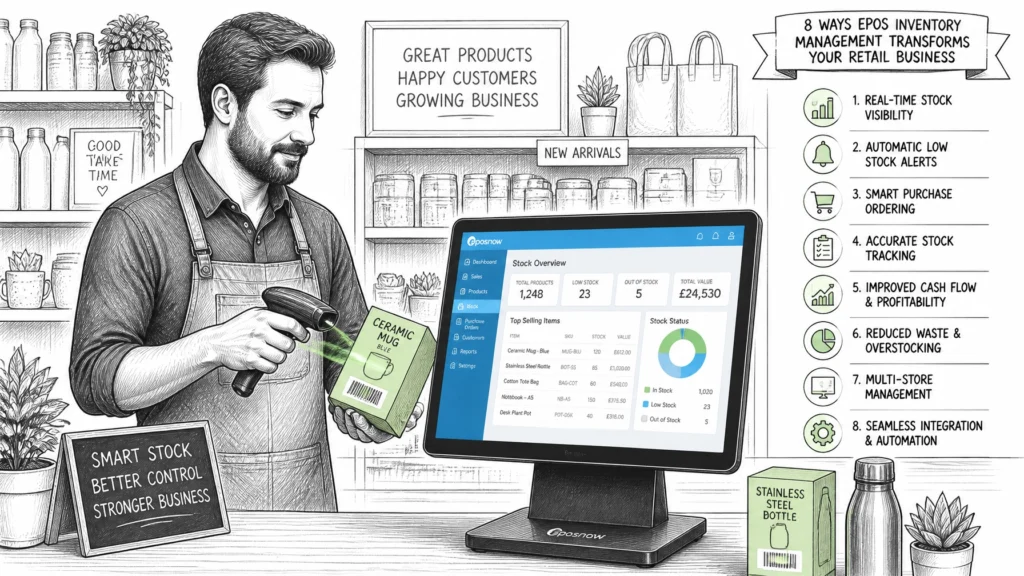
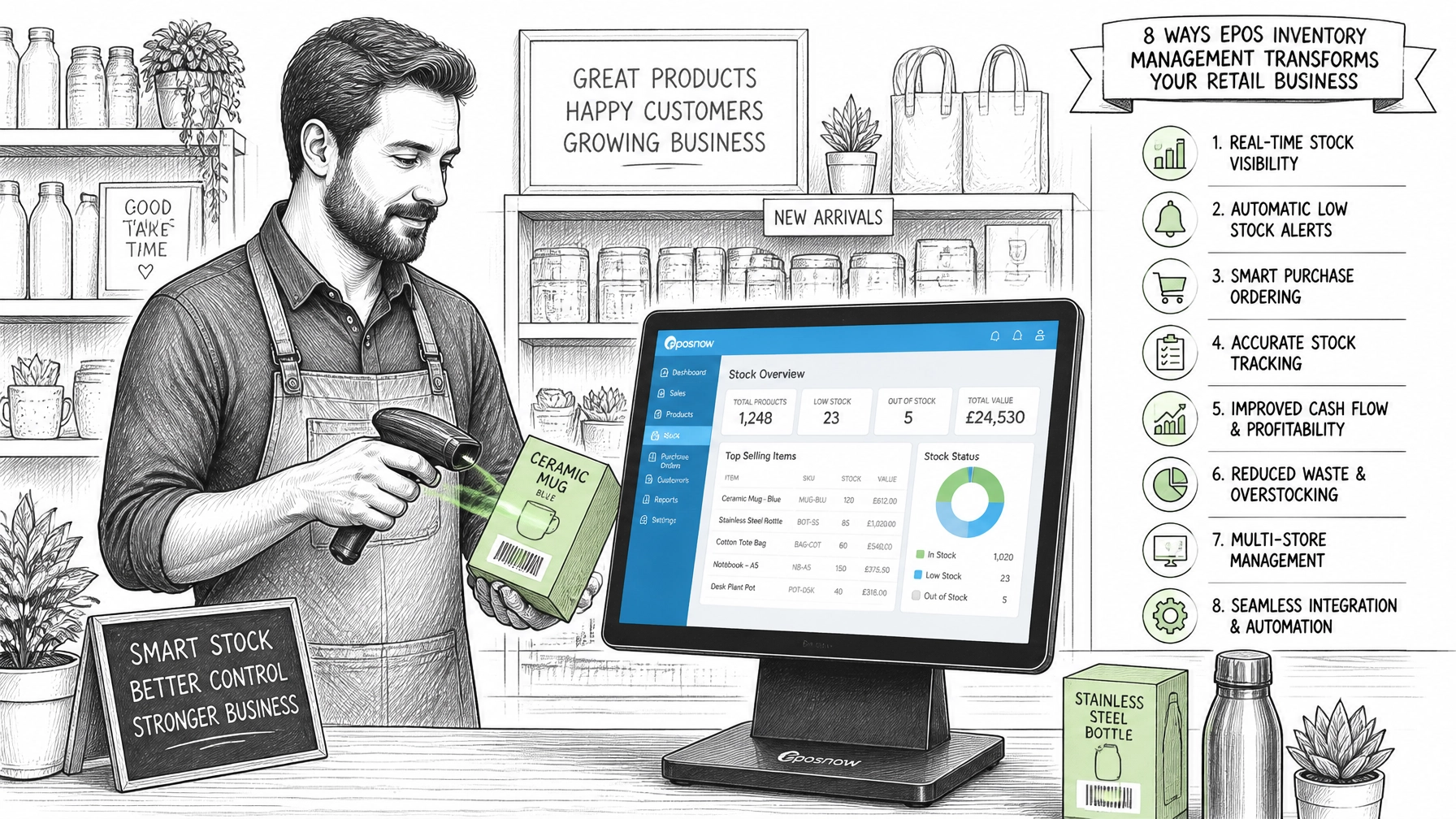
At YCR Distribution, we work closely with our nationwide network of dealers and system integrators to supply robust point of sale solutions. By deploying advanced EPOS inventory management software, businesses can move away from guesswork and embrace data-driven stock control. Below, we explore eight powerful ways EPOS inventory management transforms retail operations, driving efficiency and profitability.
1. Real-Time Stock Visibility Across Channels
Maintaining an accurate view of stock levels is essential for avoiding both dead stock and out-of-stock scenarios. With traditional stock-taking methods, inventory records are often outdated the moment physical counts are completed.
An integrated EPOS system updates inventory levels instantly with every transaction. Whether an item is sold over the counter, returned by a customer, or dispatched online, the central database adjusts immediately. This real-time visibility ensures that sales staff on the shop floor and managers in the back office operate from the exact same dataset.
Pro Tip: Pair your core system with our high-performance pos-terminals/ hardware range to ensure lightning-fast transaction processing and uninterrupted inventory synchronisation.
2. Automated Reorder Points and Purchase Orders
Running out of bestselling products damages customer loyalty and results in lost revenue. Conversely, over-ordering ties up critical working capital in slow-moving stock.
Modern EPOS software allows retailers to establish minimum and maximum stock thresholds for every item in their catalogue. When inventory for a specific SKU drops to the predefined reorder point, the system can automatically generate a purchase order or alert the procurement team. This proactive approach ensures continuous shelf availability while maintaining lean working capital.
3. Barcode Scanning and Rapid Goods-In Processing
Manual data entry is one of the leading causes of inventory discrepancies in retail environments. Miskeyed SKUs or incorrect quantity counts during deliveries cascade into systematic errors across accounts and sales reports.
By implementing comprehensive barcode scanning at goods-in and checkout, staff can process deliveries and customer purchases in seconds. Scanning an incoming delivery carton updates the warehouse inventory instantly, verifying supplier shipments against purchase orders with absolute accuracy.
Explore our dedicated shop-2/ section for reliable barcode scanners, mobile terminals, and receipt printers designed for heavy-duty retail environments.
4. Multi-Location Inventory Synchronisation
Managing stock across multiple retail branches, pop-up shops, or warehouses presents unique logistical challenges. Without centralized oversight, retailers often struggle to locate surplus stock that could fulfill demand at another under-stocked site.
Cloud-enabled EPOS solutions provide a unified master inventory across all business locations. If a customer requires an item that is out of stock in your Manchester branch, staff can instantly check availability in your Birmingham warehouse or Leeds store, arranging inter-branch transfers seamlessly.
5. Variant Management for Complex Assortments
Retail sectors such as fashion, footwear, and specialty hardware deal with immense product variations: tracking items by size, colour, style, and material. Manual tracking of matrix inventories quickly becomes unmanageable.
Advanced EPOS inventory management handles product variants effortlessly. Each size and colour combination is assigned a unique sub-SKU linked to a parent product. When a size 10 black shoe is sold, the system precisely deducts that specific variant, leaving other sizes untouched and ensuring accurate reordering for popular sizes.
6. Shrinkage Control and Discrepancy Audits
Stock shrinkage: caused by theft, administrative error, or supplier discrepancies: eats directly into retail profit margins. Identifying where and when stock is disappearing is notoriously difficult without digital tracking.
EPOS systems generate comprehensive audit trails, tracking every adjustment, return, and discount applied at the terminal. Regular cycle counts combined with system discrepancy reports allow managers to pinpoint stock variances quickly, tightening security and refining operational workflows.
Pro Tip: Integrate user permission levels within your EPOS software so that only authorized supervisors can process stock write-offs, price overrides, or inventory adjustments.
7. Advanced Sales Reporting and Demand Forecasting
Inventory management is not just about counting what is on the shelf; it is about understanding sales velocity and consumer purchasing patterns.
EPOS reporting tools analyze historical sales data to highlight top-performing products, seasonal trends, and slow-moving inventory. Armed with these insights, buyers can make informed purchasing decisions, plan targeted promotions, and phase out unprofitable product lines before they require deep discounting.
For businesses expanding into food service or hybrid retail-hospitality formats, our specialized insights on why-use-pos-for-catering-efficiency-service-2026 offer additional strategies for operational efficiency.
8. Seamless Integration with E-commerce Platforms
Today’s consumers expect a unified shopping experience, moving effortlessly between physical brick-and-mortar stores and online webshops. When online and offline stock databases operate in silos, retailers face the risk of overselling items.
Modern EPOS solutions integrate directly with e-commerce platforms and marketplace channels. When an online customer purchases the last remaining unit of a product, your in-store EPOS terminal updates instantly, preventing shop floor staff from promising the same item to an in-store shopper.
For powerful software integration, explore leading platforms like Samtouch for intuitive control over retail and hospitality workflows.
Find your ideal POS system with YCR
At YCR Distribution, we pride ourselves on over three decades of industry experience, supporting resellers, dealers, and system integrators across the UK. Whether you are upgrading a single boutique or rolling out an enterprise-grade multi-site retail network, our team provides robust hardware, bespoke software solutions, and unrivaled technical support.
Explore our comprehensive retail-point-of-sale/ collections and flexible Tablets hardware to deliver exceptional value and reliability to your retail clients. Contact our expert team today to discuss your next POS project.
Frequently Asked Questions
What is EPOS inventory management?
EPOS inventory management is a digital system that automatically tracks stock levels, sales, returns, and deliveries in real time using point-of-sale hardware and software. Every time a product is scanned and sold, inventory counts adjust instantly across your database.
How does real-time stock control prevent stockouts?
Real-time tracking provides accurate counts and allows retailers to set minimum stock thresholds. Once stock reaches the reorder point, the system triggers automated purchase orders or alerts, ensuring replenishment orders are placed before shelves empty.
Can EPOS systems manage multi-location retail businesses?
Yes. Modern cloud-based EPOS platforms maintain a centralized master inventory that synchronizes stock data across multiple physical stores, warehouses, and online e-commerce channels simultaneously.
How do barcode scanners improve stock accuracy?
Barcode scanning eliminates manual data entry errors during goods receipt and checkout. Scanning items ensures exact SKU matching, fast processing speeds, and precise inventory record updates.