
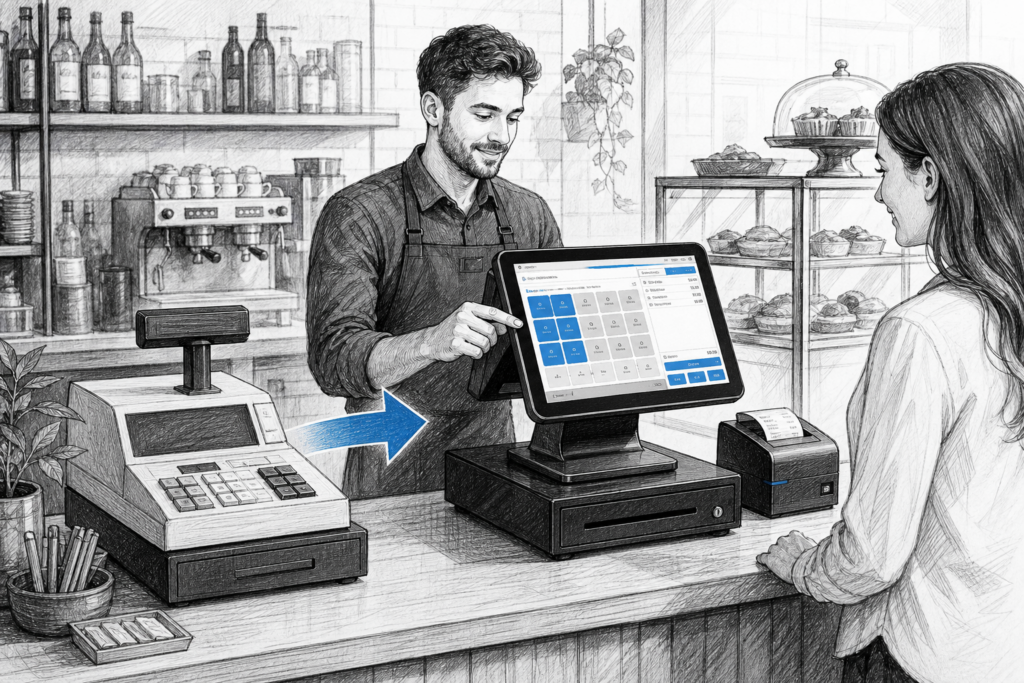
Across the UK, more retailers and hospitality businesses are moving away from traditional tills and towards modern EPOS systems. The change is not simply about having a touchscreen on the counter. It is about running the checkout, stock, reporting and day-to-day operations in a more reliable and flexible way.
For many businesses, the decision is being driven by ageing hardware, changing customer expectations and the need for better control. A basic till may still take payments and print receipts, but it often falls short when a business needs faster service, better reporting or the ability to adapt as it grows.
What is changing at the point of sale?
Point of sale in the UK has changed significantly over the last few years. Retailers and hospitality operators now expect more from their checkout technology. Staff need to process sales quickly, managers need visibility over performance, and customers expect a smooth experience whether they are shopping in a convenience store, ordering in a café or paying for a meal in a busy pub.
Modern EPOS systems are designed to support that. Instead of acting as a standalone till, they can form part of a wider business setup, connecting sales, product data, reporting and peripherals such as barcode scanners, customer-facing displays and receipt printers.
For a growing business, that difference matters. It can reduce manual work, improve accuracy and make it easier to introduce new services or trading formats later on.
Why businesses are replacing older till hardware
One of the main reasons businesses upgrade is simply that older tills are no longer keeping pace with how they trade. A traditional cash register may be dependable for basic transactions, but it can become limiting when the business needs more detailed sales reporting, better product lookup or tighter staff controls.
Common triggers for an upgrade include:
- longer queues at busy times
- difficulty managing promotions or discounts
- limited reporting for owners and managers
- ageing hardware that is harder to maintain
- the need to support card payments, digital receipts or other connected devices
- expansion to new sites or additional checkout points
When these issues start to affect daily trading, a modern EPOS system often becomes a practical investment rather than a nice-to-have upgrade.
What modern EPOS systems offer
Modern POS systems UK businesses use are usually more adaptable than older tills. They may use touchscreen POS hardware, a standard computer-based setup or Android POS devices depending on the size and style of the operation. The advantage is not just the hardware itself, but the way the system can support everyday tasks more cleanly.
Better speed at busy times
A well-planned POS terminal can help staff work faster at the counter. Clear menus, touch operation and connected peripherals make it easier to process sales without unnecessary steps. That is especially useful in cafés, quick-service restaurants, convenience stores and other busy environments where queues can form quickly.
Improved reporting
Modern EPOS hardware and software can make it easier to review trading patterns, identify peak times and see which products or menu items are performing well. For business owners, that means less guesswork and more informed decisions.
More control for managers
Staff permissions, void controls and transaction logs can all help reduce mistakes and improve accountability. These are especially useful in hospitality EPOS environments where different team members may use the same terminal during a shift.
Easier scaling
If a business grows, a modern system is usually easier to expand. That might mean adding another till point, introducing a kitchen printer, fiting a customer display or supporting multiple sites under one reporting structure.
Windows POS versus Android POS
One of the common questions in the UK point of sale market is whether a business should choose Windows POS or Android POS. The right answer depends on what the business needs, the software being used and the type of environment the hardware must support.
Windows systems are often chosen where businesses want a familiar desktop-style environment or need to connect to established EPOS software and hardware workflows. Android POS is often attractive where businesses want a simpler, compact interface and hardware designed specifically for touchscreen use.
Rather than thinking in terms of which platform is universally better, it is more helpful to consider how each one fits the day-to-day demands of the site. A reseller, installer or EPOS distributor UK businesses trust should be able to help shoppers compare options based on real operational needs.
Practical considerations when planning an EPOS upgrade
Before replacing ageing POS equipment, it helps to look at the business as a whole. A new terminal alone will not solve every problem if workflow, peripherals and software settings are overlooked.
Useful questions to ask include:
- How busy is the checkout during peak periods?
- Does the business need one terminal or several?
- Will staff need barcode scanning, receipt printing or customer-facing displays?
- Is the current setup aimed at retail, hospitality or mixed use?
- Does the business need simple transaction processing or broader operational control?
Answering these questions early makes it easier to choose the right POS hardware UK businesses can rely on and avoids installing a system that looks modern but does not actually suit the workflow.
Why UK support matters
For many businesses and resellers, local support is just as important as the equipment itself. EPOS systems are often chosen because they need to keep working through busy trading periods, so access to practical advice, compatible hardware and responsive supply can make a real difference.
YCR Distribution supports EPOS dealers, resellers, installers and business customers across the UK with point of sale hardware and related technology. That kind of UK-based product knowledge can help with planning a new installation, replacing older equipment or sourcing the right hardware for a specific retail or hospitality application.
Choosing a modern POS setup that fits the business
There is no single setup that suits every retailer or hospitality venue. A small café may need a compact touchscreen POS terminal with straightforward operation. A multi-site retailer may need a more connected and scalable EPOS system. A busy takeaway may prioritise speed, simplicity and reliable printing. The key is matching the technology to the way the business actually works.
As customer expectations continue to rise, the role of the point of sale is becoming broader than ever. It is no longer just the place where money changes hands. It is a central part of how the business serves customers, manages stock, monitors performance and supports staff.
For more information about point-of-sale hardware and EPOS solutions, contact YCR Distribution on 01924 438238 or visit www.ycr.co.uk.
Whether a business is upgrading from a basic till or planning a more complete EPOS refresh, taking time to choose the right system can pay off in day-to-day efficiency and longer-term flexibility.