
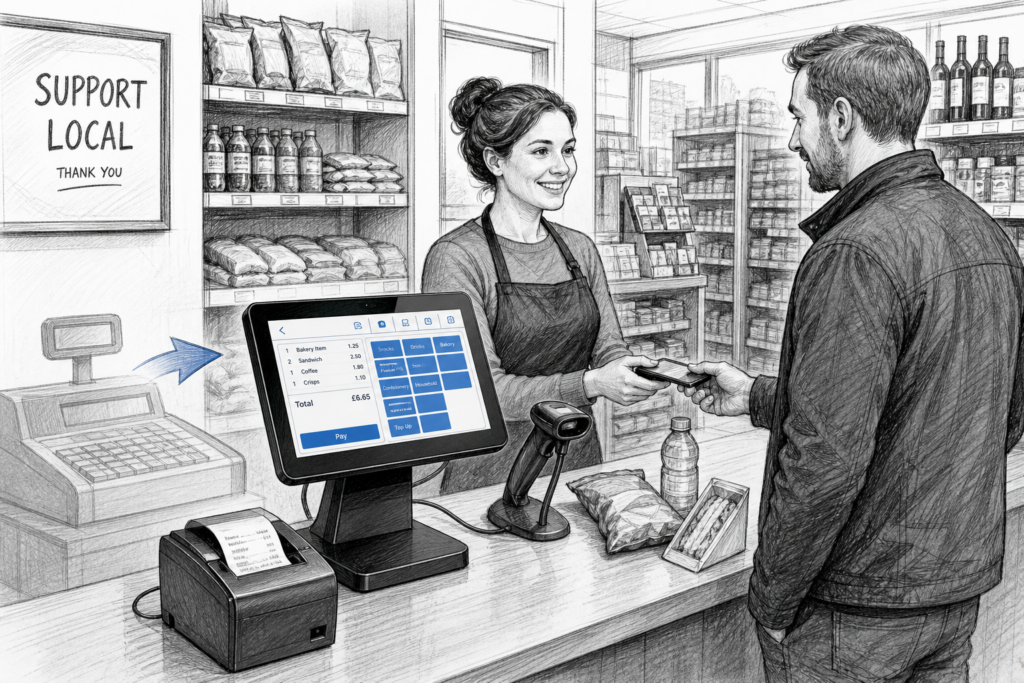
Across the UK retail sector, the traditional basic till is being replaced by modern EPOS systems that do far more than take payments. For many businesses, the change is not about technology for its own sake. It is about speeding up transactions, improving visibility of sales, and giving staff the tools they need to serve customers properly.
In convenience stores, garden centres, farm shops, fashion outlets and multi-department stores, the point of sale has become a central part of how the business operates. A well-chosen EPOS system can help with stock enquiries, promotions, reporting and staff control, while a basic till usually offers very little beyond simple transaction processing.
What is driving the move away from basic tills?
One of the biggest reasons businesses upgrade is that customer expectations have changed. Shoppers now expect quicker checkout times, clearer receipts and smoother service. In busy retail environments, especially during peak trading periods, a slow or limited till can create queues and frustrate both staff and customers.
Modern EPOS systems also make it easier to manage everyday tasks. Instead of relying on manual notes or separate systems, retailers can often access sales data, item look-up, discount handling and user permissions from a single interface. That can reduce mistakes and save time at the counter.
Ageing hardware is another issue. A basic till that has been in service for years may still work, but it may no longer suit the way the business trades. If replacement parts are difficult to source or the system cannot keep up with changing operational needs, it is usually more practical to plan an upgrade rather than wait for failure.
How modern EPOS improves day-to-day retail operations
Modern point-of-sale UK systems are designed to support the wider business, not just the transaction itself. For retailers, that can make a noticeable difference in several areas:
- Faster checkouts, which help reduce queues and improve the customer experience.
- Better product lookup, making it easier for staff to find items, prices and category details.
- More controlled discounts and promotions, helping stores apply offers consistently.
- Sales reporting that gives owners or managers a clearer view of trading patterns.
- Staff permissions that help limit sensitive actions to authorised users.
For a busy independent shop, these functions can mean less time spent correcting problems and more time focused on serving customers. For larger operators, they can also improve consistency between stores and support better decision-making across the business.
Why hardware choice matters as much as the software
When retailers think about EPOS upgrades, the software often gets most of the attention. In practice, the hardware matters just as much. A touchscreen POS terminal, receipt printer, barcode scanner and customer-facing display all need to work reliably together in a retail setting.
Commercial-grade POS hardware is built for regular use and generally offers a more suitable experience than consumer equipment such as an office computer or tablet. It is designed for the checkout environment, where staff may be using the system all day and need something stable, straightforward and durable.
Retailers should think about how their hardware will be used. A compact till point in a small deli has different requirements from a multi-counter hardware store or a garden centre with seasonal peaks. The right combination of terminal and peripherals can improve workflow without making the counter feel cluttered.
For resellers and installers, compatibility planning is essential
EPOS dealers and installers know that a successful installation depends on more than the equipment itself. Cable layout, counter space, peripheral matching and support arrangements all affect the end result. That is why many resellers work with a specialist POS distributor in the UK who understands the practical side of installation and can help match hardware to the business need.
YCR Distribution supports the UK EPOS channel with POS hardware and related technology for resellers, installers and businesses. For projects that involve replacing outdated equipment, planning a new checkout or standardising hardware across sites, that kind of product knowledge can save time and reduce disruption.
What retailers should consider before upgrading
Before replacing a basic till, it helps to look at how the business actually trades rather than starting with a long list of features. A useful EPOS system should fit the counter, the workflow and the level of staff training available.
- Transaction volume: How busy is the checkout during peak times?
- Store layout: Is there space for a touchscreen terminal, printer and scanner?
- Reporting needs: Does the business need simple takings data or more detailed sales analysis?
- Staff access: Do different users need different permissions?
- Growth plans: Is the business likely to open more sites or add new services?
Asking these questions early helps avoid buying a system that solves today’s problem but creates a new one later. It also gives resellers and installers a clearer brief when recommending hardware or planning a replacement.
The role of modern POS in customer service
Although EPOS systems are often discussed in terms of efficiency, they also affect the customer experience. A quicker checkout, clearer screen prompts and fewer errors at the till all contribute to a smoother interaction. In retail, that can make the difference between a routine sale and a memorable service experience.
Modern systems can also support staff confidence. When it is easy to find items, apply the right price and handle common tasks, employees can concentrate more on the customer and less on the technology. That is particularly useful in businesses with seasonal staff or part-time teams, where training time may be limited.
Choosing the right path for your business
Not every retailer needs the same EPOS setup, but many are finding that the old model of a simple till is no longer enough. Whether the goal is to cut queue times, improve reporting or prepare for future growth, modern POS systems UK businesses rely on can offer a far more flexible foundation.
For EPOS resellers and business owners alike, the key is to choose hardware and software that match the work being done at the counter. That usually means thinking beyond basic transactions and focusing on how the system will support the business every day.
For more information about point-of-sale hardware and EPOS solutions, contact YCR Distribution on 01924 438238 or visit www.ycr.co.uk.