
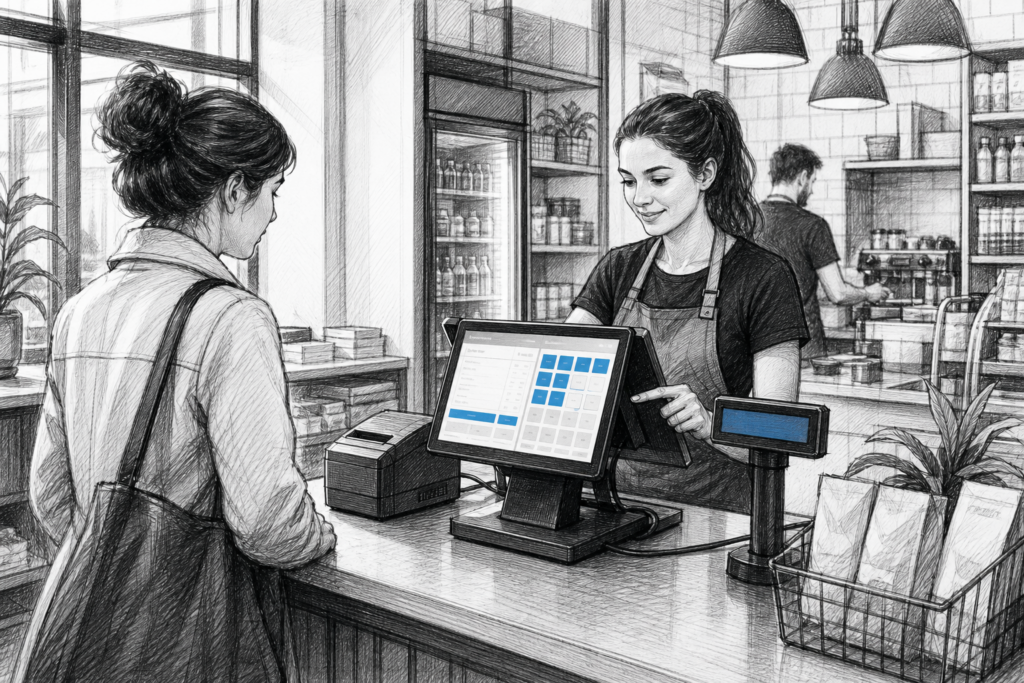
For many UK retailers, cafés and restaurants, the checkout area has become more than a place to take payment. It is now the working centre of the business, where orders are entered, receipts are printed, customer questions are handled and service speed is measured minute by minute. That is one reason integrated POS hardware has become such an important part of modern EPOS planning.
Instead of treating terminals, printers and customer-facing devices as separate items to be added later, integrated POS hardware brings together the main point-of-sale functions in a more coordinated setup. In practical terms, that can mean less clutter on the counter, fewer cables to manage and a setup that is easier for staff to learn and use every day.
What integrated POS hardware means on the shop floor
Integrated POS hardware usually refers to equipment that is designed to work together as a single counter solution, rather than a collection of unrelated devices. In a retail environment, that may include a touchscreen POS terminal, a receipt printer and a customer display positioned so the staff member and customer can both interact with the system naturally. In hospitality, the same approach can help with order entry, bill presentation and front-of-house efficiency.
The main benefit is not simply appearance. A tidier installation often means better working conditions for staff, easier cleaning around the till point and fewer weak points caused by loose or awkward connections. For businesses with several counters, standardising the hardware layout can also make training simpler and reduce variation between sites.
Why counter design affects day-to-day performance
Busy counters tend to expose small design problems very quickly. If the receipt printer is hidden too far away, the customer-facing display is hard to read or the terminal takes up too much space, staff lose time adjusting to the layout. Over a whole trading day, those small delays add up.
Integrated POS hardware helps solve that by creating a more deliberate workflow. The screen is easier to reach, the printer is typically placed where the operator can use it quickly and the customer-facing side is positioned to support clear communication. In hospitality, where staff may be dealing with table service, takeaway orders and collection requests at the same time, that coordination matters just as much as raw hardware performance.
It is also easier to plan around power and data connections when the system is designed as a complete counter solution. That is especially useful for new openings, refits and rollouts where the equipment must fit within a fixed footprint.
Which businesses benefit most
Integrated POS hardware is particularly useful where space, speed and consistency matter. Typical examples include:
- convenience stores and small retail checkouts
- cafés and quick-service restaurants
- pubs and bars with mixed food and drink ordering
- takeaways and collection counters
- specialist retailers with limited counter space
- multi-site operators looking for a consistent layout
For these businesses, a well-planned terminal and peripheral setup can support smoother service and reduce frustration for staff. It can also make it easier for managers to introduce a standard operating pattern across locations.
Choosing the right combination of terminal and peripherals
The key is to think about workflow before hardware. A business that prints receipts at the counter, for example, may want a terminal and receipt printer arrangement that keeps the operator moving in one direction with minimal hand movement. A hospitality site may need a layout that supports quick order entry and clear customer communication, while a retail environment may place more emphasis on barcode scanning and a clean customer handover area.
When reviewing integrated POS hardware, it is worth asking practical questions such as:
- How much counter space is available?
- Will staff need to move quickly between order entry and receipt printing?
- Is a customer-facing display required?
- Will the hardware need to suit one counter or several identical tills?
- How easy will it be to service or replace a component later?
That last point is often overlooked. A system that looks neat on day one should still be maintainable after months or years of service. For EPOS resellers and installers, serviceability is just as important as first impressions.
Why serviceability matters to resellers and installers
For EPOS dealers and installers, integrated POS hardware can simplify deployment, but only if the equipment remains practical to support. Businesses do not just need a counter that works now; they need a setup that can be maintained when printers require replacement, terminals are upgraded or a new lane is added.
This is where UK distribution and support become especially valuable. A supplier such as YCR Distribution can help resellers and business owners think beyond a single device and plan a complete hardware mix that suits the working environment. That support is important when standardising equipment across multiple sites or when replacing older hardware in stages rather than all at once.
For businesses with existing EPOS systems, it can also be helpful to consider whether the current counter layout makes everyday tasks harder than they need to be. Often, a better hardware arrangement brings noticeable operational benefits without requiring a complete rethink of the software.
A practical approach to modern POS planning
Integrated POS hardware is not about adding more technology for its own sake. It is about building a counter setup that helps staff work efficiently, keeps the environment organised and supports consistent service. In retail and hospitality alike, those are the qualities that tend to matter most once the doors are open and trading begins.
Whether a business is opening a new site, planning an EPOS upgrade or replacing ageing till equipment, it is worth looking at the whole workstation rather than each device in isolation. A well-matched terminal, printer and display combination can make the point of sale easier to manage every day.
For more information about point-of-sale hardware and EPOS solutions, contact YCR Distribution on 01924 438238 or visit www.ycr.co.uk.