
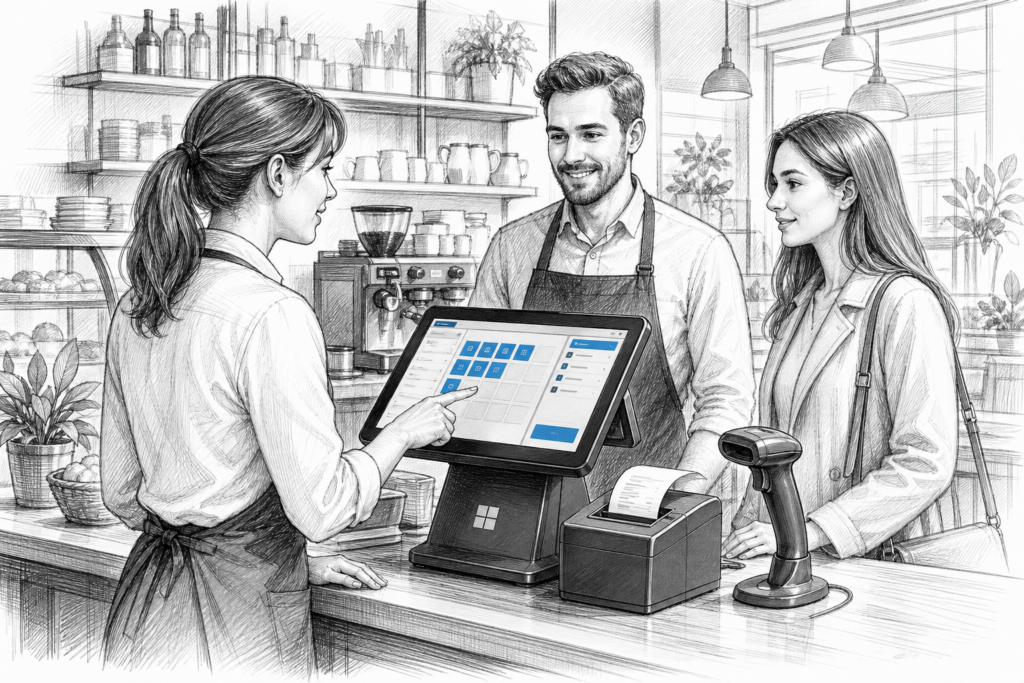
For many UK retailers and hospitality venues, the decision to upgrade a point of sale system starts with the terminal itself. A Windows POS terminal is often chosen when a business needs commercial hardware that can support established EPOS software, handle busy front-of-house use and fit neatly into an existing installation.
That sounds straightforward, but the right choice depends on more than screen size or appearance. The terminal has to suit the working environment, the software stack, the level of support required and the way staff actually use the counter. For EPOS resellers and installers, those factors matter just as much as the specification sheet.
Why Windows POS terminals remain relevant
Windows POS hardware is still widely used across retail and hospitality because many businesses value continuity. If a shop, café, pub or restaurant already relies on a Windows-based EPOS package, moving to purpose-built POS hardware can be a more practical step than replacing the whole software estate.
Unlike a conventional office computer, a proper POS terminal is designed for a counter environment. It usually prioritises a compact footprint, easier cable management and operation from a touchscreen interface. That can make a real difference at a checkout where space is limited and staff need to work quickly.
What makes a POS terminal different from a standard PC
A standard desktop PC can run EPOS software, but it is not always the best fit for a trading counter. A commercial Windows POS terminal is typically designed to be used in places where equipment is constantly handled, where peripherals are connected permanently and where downtime can interrupt trading.
In practical terms, businesses often look for a terminal that supports neat, fixed installation rather than a cluttered desk setup. That can help with:
- a cleaner front-of-house appearance
- easier connection to printers, scanners and cash drawers
- more predictable day-to-day operation
- simpler maintenance for installers and support teams
For busy retail counters and hospitality service points, those benefits often matter more than raw processing power alone.
Planning the right Windows POS setup
Choosing hardware starts with understanding how the terminal will be used. A convenience store checkout has different demands from a table-service restaurant or a takeaway counter. The right setup should reflect the pace of service, the number of transactions, the peripherals required and the space available.
For example, a retailer may need a Windows POS terminal paired with a barcode scanner and receipt printer for fast till-point processing. A hospitality venue may focus more on order entry, kitchen printing and customer-facing interaction. In both cases, the terminal needs to support the workflow without creating extra steps for staff.
Questions to ask before specifying hardware
- Will the EPOS software stay in place after the upgrade?
- Is the terminal intended for retail, hospitality or a mixed environment?
- How many peripherals need to connect at the counter?
- Will the site benefit from a touchscreen format?
- Does the installer need hardware that is straightforward to service?
Answering those questions early can save time later, especially where multiple sites need consistent equipment.
Why support and serviceability matter
One of the main reasons businesses choose commercial POS hardware is supportability. If a terminal fails or needs replacement, the business needs a solution that can be integrated into the wider EPOS setup with minimal disruption. That is particularly important for resellers and installers managing several customers or planning standard hardware across locations.
Serviceability also affects the lifespan of an installation. Businesses that want to extend the life of existing equipment may prefer a Windows POS terminal that fits a known support model, with well-understood deployment and upgrade pathways. That can make future maintenance more manageable than relying on generic hardware built for office use.
Where a Windows terminal fits best
Windows POS terminals are often a strong choice for:
- independent retailers replacing ageing till hardware
- hospitality sites that already use Windows-based EPOS software
- resellers looking to standardise installations across multiple customers
- multi-site operators that value consistency and support planning
- businesses that need a dedicated touchscreen POS terminal rather than a consumer tablet
They are particularly useful when the goal is to keep the software environment familiar while improving the hardware underneath it. That can help reduce staff retraining and keep the upgrade focused on reliability, usability and support.
Working with a UK POS distributor
For installers and dealers, choosing equipment through an experienced UK POS distributor can make the specification process easier. YCR Distribution works with EPOS resellers, installers and business owners who need practical advice on POS hardware UK requirements, from terminal selection through to printers and related peripherals. That kind of support is valuable when a project needs hardware compatibility checked against a real-world installation rather than a generic product listing.
If you are planning a broader EPOS refresh, it can help to review the wider hardware mix at the same time. A terminal, receipt printer and customer-facing setup often work best when selected as part of one coherent solution rather than as separate purchases.
For more information about point-of-sale hardware and EPOS solutions, contact YCR Distribution on 01924 438238 or visit www.ycr.co.uk.
Choosing with the long term in mind
The best Windows POS terminal is not simply the one with the most features. It is the one that fits the business today and can still be supported as trading needs change. For many UK retail and hospitality sites, that means choosing hardware that is commercial grade, easy to integrate and suitable for future maintenance.
When a terminal is selected carefully, it can help the business improve checkout speed, reduce operational friction and support a more stable EPOS environment. That is why Windows POS hardware remains an important part of the UK point-of-sale market.