
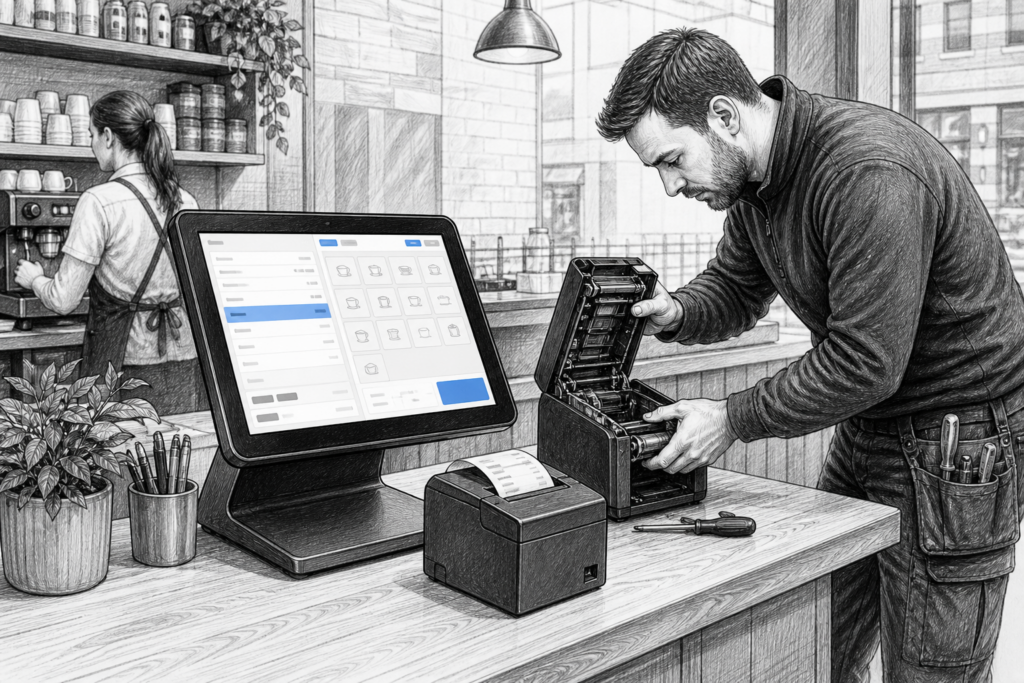
When a checkout or counter system fails, the issue is rarely just the hardware itself. It can slow queues, disrupt service, hold up orders and create extra pressure on staff. For many UK retailers and hospitality businesses, the real question is not simply whether a POS terminal or printer works well on day one, but whether it can be supported, repaired and kept in service over time.
That is why serviceability has become an important consideration in point of sale UK planning. Whether you are replacing ageing EPOS hardware, standardising equipment across sites or advising customers as an installer or reseller, hardware that can be maintained sensibly is often a better long-term choice than equipment that is difficult to access, diagnose or repair.
What serviceable POS hardware means in practice
Serviceable POS hardware is equipment that can be maintained without unnecessary disruption. In practical terms, that may mean a receipt printer with replacement parts available, a terminal design that supports straightforward servicing, or a product family that is familiar to EPOS engineers and support teams.
For retailers, that can mean less downtime at the till and fewer emergency replacements. For cafés, restaurants, pubs and takeaways, it can mean faster recovery if a front-of-house printer, kitchen printer or touchscreen terminal develops a fault during trading hours. For installers and dealers, it can mean being able to support a customer more efficiently because the hardware has a practical lifecycle rather than being treated as a sealed replacement item.
Why repairability matters in busy trading environments
In a busy environment, POS equipment is worked hard. Terminals are touched constantly, printers produce high volumes of receipts and order tickets, and operators often rely on the same hardware for years. Over time, common wear points can appear. The value of serviceable design is that these issues do not automatically force a full system replacement.
That matters for several reasons:
- it can reduce the cost and disruption of replacing complete devices unnecessarily
- it helps businesses extend the working life of installed EPOS equipment
- it gives resellers and installers more options when support is required
- it can make planning spares and replacements more practical across multiple sites
For many businesses, the most expensive part of a hardware failure is not the component itself, but the interruption to trading. A repairable and supportable device can make the difference between a short maintenance visit and a full checkout outage.
Where serviceability is especially useful
Some parts of a POS installation are more likely to benefit from serviceable hardware than others. Receipt printers are a good example because they are often running throughout the day and may need attention to cutters, print mechanisms or other replaceable parts. In foodservice, kitchen printers can be exposed to heat, steam and constant use, so the ability to maintain them matters even more.
Touchscreen terminals also benefit from a sensible support strategy. In retail and hospitality, a terminal is not a disposable accessory; it is the operator’s main working tool. If a screen, interface board or internal assembly can be supported properly, that can protect the investment and reduce the risk of lengthy downtime. Even simple things, such as having the right spare parts available, can help a dealer or service company respond faster.
Examples of useful applications
- independent retailers that want to keep tills operational without frequent full replacements
- cafés and quick-service sites that depend on order printing and fast issue resolution
- multi-site operators that need a consistent support plan across locations
- EPOS resellers that want to offer stronger after-sales support to customers
How this affects EPOS resellers and installers
For EPOS professionals, serviceable hardware creates a more manageable support model. Instead of treating each fault as a complete swap-out, a reseller can often assess the issue against the available parts, the product design and the practical service path. That can help with planned maintenance, spare unit holdings and long-term customer support.
It also improves confidence when specifying systems for new installations. A business owner may not ask about repairability first, but they will notice it later if a terminal or printer can be supported without major disruption. In that sense, serviceability is not only a technical feature; it is part of the commercial value of the installation.
Choosing the right hardware for a longer lifecycle
When selecting POS hardware, it is worth asking a few straightforward questions:
- Are replacement parts or component-level solutions available where appropriate?
- Can the hardware be supported by an EPOS dealer or installer with practical product knowledge?
- Does the range include models or spares that make future replacement planning easier?
- Will the product fit the business’s daily working environment without unnecessary complexity?
These questions apply to retail EPOS, hospitality EPOS and broader POS hardware UK requirements. They are especially important where a business expects to keep the system in service for many years, or where a reseller needs to support several customer sites with similar equipment.
The role of UK-based support
One advantage of buying through an experienced POS distributor UK is access to guidance that goes beyond the product datasheet. UK-based support can help dealers and business owners choose equipment that suits the environment, identify sensible replacement paths and source the right products or components when maintenance is required. That is particularly valuable when trying to keep existing installations functioning while planning for future upgrades.
YCR Distribution works with EPOS resellers, dealers, installers and end users who need dependable point-of-sale hardware and practical advice. If a business is trying to reduce downtime, extend the life of installed equipment or plan a more supportable POS estate, that local product knowledge can be as important as the hardware itself.
For more information about point-of-sale hardware and EPOS solutions, contact YCR Distribution on 01924 438238 or visit www.ycr.co.uk.
In a market where retail and hospitality operators expect more from their checkout and counter systems, serviceability deserves attention. The best-known specifications are not always the most useful ones; often, it is the ability to maintain, support and replace parts sensibly that determines whether a POS investment continues to pay off over time.