
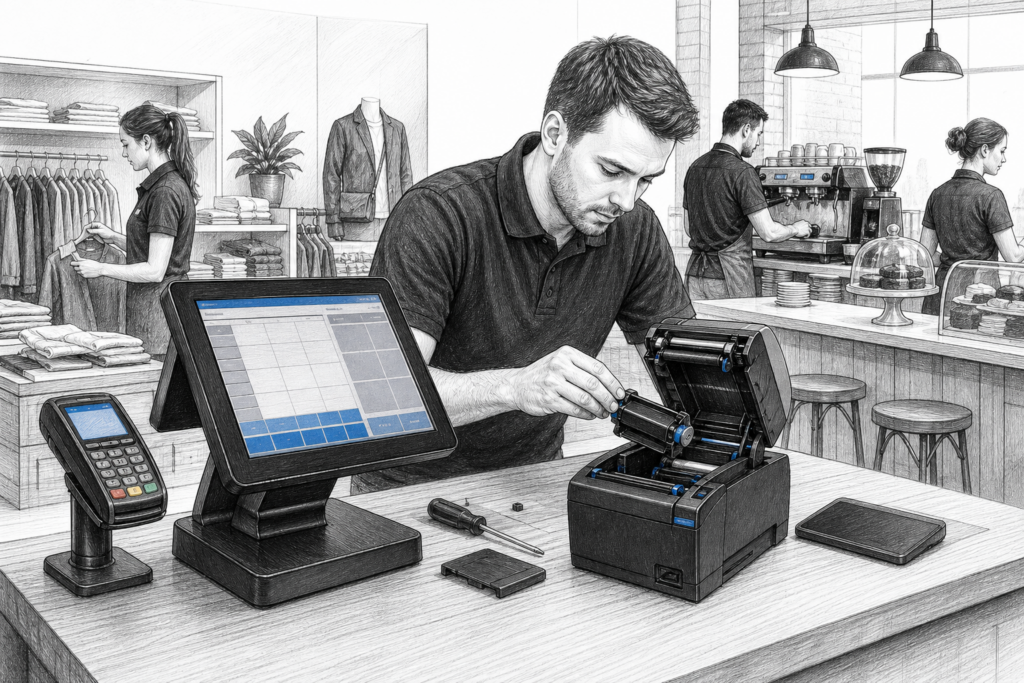
When a point of sale system goes down, the problem is rarely just technical. It can delay transactions, disrupt queues, slow table turns, and create avoidable pressure for staff. That is why serviceable POS hardware has become an important planning consideration for UK retailers, cafés, restaurants, pubs and installers alike.
Choosing hardware that can be maintained, repaired or supported over a longer period can make a real difference to day-to-day operations. For EPOS resellers and installers, it can also help reduce the cost and disruption of replacing an entire terminal when only one part needs attention.
What serviceable POS hardware means in practice
Serviceable hardware is equipment designed so that individual parts, modules or components can be accessed, maintained or replaced without unnecessarily removing the whole system. In a point-of-sale environment, that might mean a receipt printer with replaceable internal parts, a terminal built for easier access, or a setup that uses standard peripherals rather than a highly integrated and difficult-to-support unit.
This matters because many businesses do not want to replace an entire POS installation every time one element fails. A kitchen printer, thermal print mechanism, power assembly or other internal component may be the only part needing attention. In a well-planned system, that can reduce downtime and keep the rest of the setup working as intended.
Why serviceability matters more than ever
UK retail and hospitality businesses are placing greater pressure on checkout and order-processing points than before. Staff turnover, seasonal trading, longer opening hours and tighter service expectations all put extra demands on the hardware behind the counter. In that environment, the ability to support and maintain equipment matters just as much as screen size or processor type.
Serviceable hardware can help in several practical ways:
- it can make fault diagnosis faster for EPOS engineers
- it can reduce the need for complete equipment replacement
- it can support planned maintenance and component swaps
- it can help businesses keep a familiar user experience in place
- it can make spare parts stocking more practical for resellers and installers
For a multi-site operator, standardised and repairable hardware can also simplify support across several branches. A dealer does not want every site to require a different approach to maintenance, and a business owner does not want every fault to become a full replacement project.
The role of printers, terminals and components
Receipt printers are one of the clearest examples of why serviceability matters. They are used constantly in retail, hospitality and quick-service environments, and they often carry the burden of high-volume printing. If a printer can be maintained with appropriate replacement parts, the business may be able to extend the useful life of the device and avoid unnecessary disruption.
The same thinking applies to POS terminals. A commercial touchscreen terminal should not be treated like a consumer desktop PC. In busy environments, it needs to be suitable for sustained use, straightforward to support, and practical for technicians to work on if there is a fault. That is especially important for EPOS dealers and installers who need to protect their own service standards as well as their customers’ trading continuity.
YCR Distribution supplies POS hardware and related technology to the UK EPOS channel, including products and categories that support this more maintainable approach. Where replacement parts or printable components are available through an approved store source, they give resellers and service companies a more practical route to supporting existing installations. More information can be found at www.ycr.co.uk.
How this affects different business types
Retail environments
In retail, downtime at the checkout quickly becomes visible. Customers see the queue building, staff can become overloaded, and managers may need to move colleagues onto manual workarounds. Serviceable hardware helps reduce the risk that a single fault becomes a full trading issue.
Conventional office equipment is often chosen too quickly for shops simply because it appears familiar. In practice, purpose-built POS hardware is far more suitable for repeated use, quicker support and longer-term maintenance. A serviceable terminal or printer can be the difference between a planned repair and an emergency replacement.
Hospitality environments
In cafés, restaurants, bars and pubs, the pressure point is often order flow. If a front-of-house terminal or printer fails during a busy service, the impact can spread quickly to the kitchen, bar and payment area. In these settings, being able to repair or replace a component promptly is a major advantage.
Hospitality EPOS systems also tend to work best when the hardware is configured with support in mind. Clear cable management, sensible peripheral choices and equipment that can be maintained by an installer all help create a better long-term setup.
What EPOS resellers and installers should look for
When specifying hardware for a new project or upgrade, it is worth thinking beyond the initial installation. Consider how the equipment will be supported six months, two years or longer down the line. Useful questions include:
- Can key parts be serviced without replacing the whole unit?
- Are suitable replacement components available through the supply chain?
- Will the installation be easy to support remotely or on site?
- Can terminals and printers be standardised across branches?
- Does the hardware suit the trading environment, not just the specification sheet?
Those questions matter for businesses as much as they do for the channel. A reseller can protect margins and reputation by recommending hardware that is easier to support. A business owner can protect trading continuity by choosing equipment that is designed for real-world maintenance rather than one-off replacement.
UK support and supply make a difference
One reason serviceability matters is that it works best when supported by knowledgeable UK distribution and reseller channels. Local product knowledge, access to appropriate hardware ranges and the ability to source replacement parts can help reduce avoidable downtime. That is especially relevant for businesses that cannot afford long interruptions at the point of sale.
YCR Distribution works with resellers, installers and business customers across the UK, helping them plan practical POS and EPOS hardware deployments. For many organisations, the long-term value of hardware is not just what it can do on day one, but how well it can be supported afterwards.
For more information about point-of-sale hardware and EPOS solutions, contact YCR Distribution on 01924 438238 or visit www.ycr.co.uk.
In a market where businesses depend on reliable transactions and consistent customer service, serviceable POS hardware is no longer a niche consideration. It is a sensible part of choosing equipment that can continue to earn its place on the counter.