
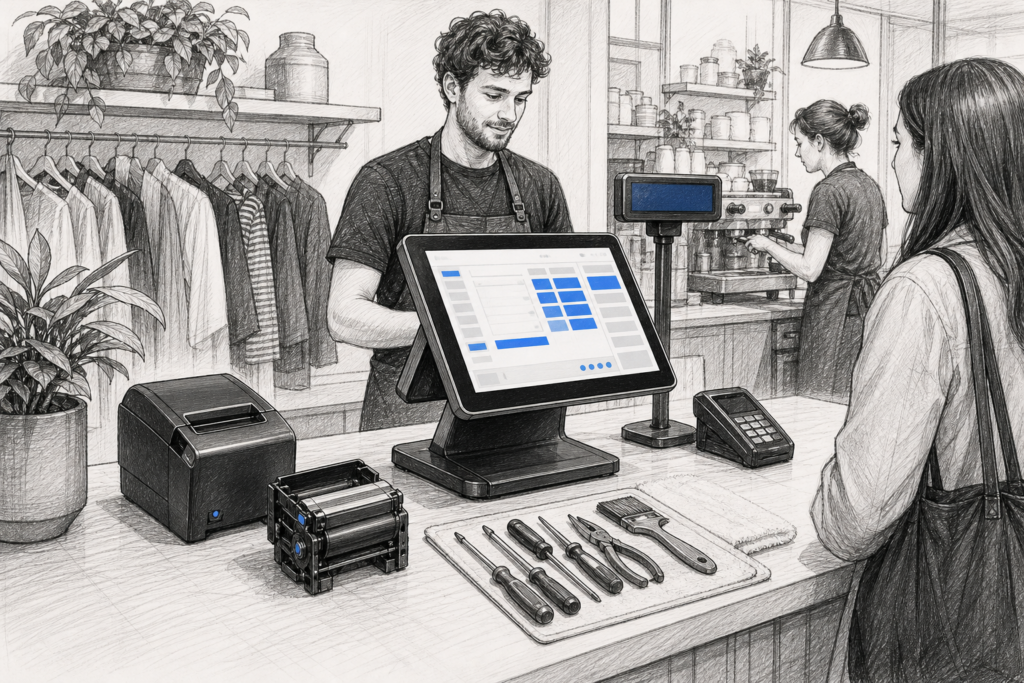
When a till point fails, the problem is rarely just technical. In a retail shop or hospitality venue, a faulty screen, printer or terminal can slow down queues, disrupt staff and affect the customer experience almost immediately. That is why serviceable POS hardware matters so much in the UK point-of-sale market.
For EPOS resellers, installers and business owners, the value of a system is not only in how it performs on day one, but in how easily it can be supported over time. Hardware that is easier to maintain, repair and adapt can stay in service longer, with less interruption to trading.
What serviceable POS hardware means in practice
Serviceability is about whether a device can be maintained without unnecessary complexity. In a point-of-sale environment, that may include straightforward access to components, sensible modular design, and the availability of replacement parts or compatible peripherals. It can also mean choosing hardware that is familiar to support teams and simple to standardise across several sites.
For a small independent retailer, that might mean replacing a receipt printer mechanism rather than changing the entire counter setup. For a hospitality group, it might mean keeping spare terminals or printer components ready so a single fault does not stall service. For an EPOS reseller, it can mean recommending hardware that is easier to integrate into a long-term support plan.
Why repairability matters at the checkout
Retail and hospitality businesses often use POS hardware under constant pressure. Printers run repeatedly during busy periods. Touchscreens are used all day. Customer-facing hardware may be exposed to food service environments, cleaning routines or constant movement between shifts. Even well-made equipment can eventually need attention.
When hardware is serviceable, the response to a fault can be more practical:
- replace the worn part rather than the whole unit
- keep the installation consistent for staff
- reduce the training needed for replacement equipment
- avoid redesigning the till point unnecessarily
- support business continuity when a device needs maintenance
This is especially relevant for businesses that depend on a compact front counter or a tightly planned checkout area, where every item has a purpose and flexibility is limited.
The role of the EPOS reseller and installer
Serviceable hardware is not only a benefit to the end user. It also helps the dealer or installer who supports the site. A reseller managing multiple customer installations needs products that can be understood quickly, supported confidently and maintained without excessive downtime. That becomes even more important when a customer operates several branches or mixes retail and hospitality operations.
Standardising on a smaller number of proven product families can make ongoing support much simpler. It can help with spares planning, reduce the risk of mismatched accessories and make it easier to propose like-for-like replacements when something fails. For installers, that translates into faster service calls and fewer surprises during maintenance visits.
Choosing hardware with support in mind
When evaluating POS hardware, it is sensible to look beyond the headline specification. A business may ask how the device fits into daily use, but a support-minded buyer will also consider how it will be maintained later. Useful questions include:
- Are replacement parts available where needed?
- Can the system be serviced without replacing the full installation?
- Will the hardware remain practical if the business grows?
- Can the same family of equipment be used across more than one site?
- How easy is it to source compatible printers, accessories and components?
These questions apply whether the business is moving away from an ageing traditional cash register or planning a new EPOS installation for a busy shop, café, restaurant or takeaway.
Extending the life of existing EPOS installations
Many UK businesses do not need a complete refresh every time one element fails. A terminal may still be suitable if a printer is replaced. A printer may remain useful if a worn component is changed. A cash wrap can often continue to work effectively if the right accessory or replacement part is sourced at the right time. This approach can be particularly helpful for operators who want to avoid unnecessary disruption to staff routines.
That is one reason replacement components and service parts remain important in the POS industry. They support a more sustainable approach to hardware ownership and make it easier to keep reliable equipment in circulation for longer. In commercial environments, that can be more practical than chasing the latest hardware release for its own sake.
Where serviceable hardware fits in modern POS planning
Modern EPOS is expected to do more than process a sale. It may need to manage stock, customer data, menu changes, reporting and integrated peripherals. But as systems become more capable, businesses still need dependable hardware that can be supported when things go wrong. That is why the conversation around POS hardware UK users choose should include serviceability alongside speed and appearance.
For growing retailers and hospitality groups, the most useful approach is often to build around equipment that can be supported consistently. That helps reduce downtime, protects the customer experience and makes future upgrades easier to plan. It is a practical way to think about retail EPOS and hospitality EPOS in a market where reliability matters every day.
YCR Distribution works with UK resellers, installers and businesses to supply point-of-sale hardware, replacement components and complete EPOS solutions that can be planned around real support needs rather than short-term convenience.
For more information about point-of-sale hardware and EPOS solutions, contact YCR Distribution on 01924 438238 or visit www.ycr.co.uk.