
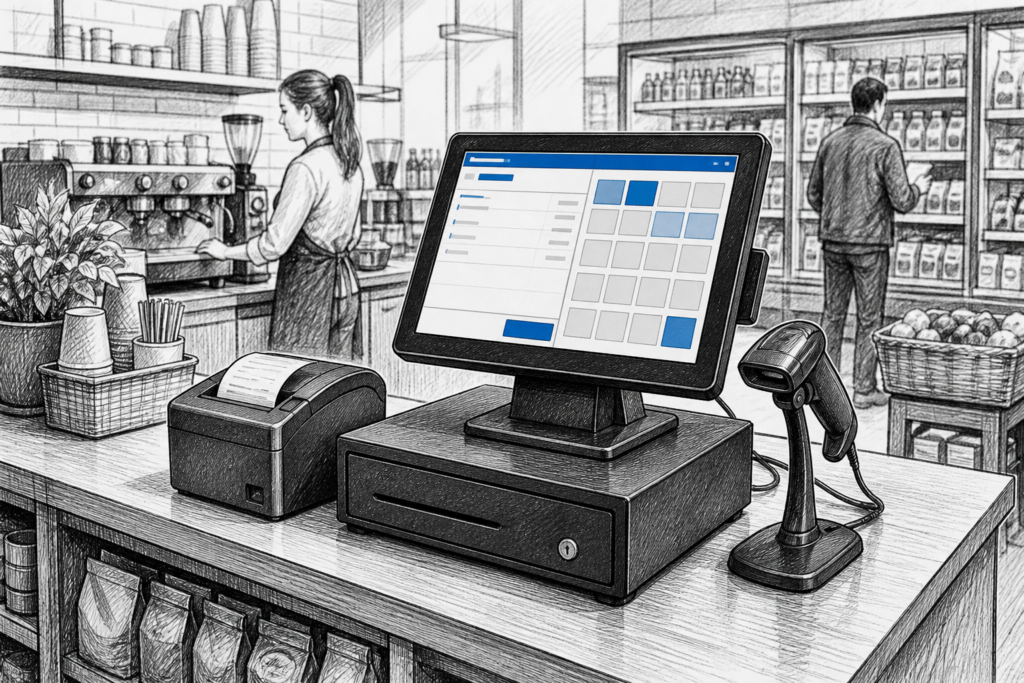
Windows POS terminals continue to play an important role in many UK point-of-sale installations, even as Android-based alternatives grow in popularity. For retailers, cafés, restaurants and multi-site operators, a purpose-built Windows terminal can still be the right foundation for a stable, serviceable EPOS setup.
The appeal is not about following trends. It is about choosing hardware that fits the way a business really works: long trading hours, busy counters, peripheral devices, existing software and the need for support when something needs replacing or expanding.
Where Windows POS still fits best
For many businesses, Windows remains attractive because it is familiar to installers, resellers and operators alike. If an EPOS platform has been built around Windows software for years, replacing the entire stack is not always practical or necessary. A new Windows POS terminal can often refresh performance and reliability without forcing a business into a much wider change programme.
Windows POS terminals are commonly suited to:
- independent retailers running established EPOS software
- hospitality venues that rely on specific front-of-house applications
- families of sites that need a consistent hardware standard
- dealers and installers supporting a wide installed base
- businesses that want a more computer-like platform with commercial POS features
That compatibility is often the key reason for choosing Windows POS hardware. If the software, peripherals and working practices already suit the business, the right terminal can reduce disruption and make the upgrade far easier to manage.
Purpose-built POS hardware versus a standard PC
A common mistake is to treat a counter-based EPOS terminal as though any ordinary office computer will do the job. In practice, a point-of-sale environment is harsher than a desk-based office setting. The device may be used by multiple staff members all day, exposed to heat, dust or spills, and connected to printers, scanners, customer displays and payment devices.
Purpose-built Windows POS terminals are designed with those conditions in mind. The goal is not simply to run Windows; it is to provide a more suitable platform for front-of-house use. That can mean a space-saving form factor, a more practical screen arrangement, better cable management, easier mounting and a design that looks appropriate at the counter.
For businesses that need a professional front-of-house presence, this difference matters. A standard desktop PC may be functional, but it is rarely as convenient or as tidy as a dedicated POS terminal when installed at a checkout or service point.
Day-to-day benefits for retail and hospitality
In busy retail and hospitality settings, the value of a Windows POS terminal is often seen in the everyday tasks that keep service moving. Staff need to enter orders quickly, process sales accurately and switch between applications without unnecessary delay. Managers need reporting, stock visibility and control over user access. Installers need hardware that can be supported efficiently if a unit is upgraded or replaced later.
Handled well, a Windows POS terminal can support all of those needs. It gives a business a familiar operating environment while still offering the dedicated form factors expected from commercial EPOS hardware.
Examples of practical advantages
- easier adoption for staff already used to Windows-based systems
- simple integration with existing back-office workflows
- good fit for EPOS software packages already approved by the business
- straightforward support for common retail and hospitality peripherals
- more predictable replacement planning for resellers and installers
For a busy café, that might mean a counter terminal that links cleanly to a receipt printer and payment workflow. For a convenience store, it may mean a checkout device that can run long trading hours with minimal fuss. For a restaurant, it may mean a dependable screen at the act of taking orders and managing table service.
Why resellers and installers still specify Windows POS
EPOS resellers and installers often recommend Windows-based hardware when they need flexibility and continuity. Not every customer wants a wholesale software change, and not every site has the same operating model. Where existing applications are proven, the most commercially sensible decision may be to modernise the terminal while keeping the software environment intact.
That can also make life easier when standardising across multiple locations. A consistent Windows POS terminal strategy can simplify spares, deployment, training and support. It may also reduce the number of unknowns when expanding an estate or replacing ageing equipment in phases.
From a support perspective, this is one reason local knowledge matters in POS systems UK projects. A distributor that understands the needs of EPOS resellers and installers can help identify suitable hardware, accessories and approaches before a rollout starts. YCR Distribution works with the UK point-of-sale channel in this way, helping businesses and resellers plan hardware around real operational needs rather than assumptions.
Planning a modern Windows EPOS upgrade
If a business is upgrading from older till hardware, it is worth looking at the whole counter environment rather than only the terminal itself. The right solution usually takes in the terminal, receipt printer, payment device, scanner and any customer-facing equipment. That is especially important in retail EPOS and hospitality EPOS settings, where service speed depends on how well the components work together.
Before choosing new hardware, consider:
- the EPOS software already in use
- the peripherals that must be retained
- the available counter space
- the trading conditions at the installation site
- how easy the terminal will be to replace or service later
These are practical questions, but they are the ones that determine whether a new installation will be easy to manage or awkward to support. A Windows POS terminal is often the right choice when reliability, software continuity and serviceability are just as important as appearance.
YCR Distribution supplies point-of-sale hardware to UK resellers, installers and businesses looking for dependable EPOS solutions. If you are planning a Windows POS upgrade or building a new checkout environment, it is worth reviewing the terminal alongside the rest of the counter hardware.
For more information about point-of-sale hardware and EPOS solutions, contact YCR Distribution on 01924 438238 or visit www.ycr.co.uk.
To explore suitable hardware, visit the Windows POS terminals collection.