
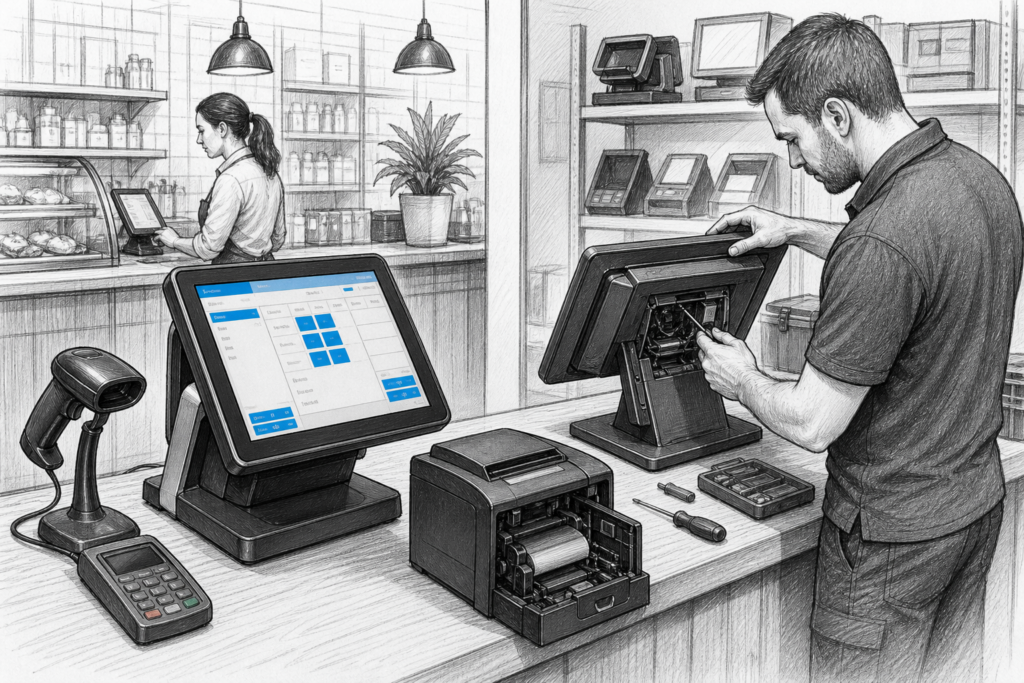
In UK retail and hospitality, the point of sale is only useful if it keeps working when trading is busy. That is why serviceable POS hardware matters: when a terminal, printer or peripheral can be maintained, repaired or upgraded more easily, businesses can reduce disruption and keep day-to-day operations moving.
For EPOS resellers and installers, this is more than a technical preference. It affects how quickly a site can be supported, how long equipment remains useful, and how consistently the same hardware can be deployed across multiple locations.
What serviceability means in practical terms
Serviceable POS hardware is equipment that is designed with maintenance in mind. Rather than treating a terminal or receipt printer as a sealed item that must be replaced at the first sign of trouble, the better approach is to consider how parts can be accessed, replaced or supported over time.
That may include easier access to a thermal printer mechanism, replaceable components in a receipt printer, or a terminal design that allows an installer to work on the unit without dismantling the entire checkout area. In a real business environment, that can make a noticeable difference.
- Less downtime: faults can be diagnosed and addressed faster.
- Longer equipment life: hardware can stay in use for more years.
- Better support planning: resellers can standardise servicing procedures.
- Lower disruption: staff are not left waiting for a complete replacement.
Why this matters in retail
Retailers rely on a smooth checkout experience. If a terminal becomes unreliable, staff may have to work around it with manual methods, which slows service and creates pressure at the till point. For convenience stores, fashion retailers, garden centres and specialist shops, even a short interruption can have a knock-on effect on queues and customer satisfaction.
Serviceable hardware is particularly valuable where a store has consistent trading hours and limited tolerance for disruption. A retailer may not need the newest model of terminal every year, but it does need a system that can be kept in good condition. That makes maintainability a commercial issue, not just a technical one.
It also helps when replacing older kit in stages. Many retailers are not refreshing an entire EPOS estate at once. Instead, they may be upgrading one terminal, printer or peripheral at a time. Hardware that is easier to support gives the business more flexibility to phase changes sensibly.
Why this matters in hospitality
In cafés, bars, pubs and restaurants, the pressure on POS hardware is often different but just as demanding. Front-of-house terminals, receipt printers and kitchen devices may be used throughout a busy service period, then reviewed after close of trade. Equipment that is easier to maintain can help teams recover quickly from small issues before they affect order flow.
For hospitality EPOS, serviceability can support areas such as:
- clearer maintenance routines for printers and terminals;
- faster replacement of worn parts on frequently used devices;
- easier support for sites with one or more counters;
- more predictable hardware upkeep across a group of venues.
That is particularly useful when a business depends on reliable order-taking, accurate printing and fast handover between the front of house, bar and kitchen.
Repairability supports better lifecycle planning
Businesses often focus on what a POS system can do on day one, but long-term value comes from how well it can be supported later. Repairable and serviceable hardware helps extend the working life of a POS installation and gives resellers a stronger story when advising customers on total cost of ownership.
It also allows businesses to build more realistic replacement cycles. Rather than replacing every device at the same time, a company can decide which items should be maintained, which should be refurbished and which should be upgraded. That approach is especially relevant for multi-site operators who want a consistent hardware standard without creating unnecessary waste.
Where receipt printers are concerned, for example, access to internal components can be especially helpful. Printers are among the hardest-working devices in many EPOS installations, so the ability to replace worn components or carry out targeted maintenance can help preserve performance and reduce avoidable downtime.
What installers and resellers should look for
When specifying POS hardware for a customer, it is worth asking not only whether the product suits the business today, but whether it will be practical to support later. Useful questions include:
- Can the hardware be maintained without excessive downtime?
- Are replacement parts or components available through the supply chain?
- Is the design suitable for the trading environment, whether that is retail or hospitality?
- Will the same model be appropriate for future rollouts at other sites?
- Does the product support a sensible service strategy for the reseller or installer?
This approach is especially relevant in the UK point-of-sale market, where dealers and installers are often expected to provide advice, supply, installation and aftercare. A system that is easy to support is usually easier to recommend.
The role of UK distribution and support
For businesses and channel partners, working with an experienced UK POS distributor can make serviceability more practical. It is not just about sourcing hardware; it is also about getting guidance on product families, replacement components and the types of devices that are suitable for ongoing support.
YCR Distribution works with EPOS resellers, installers, retailers and hospitality businesses across the UK, helping them choose point-of-sale hardware that fits real-world operational needs. That includes commercial POS products and supporting technology where maintainability and long-term support matter as much as the initial specification.
For businesses planning a refresh, this can help avoid the common mistake of choosing hardware only on features and ignoring supportability. In practice, the right selection often comes down to a balanced view of performance, reliability and service life.
For more information about point-of-sale hardware and EPOS solutions, contact YCR Distribution on 01924 438238 or visit www.ycr.co.uk.
Conclusion
Serviceable POS hardware is not a niche concern. It affects uptime, supportability and the long-term value of an EPOS installation. Whether the environment is a busy shop counter or a fast-paced hospitality venue, equipment that can be maintained properly gives businesses a better chance of avoiding disruption and protecting daily trading.
For resellers and installers, it also makes it easier to build dependable, repeatable POS solutions that can be supported confidently across one site or many.