
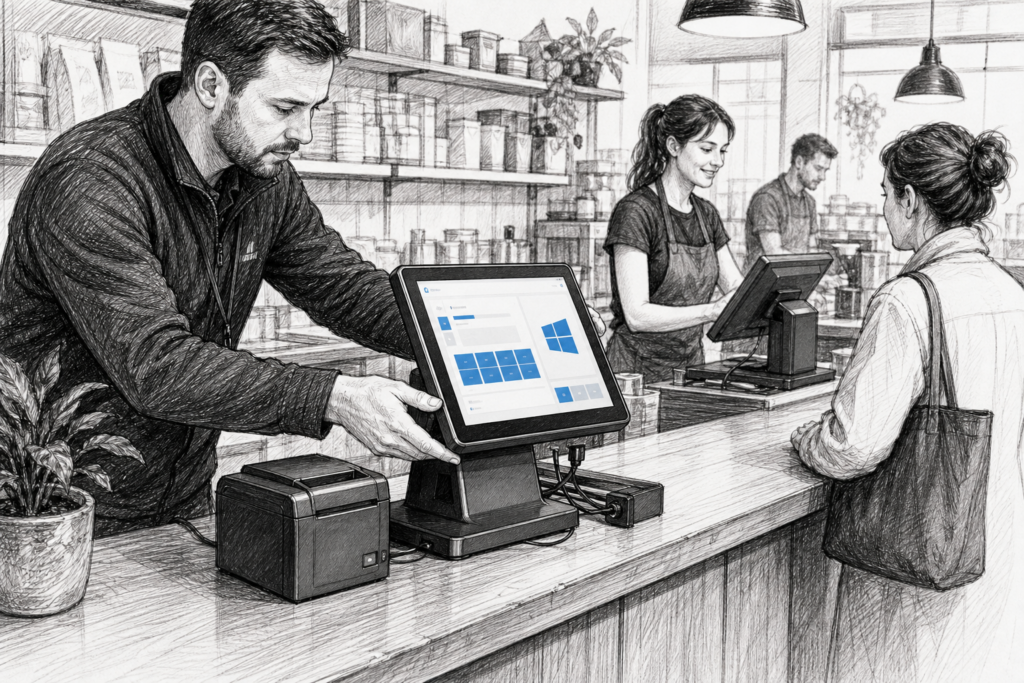
Many UK retailers and hospitality businesses are rethinking what they want from a checkout terminal. For some, the priority is no longer just basic transaction processing, but a hardware platform that can support established EPOS software, work reliably in busy trading periods and be serviced without disrupting the whole operation. That is why Windows POS terminals continue to play an important role in point of sale UK installations.
Why Windows POS still matters
Windows-based EPOS is common because it fits neatly into a wide range of business setups. A purpose-built Windows POS terminal gives resellers, installers and business owners a familiar operating environment while still providing commercial-grade hardware designed for frontline use. In practice, that often means a touchscreen terminal that can handle everyday till work, stock lookups, product searches, refunds and reporting from one reliable device.
For businesses that already use Windows-based EPOS software, staying with Windows hardware can make a deal of sense. It can reduce the disruption of retraining staff on a new system, help protect existing workflows and make upgrades easier to plan. Instead of replacing the whole checkout process, a business can modernise the hardware layer while keeping the software structure that its team already understands.
Where Windows POS terminals fit best
Windows POS terminals are used across retail and hospitality, but the reasons for choosing them can differ. In retail, they are often selected for stores that need a dependable front counter system with barcode scanning, receipts and back-office reporting. In hospitality, they can be used on the front counter, at a bar, or in a quick-service environment where staff need fast access to item buttons, modifiers and payment workflows.
They are also suitable for locations where a conventional office computer is not ideal. Unlike a standard desktop PC tucked under the counter, a commercial POS terminal is designed for repeated daily interaction, better cable management and a more fitting footprint at the point of sale. That matters in compact cafés, busy pubs, garden centres and convenience stores where space is limited and the checkout area needs to stay organised.
What buyers should look for
Choosing the right Windows POS terminal is less about chasing headline specifications and more about matching the hardware to the job. The most useful questions are practical:
- Will the terminal sit on a counter, be wall-mounted, or need a flexible base?
- Does the business need a compact footprint or a larger display for busy staff?
- Will the terminal serve as the main till, a secondary station, or a multi-site standardised unit?
- Does the installer need straightforward access to peripherals such as receipt printers, scanners or customer displays?
These points affect usability more than a long list of technical terms. For example, clear touchscreen access can speed up order entry, while a stable base and sensible port layout can make a new installation much easier to support. In a hospitality setting, that can help reduce misplaced cables and make the workstation less prone to interruption during service.
Using Windows POS to support existing EPOS software
One of the strongest reasons businesses continue to specify Windows POS is software continuity. Many EPOS systems used in the UK were built around Windows environments, and those businesses may want to preserve their current software investment while refreshing ageing hardware. This can be especially useful for resellers and installers who need to plan replacements carefully, rather than reworking the entire estate at once.
It also helps when multiple sites need a familiar standard. A chain of cafés, for example, may benefit from using the same terminal style at each location so staff moving between sites encounter the same layout and workflow. That can make training simpler and reduce the risk of avoidable mistakes at busy times.
Why serviceability and support matter
Commercial POS hardware should be chosen not just for how it looks on day one, but for how it can be supported over time. In a busy retail or hospitality environment, downtime at the till is costly. A terminal that is easy to understand, easier to install, and practical to maintain gives the reseller or dealer more options when supporting the customer.
This is where UK-based distribution and product knowledge become important. Working with an experienced POS distributor UK businesses can access support that goes beyond simply supplying a box. It can include advice on suitable hardware families, peripheral matching, installation planning and replacement hardware for existing sites. For EPOS resellers, that support can be the difference between a straightforward rollout and a prolonged compatibility headache.
Planning a Windows POS refresh
If a business is replacing older checkout hardware, the best approach is usually to look at the whole line-up rather than the terminal alone. A Windows POS terminal often needs to work with a receipt printer, scanner, cash drawer or customer display, and the right combination will depend on the venue and the software in use. That is why many installers prefer to specify a complete solution rather than treat the terminal as a standalone purchase.
For new openings, the advantage is even clearer. A fresh EPOS installation is the ideal time to standardise terminal layouts, select proven peripherals and create a hardware platform that can be replicated later if the business expands. For growing retailers and hospitality operators, that consistency can save time on support and reduce the complexity of future upgrades.
If you are comparing Windows POS hardware for a retail or hospitality project, it helps to focus on the working environment first and the hardware second. A terminal that suits the counter, the staff workflow and the support model is usually the right choice.
For more information about point-of-sale hardware and EPOS solutions, contact YCR Distribution on 01924 438238 or visit www.ycr.co.uk.
YCR Distribution works with UK resellers, installers and businesses to supply POS hardware and related technology for modern EPOS deployments.