
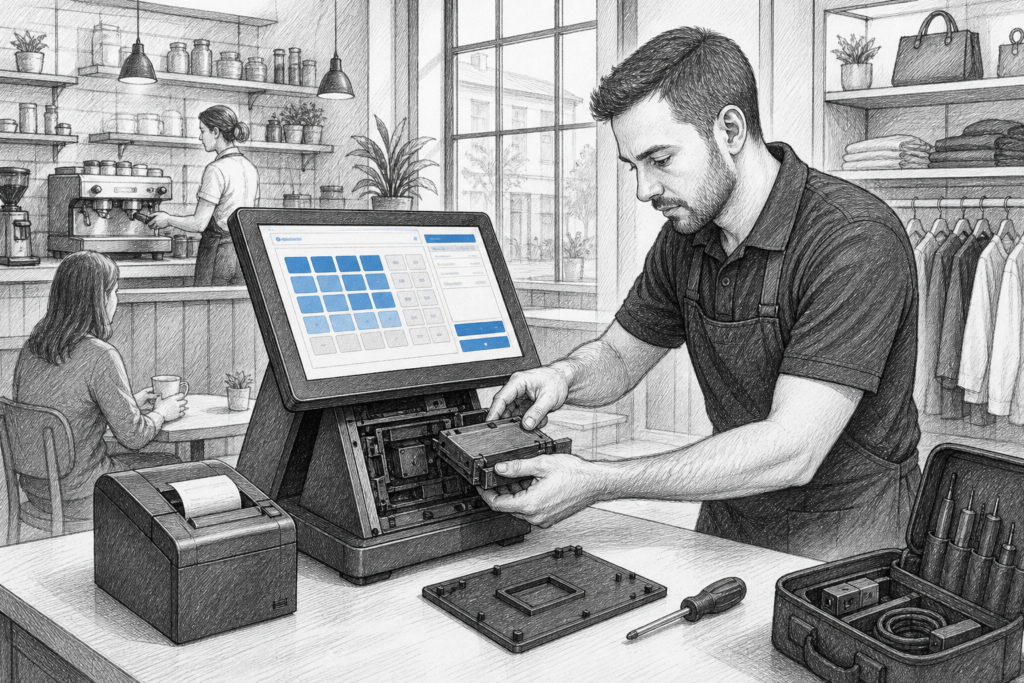
When a checkout goes down, the problem is rarely just technical. It can slow queues, disrupt service, create pressure on staff and leave customers waiting at the worst possible moment. That is why serviceability has become an important consideration when businesses choose POS hardware in the UK.
For retailers, cafés, restaurants and hospitality venues, a point-of-sale system is not just a screen on the counter. It is a working part of day-to-day operations, and like any commercial equipment it needs to be supportable. That means thinking beyond the initial installation and asking practical questions about repair, replacement parts, long-term continuity and how quickly the hardware can be returned to service if something goes wrong.
What serviceability means in practice
Serviceable POS hardware is equipment that can be maintained without replacing the whole system every time a single part fails. In a busy environment, that might mean a printer mechanism that can be replaced, a terminal that can be swapped into an existing installation more easily, or a hardware range that is well understood by an EPOS reseller or installer.
This matters because POS systems are often used every day, for long hours, in demanding conditions. Heat, dust, constant tapping, repeated cable movement and general wear all take their toll. If a terminal or printer is designed with servicing in mind, support teams may be able to isolate the issue faster and keep a business trading with less disruption.
Why repairable hardware can be a better business decision
Many businesses focus on specification alone when planning an EPOS upgrade, but the ability to maintain the hardware should carry real weight. A replacement part can sometimes be more practical than a full replacement, particularly where an installation has been tailored around a counter layout, shelf space or cable route.
There are several commercial benefits to prioritising serviceability:
- Less downtime at the checkout or till point
- Better use of existing installations and accessories
- Easier support for multi-site estates with standardised hardware
- More predictable maintenance for resellers and installers
- Potentially longer useful life for the overall POS set-up
For businesses that operate on tight service windows, such as cafés, takeaways and convenience stores, being able to restore a system quickly is often more important than replacing the entire installation.
What EPOS resellers and installers should look for
EPOS resellers and installers are often the ones who feel the impact of poor serviceability first. If a product range is difficult to access, difficult to diagnose or impossible to support with genuine components, the result can be unnecessary site visits and longer service times.
When specifying hardware, it helps to consider:
- Whether the product family has clearly defined components and accessories
- Whether replacement parts are available through the supply chain
- Whether the hardware can be integrated into an existing support process
- Whether the design suits routine maintenance as well as first installation
- Whether the platform is appropriate for the expected trading environment
That approach is particularly useful for resellers supporting multiple customer sites, because a standardised hardware base can simplify spares handling and reduce the number of product variations the support team needs to know.
Where serviceability matters most
Some environments place a heavier load on POS hardware than others. A busy restaurant, for example, may need terminals that can cope with constant order entry, frequent printing and fast turnaround at the counter. A retail site may need reliable receipts and stable till-point operation throughout peak trading periods. In both cases, a failure that can be resolved through replacement of a specific component is less disruptive than a full hardware change.
Serviceability is also relevant when businesses want to extend the life of an existing EPOS installation. Rather than replacing everything at once, a practical upgrade plan may involve refreshing the most heavily used items first and keeping other parts of the system in service for longer. That can be especially useful when a business is managing several locations or rolling out changes in phases.
How YCR Distribution supports supportable POS installations
YCR Distribution supplies POS and EPOS hardware to resellers, installers and business customers across the UK, with a focus on practical products that can be deployed and supported in real-world environments. For many buyers, that means looking not only at the terminal or printer itself, but also at how the wider solution will be maintained over time.
Where appropriate, that can include hardware families, accessories and replacement components that help preserve an installation rather than forcing a full redesign. For EPOS professionals, this is valuable because it supports a more sustainable service model: fewer emergency replacements, simpler maintenance planning and better continuity for the end customer.
Businesses exploring a new installation should also think about future support when comparing platforms. A well-chosen POS system is one that suits today’s operation, but can also be maintained sensibly if trading patterns change, footfall increases or a component eventually needs attention.
Planning for continuity, not just installation
A reliable EPOS project should be judged on more than how the hardware looks on day one. It should also be measured by how easily it can be supported six months, two years or five years later. That includes the availability of parts, the skillset of the installer, and how straightforward it is to keep the system running during busy periods.
For independent retailers and hospitality businesses, this approach helps reduce risk. For EPOS dealers and installers, it strengthens the service they can offer. And for multi-site operators, it supports consistency across locations without tying every update to a full equipment refresh.
For more information about point-of-sale hardware and EPOS solutions, contact YCR Distribution on 01924 438238 or visit www.ycr.co.uk.