
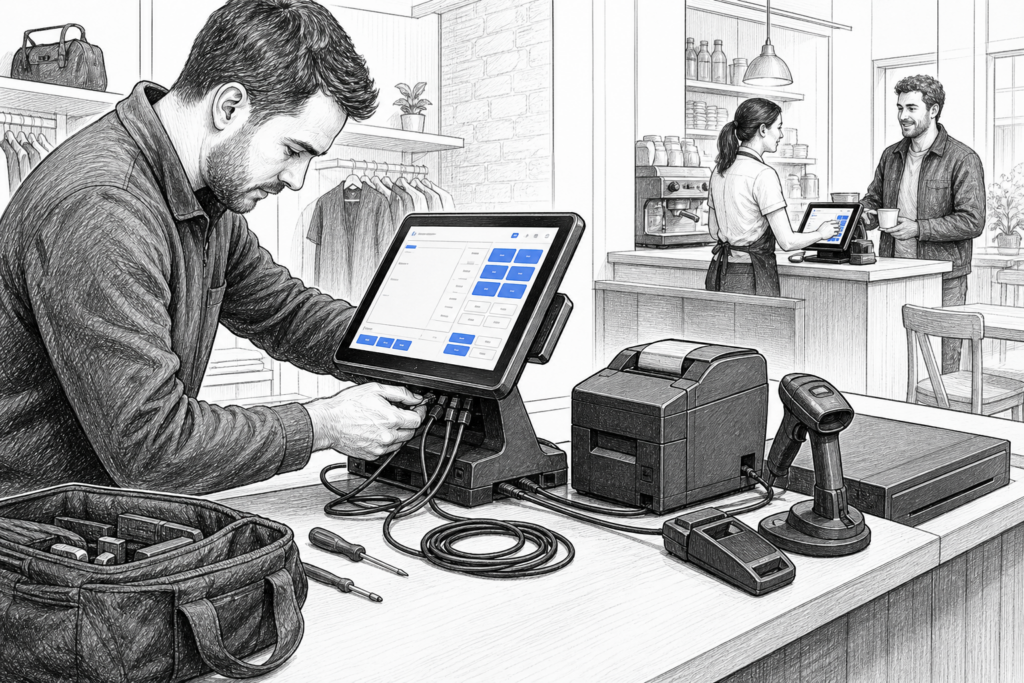
When a checkout stops working, the issue is rarely just inconvenience. For a retailer, café or hospitality venue, it can interrupt sales, slow service and create pressure on staff at exactly the wrong time. That is one reason serviceable POS hardware matters so much in UK EPOS installations: it helps businesses keep trading, recover faster when something fails and plan replacements more intelligently.
In practice, serviceability is about more than whether a terminal or printer powers on. It covers how easy the equipment is to support, repair, replace and standardise. For EPOS resellers, installers and business owners alike, that can make a major difference to the long-term cost and reliability of a point-of-sale system.
What serviceable POS hardware means
Serviceable hardware is equipment designed with maintenance in mind. That might mean accessible components, modular parts, common peripherals or a product range that is straightforward to support over time. It does not necessarily mean the hardware is simple or basic. In many cases, modern commercial POS products are more capable than older tills, but they are also easier to manage because they are built for ongoing use in a business environment.
For UK point of sale installations, this matters because the checkout is rarely a stand-alone device. A typical setup may include a touchscreen terminal, receipt printer, customer display, scanner and payment peripherals. If one part becomes unavailable or difficult to support, the whole lane can be affected.
Why serviceability reduces disruption
At the point of sale, time lost is often visible immediately. A faulty printer can delay receipts and kitchen tickets. A terminal issue can hold up sales or require staff to move to a backup lane. Hardware that is easier to service helps reduce these interruptions in several ways:
- it can be diagnosed more quickly
- replacement parts may be easier to source
- installers can maintain familiar product families with less training
- spare units can be swapped in with less configuration effort
- existing hardware can often be kept in use for longer
That last point is especially important for businesses that want to avoid unnecessary refresh cycles. A well-supported POS platform does not need to be replaced the moment one part wears out.
The value for retailers and hospitality operators
Retail and hospitality businesses have very different demands, but serviceability helps both. In retail, the checkout must handle busy periods, stock lookups and customer payments without causing queues. In hospitality, the terminal and printer setup needs to support table service, bar orders, kitchen communication and fast turnaround during peak periods.
In both settings, replacing a complete system because one component is difficult to maintain can be wasteful. Serviceable POS hardware gives operators more options:
- replace only what actually needs replacing
- keep staff training consistent by using familiar layouts and interfaces
- maintain a standard hardware estate across branches
- reduce the need for emergency substitutions with consumer-grade equipment
This is one reason commercial-grade terminals and printers remain popular in point-of-sale UK installations. They are designed to be supported as part of a working business system, not just sold as a one-off device.
What EPOS installers should look for
For installers and resellers, serviceability is also a practical project management issue. A system that is easy to support is easier to roll out, document and maintain across multiple customers. It can also help reduce call-backs when replacement parts, accessories or compatible peripherals are easier to identify.
When assessing POS hardware UK projects, it is worth considering:
- how straightforward the hardware is to mount and cable
- whether the product family is consistent across sites
- how easy it is to source replacement items within the same range
- whether the device has a sensible layout for cleaning and routine checks
- how well the hardware fits with the customer’s support model
This is where choosing the right distributor matters. A knowledgeable UK POS distributor can help resellers and installers match the project to the hardware, rather than forcing the site to adapt to a product that is awkward to support.
Repair, replace or standardise?
Not every issue should lead to a full system refresh. In many cases, a customer only needs a replacement printer mechanism, a compatible terminal, or a spare unit from the same hardware family. Serviceable POS hardware makes those decisions more realistic because the whole installation is easier to understand and maintain.
Standardisation is particularly useful for multi-site businesses. If every location uses broadly the same POS hardware, support becomes simpler, staff move between sites more easily and spare equipment can be shared when needed. For hospitality groups, convenience stores and growing retail chains, that can save time every day.
It is also worth thinking ahead about lifecycle planning. A replacement strategy is easier to manage when the hardware range is known, documented and supported by a distributor that understands the EPOS market.
Support from a UK POS distributor
Local support can be as important as the hardware itself. UK-based distribution gives resellers and operators access to practical product knowledge, help with selecting suitable equipment and better planning for replacement or expansion. That is especially useful when a business needs to keep existing installations running while preparing for future upgrades.
YCR Distribution works with EPOS dealers, installers, resellers and businesses across the UK to supply point-of-sale hardware and related technology. If you are planning a new rollout, upgrading ageing equipment or looking for ideas on how to make a system easier to support, it helps to speak to a distributor that understands both the products and the pressures of day-to-day trading.
For more information about point-of-sale hardware and EPOS solutions, contact YCR Distribution on 01924 438238 or visit www.ycr.co.uk.