
Benefits of digital signage for restaurants in 2026
TL;DR:
- Implementing digital signage in restaurants significantly increases sales, improves operational efficiency, and enhances customer experience through dynamic content. It offers rapid menu updates, reduces perceived wait times, and enables targeted upselling, resulting in measurable revenue growth. Choosing the right hardware and software, with proper integration and real-time features, ensures maximum benefits and a solid return on investment.
Running a restaurant in 2026 means competing on experience as much as food. The benefits of digital signage for restaurants go well beyond displaying a menu: the right system influences purchasing decisions at the exact moment customers are ready to order, cuts operational overhead, and gives your brand a polished, modern presence that static printed boards simply cannot match. This article covers the real, quantified advantages, the criteria that separate good systems from great ones, and a direct comparison to help you make a confident decision.
Table of Contents
- Key takeaways
- 1. The benefits of digital signage for restaurants: what the data says
- 2. How to choose the right digital signage solution
- 3. Reduced wait time and improved customer experience
- 4. Dynamic content features that maximise revenue
- 5. Upselling and average order value
- 6. Operational efficiency across multiple sites
- 7. Staff experience and service quality
- 8. Static versus digital signage: a direct comparison
- My honest take on why restaurants still hesitate
- How Ycr can help you get started
- FAQ
Key takeaways
| Point | Details |
|---|---|
| Sales uplift is measurable | 86% of restaurants see increased sales after implementation, with average order value rising 20 to 30%. |
| Update speed transforms operations | Menu changes that took weeks with printed boards now take under an hour via cloud-based content management. |
| Perceived wait time drops | Digital displays reduce perceived wait time by up to 35%, directly improving customer satisfaction and repeat visits. |
| Hardware spec matters | Screen brightness, screen size, and POS integration are non-negotiable criteria, not optional extras. |
| Dynamic content earns more | Dayparting, animations, and real-time inventory triggers are the features that separate a passive screen from an active sales tool. |
1. The benefits of digital signage for restaurants: what the data says
The headline figure is hard to ignore. 86% of operators who have deployed digital menu boards report increased sales, with average order values rising between 20 and 30%. McDonald’s recorded a 3 to 5% ticket increase across US locations following a nationwide rollout of digital menu boards. For a restaurant turning over £500,000 annually, a 5% uplift is £25,000 in additional revenue from the same footfall.
The advantages of digital displays extend into operational savings as well. A QSR chain reduced its annual print budget from $540,000 to $45,000 by switching to digital menu boards. That is a 92% reduction in printing costs, and it removes the hidden labour cost of distributing physical materials to every location.
Order accuracy is another measurable win. Digital deployments have shown order accuracy improvements from 94.2% to 98.1%, alongside a 12-second reduction in average drive-thru time per car. Fewer errors means less food waste, fewer refunds, and less friction for your staff during peak hours.
2. How to choose the right digital signage solution
Before you invest, there are specific criteria worth evaluating carefully. Not all screens are built for a commercial kitchen environment, and not all content management systems (CMS) give you the control you actually need.
- Screen brightness. Indoor screens need at least 700 nits; window-facing displays require significantly more to remain readable in direct sunlight. A menu that is hard to read slows ordering and frustrates customers.
- Screen size and placement. The screen must be readable from the ordering position. A screen that is too small or mounted at the wrong angle undermines the entire investment.
- Software capabilities. Look for a CMS that supports content scheduling, real-time updates, and cloud management so that changes made at head office push instantly to every location.
- POS and inventory integration. Tight integration with your POS ensures pricing stays consistent and sold-out items disappear from the menu automatically, removing a common source of customer complaints.
- Ease of use. If your team cannot update the menu without calling a technician, the system will not be used to its full potential. Prioritise platforms with straightforward interfaces.
- Cost structure. Consider upfront hardware costs alongside monthly software licensing fees. Cloud-based systems often have lower upfront costs but ongoing subscriptions.
- Offline reliability. A system with local caching continues to display content even if the internet connection drops. This is non-negotiable for a busy service environment.
Pro Tip: Ask any vendor for a demonstration of how long it takes to push a price change across all screens. If the answer is longer than five minutes, keep looking.
3. Reduced wait time and improved customer experience
The digital menu boards benefits that operators underestimate most are perceptual. Perceived wait time drops by up to 35% when customers have engaging content to view while they queue. The Cornell Center for Hospitality Research has documented this effect: actual wait time does not need to change for customers to feel they waited less.
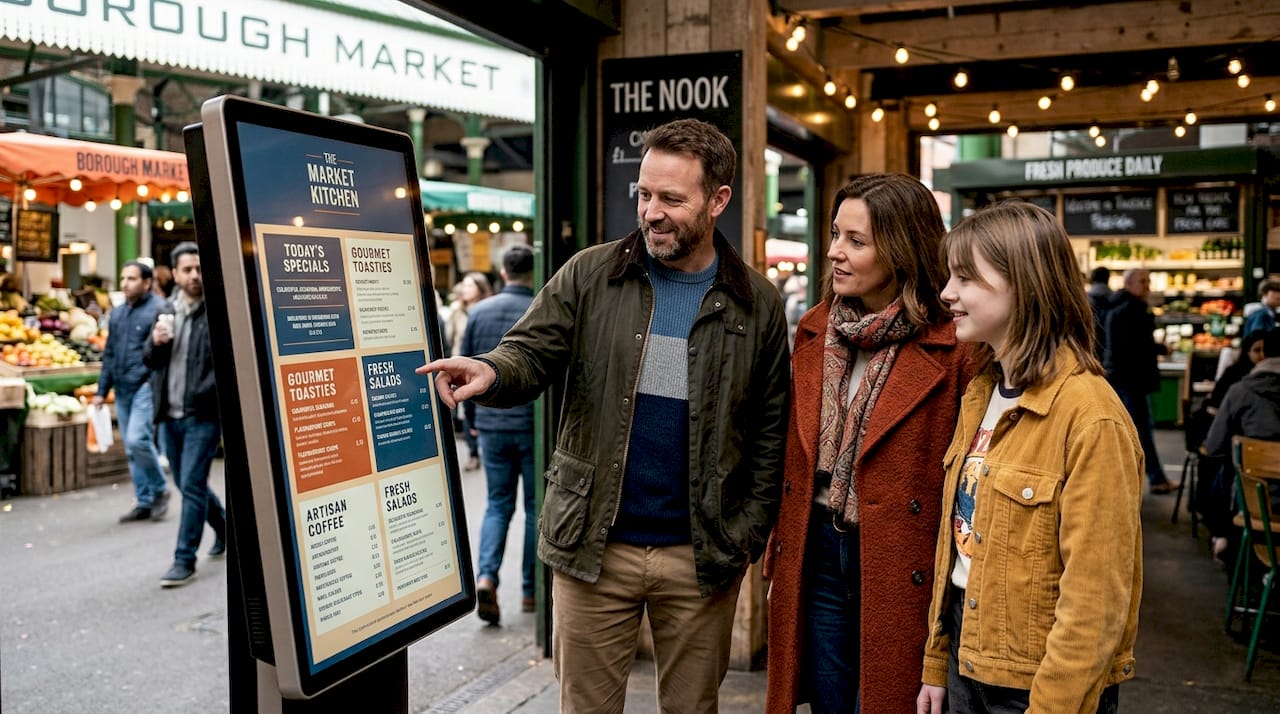
How digital signs enhance dining experience goes beyond distraction. A well-designed screen with appealing food photography, rotating promotions, and clear pricing creates a sense of professionalism that customers associate with the quality of the food itself. Digital signage profoundly improves brand image and meets modern customer expectations in a way that a laminated printed board simply does not.
Self-service kiosks take this further. When customers order through a kiosk without time pressure from a member of staff waiting for their answer, average order values rise by 20 to 30%. McDonald’s recorded a 30% kiosk order value rise as customers browsed at their own pace and added items they would not have considered under social pressure.
4. Dynamic content features that maximise revenue
A static digital board is better than a printed one, but a dynamic board is a different category of tool entirely. Improving restaurant customer engagement through digital signage depends heavily on how well you use the content management capabilities available to you.
Dayparting is the practice of scheduling different content for different time periods: breakfast deals in the morning, lunch combos from midday, evening specials from 5pm. This removes the need for manual changes during a busy service. Advanced CMS systems handle this automatically with conditional logic, meaning your board promotes the right items without any staff input during a shift.
Motion and animation are not cosmetic extras. Dynamic content and high-contrast images at the point of decision actively influence purchasing behaviour, nudging customers towards higher-margin items. A slowly rotating image of a dessert placed near the till is a more effective upsell prompt than a printed card that customers have stopped noticing.
Real-time inventory triggers allow the system to remove sold-out items the moment your kitchen flags them in the POS. Automatic sold-out item removal eliminates the frustration of customers ordering something unavailable, which is one of the most common negative dining experiences. Some systems also trigger weather-based promotions, serving hot drinks on cold days without any manual intervention.
Pro Tip: When setting up dayparting, programme your highest-margin items into every time slot. The board should always be working on your behalf, not just displaying information.
5. Upselling and average order value
Improving restaurant customer engagement through targeted upselling is where digital signage earns back its cost fastest. Upsell rates improve by 10 to 15% within 90 days when high-margin items are actively managed on screen. This is not about bombarding customers with promotions. It is about placing the right suggestion in the right position at the right moment.
Operators who treat their digital boards as menu engineers, rather than just menu displays, see the most significant gains. Placing a premium side dish next to a popular main, or featuring a large drink next to a meal deal, drives incremental spend without any pressure on front-of-house staff. The screen does the selling.
Consider the sales lift data for UK hospitality specifically: digital menu displays have produced a 31.8% sales uplift in domestic hospitality settings. That figure accounts for a combination of upselling, faster decision-making, and reduced abandonment at the point of ordering.
6. Operational efficiency across multiple sites
For restaurant groups and franchises, the advantages of digital displays become even more pronounced. Pushing a price change or a seasonal menu update to a single site takes minutes. Pushing the same change across 20 sites takes the same amount of time with a cloud-based CMS.
Menu update times drop from three to four weeks to under an hour when you replace printed boards with digital systems. That responsiveness matters when commodity prices shift or when you need to run a time-limited promotion. You can react to market conditions the same day, rather than waiting for a print run to arrive.
Cloud deployment ensures brand compliance across every location, with proof-of-play reporting confirming that the correct content ran at the correct time. This is particularly valuable for franchise operators who need consistency without relying on individual site managers to implement changes manually.
7. Staff experience and service quality
Digital signage reduces manual intervention during peak hours, decreasing staff stress and freeing your team to focus on hospitality rather than answering questions about prices or availability. When the menu on the screen is accurate and well-organised, customers arrive at the counter with their decisions largely made.
This has a direct effect on throughput. Faster ordering means shorter queues, which means more covers served during a lunch rush or an evening peak. The operational efficiency gains compound: fewer errors, faster service, and less time spent correcting mistakes.
8. Static versus digital signage: a direct comparison
| Factor | Static signage | Digital signage |
|---|---|---|
| Menu update time | 3 to 4 weeks (print and distribute) | Under 1 hour (cloud push) |
| Annual print cost | £10,000 to £500,000+ | Near zero after setup |
| Average order value impact | Baseline | 20 to 30% uplift |
| Perceived wait time | Unchanged | Up to 35% reduction |
| Order accuracy | Baseline | Up to 4% improvement |
| Multi-site consistency | Relies on manual compliance | Automated, verified |
| Promotional flexibility | Limited to print schedule | Real-time, dayparted |
The table makes the case plainly. On every measurable factor, digital outperforms static. The upfront cost of hardware and software is the only credible argument for staying with printed boards, and the payback period for most restaurant operators is under 12 months given the combined savings on printing and the uplift in order value.
My honest take on why restaurants still hesitate
I have worked with enough restaurant operators to know that the hesitation around digital signage is almost never about money. It is about trust. Owners who built their business on physical instinct, great food, and personal service are understandably sceptical of technology that promises to change how customers order.
What I have found, consistently, is that the operators who get the most from digital signage are the ones who treat it as part of operations rather than a marketing exercise. They integrate it with their POS from day one. They take the time to learn dayparting. They treat the screen as a member of the sales team.
The operators who under-invest in setup and then complain that digital signage did not deliver are almost always the ones who plugged in a screen and uploaded a static image. That is not digital signage. That is an expensive poster.
My advice is straightforward: choose a system that integrates with your existing POS hardware properly, insist on a CMS demonstration before you buy, and commit to using the dynamic features from week one. The ROI follows from the quality of the implementation, not the quality of the screen alone.
— John
How Ycr can help you get started
If you are ready to move beyond printed menus and start capturing the operational and revenue gains outlined in this article, Ycr offers a full range of commercial-grade digital signage hardware and integrated POS solutions built specifically for UK hospitality businesses.
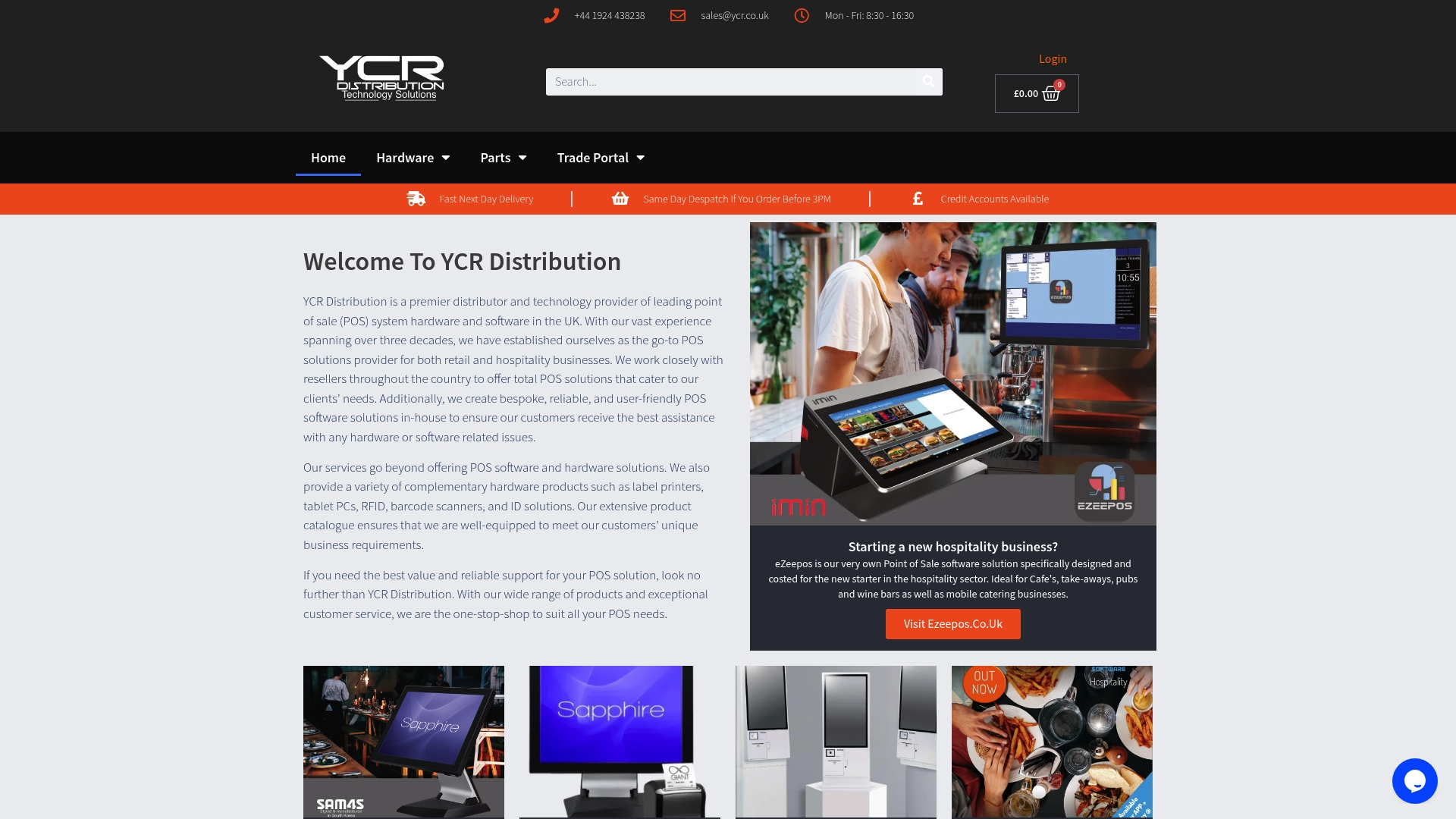
Ycr’s digital signage solutions include screens specced correctly for restaurant environments, paired with cloud-based content management that your team can operate without technical training. The hardware range covers everything from counter-mounted displays to large-format menu boards, and every solution is backed by Ycr’s three decades of POS expertise. Explore the full hardware range or speak to the team directly to discuss the right configuration for your site.
FAQ
How much can digital menu boards increase sales?
86% of restaurants report increased sales after deploying digital menu boards, with average order values typically rising by 20 to 30%. McDonald’s recorded a 3 to 5% ticket value increase across US locations following its digital rollout.
How long does it take to update a digital menu board?
With a cloud-based CMS, menu updates can be pushed to all screens in under an hour. This compares to three to four weeks for a traditional print-and-distribute process.
Do digital signs actually reduce wait times?
Digital displays reduce perceived wait time by up to 35% according to Cornell Center for Hospitality Research findings, even when the actual queue length does not change.
What is dayparting and why does it matter?
Dayparting is scheduling different menu content for specific times of day, such as breakfast deals in the morning and evening specials from 5pm. It removes the need for manual menu changes during service and keeps promotions relevant throughout the day.
What should I check before buying digital signage hardware?
Prioritise screen brightness (700+ nits for indoor use), POS integration capability, CMS ease of use, and offline caching. Poor brightness choices in particular slow down ordering by making menus unreadable under certain lighting conditions.