

Data security in POS systems: a 2026 UK guide

Protecting payment and customer data within a point of sale environment means far more than locking down a card reader. Data security in POS covers every device, software layer, network connection, and human process that touches cardholder information, from the moment a customer taps their card to the point where transaction records are archived or deleted. For UK retailers and hospitality operators, the stakes are concrete: POS breaches cause financial loss, reputational damage, and compliance penalties, with the average global breach cost nearing $4.4 million in 2025. PCI DSS compliance is mandatory for every UK merchant handling card payments, and the standard requires encryption or tokenisation wherever cardholder data is stored or transmitted.
The fundamentals you need to act on now:
- Encrypt at the point of capture using point-to-point encryption (P2PE) so raw card data never enters your systems in cleartext.
- Tokenise stored data to replace sensitive values with non-exploitable tokens.
- Segment your POS network away from guest Wi-Fi, office workstations, and any other traffic.
- Apply role-based access controls with unique accounts and multi-factor authentication for every staff member.
- Patch and update POS software and firmware on a regular, documented schedule.
- Inspect devices physically for skimmers, overlays, or swapped terminals before each trading day.
- Train staff to recognise social engineering, phishing, and suspicious device behaviour.
Table of Contents
- POS data security goes well beyond the payment terminal
- What UK regulations require from your POS security
- Practical security controls that actually protect your POS environment
- Common misconceptions that leave POS systems exposed
- How Ycr’s three decades of POS expertise inform better security
- Why regular security audits matter more than a one-off setup
- Integration with other business systems creates security gaps you need to close
- Ycr supplies the hardware and software UK businesses need for secure POS operations
- Key takeaways
POS data security goes well beyond the payment terminal
Most breaches do not start at the card reader. They start at the weakest point in the broader ecosystem, and that ecosystem is larger than many business owners realise.
A typical retail or hospitality POS environment includes payment terminals, card readers, receipt and label printers, barcode scanners, cash drawers, back-office servers or cloud management portals, loyalty and CRM integrations, and the routers and switches that tie them together. Each component is a potential entry point. Malware injected into a back-office workstation can traverse a flat network and reach the terminal that processes card data. A compromised cloud integration can expose transaction logs. Even a printer with default credentials left unchanged can serve as a foothold.
Physical threats sit alongside digital ones. Skimmers attached to card readers, swapped terminals, and loose cables are all documented attack methods. Physical inspection of devices to detect tampering is as necessary as any software control.
The threat vectors worth mapping across your environment:
- Malware via removable storage introduced during maintenance or by a rogue employee.
- Credential abuse through shared passwords or accounts that were never deactivated after staff turnover.
- Network lateral movement when POS devices share a segment with less-secured equipment.
- Third-party integrations such as loyalty platforms or delivery aggregators that connect directly to POS data flows.
- Physical tampering including skimming overlays and terminal swaps at unattended points of sale.
Understanding the full scope is the prerequisite for building controls that actually hold.
What UK regulations require from your POS security
PCI DSS is the baseline for every UK business that accepts card payments, regardless of size or transaction volume. The standard is tiered by volume: Level 1 applies to the highest-volume processors and carries the most demanding audit requirements, while smaller merchants fall into Levels 2 through 4 with lighter but still mandatory self-assessment obligations. Falling out of compliance does not just attract fines from your acquiring bank; it can result in suspension of card acceptance entirely.
The PCI DSS framework focuses on several interlocking areas:
- Data minimisation: do not store cardholder data unless there is a documented business need, and never store the full magnetic stripe, CVV, or PIN.
- Encryption and tokenisation: protect data in transit and at rest so that intercepted records are useless without the keys.
- Access control: restrict who can see cardholder data to the minimum necessary, and log every access event.
- Vulnerability management: patch systems promptly and run regular scans.
- Monitoring and testing: maintain logs, test controls, and document your security posture.
The UK government’s Cyber Security Breaches Survey consistently finds that a significant proportion of UK businesses experienced a cyberattack or breach in the preceding 12 months, with phishing and malware among the most common vectors. For retail and hospitality operators running POS systems, the combination of high transaction volumes, staff turnover, and connected devices makes the sector a persistent target.
Beyond PCI DSS, UK businesses must also consider the UK GDPR and the Data Protection Act 2018, which govern how personal data collected through loyalty schemes, customer accounts, and digital receipts is stored and processed. A POS breach that exposes customer names, email addresses, or purchase histories triggers notification obligations to the Information Commissioner’s Office (ICO) within 72 hours.
Practical security controls that actually protect your POS environment
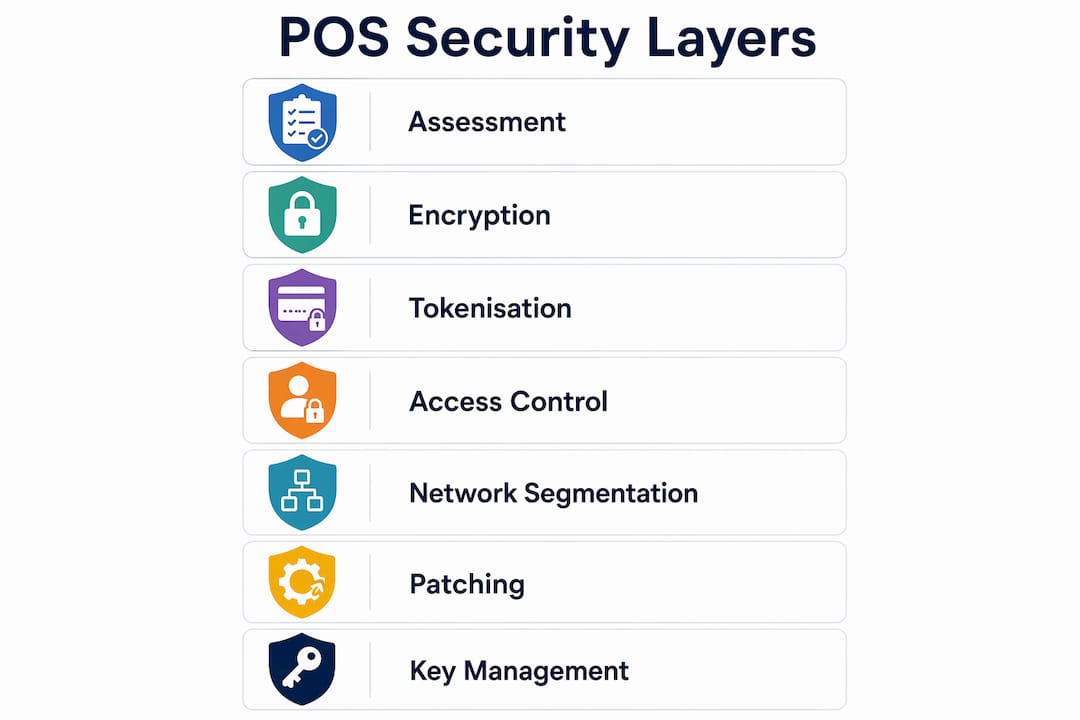
The most effective POS security architecture layers multiple controls so that the failure of any single measure does not expose the whole system. Here is how to build that in practice.
Encryption from the moment of capture
Point-to-point encryption encrypts cardholder data at the card reader before it enters any merchant system. P2PE devices must appear on the PCI-approved list, use secure cryptographic modules, and have keys injected at certified facilities. When implemented correctly, P2PE dramatically reduces your PCI DSS scope because the data flowing through your network is already encrypted and unreadable to an attacker. For offline terminals, Secure Reading and Exchange of Data (SRED) performs the equivalent function at the point of entry.

Tokenisation for stored data
Tokenisation replaces a card number with a non-sensitive token that your systems use for receipts, refunds, and loyalty lookups. The actual card data lives in a secure vault operated by your payment processor. Even if your database is compromised, the attacker retrieves tokens with no monetary value.
Access control done properly
Shared passwords are one of the fastest routes criminals use to bypass security. Every staff member needs a unique account with permissions scoped to their role. A cashier does not need access to refund authorisation; a manager does not need access to system configuration. Multi-factor authentication should apply to any account that can access back-office systems or cloud management portals. Accounts for former employees must be deactivated on the day they leave.

Network segmentation and firewall rules
Dedicated network segments for POS devices prevent malware on a compromised workstation or guest Wi-Fi network from reaching payment infrastructure. Firewall rules should whitelist only the specific IP addresses and ports your POS devices need to communicate with, and block everything else. This is one of the highest-impact controls available and one of the most commonly skipped in smaller hospitality businesses.
Software patching and firmware updates
Attackers routinely exploit known flaws in outdated POS software and firmware. A documented patching schedule, with updates tested in a staging environment before deployment, closes the window of exposure. This applies to the POS application, the operating system, any plugins or integrations, and the firmware on card readers and terminals.
Key management hygiene
Encryption keys require active management: rotation on a defined schedule, secure storage separate from the data they protect, and a revocation process for compromised keys. Key-encrypting keys (KEKs) add a further layer, protecting data encryption keys even if the primary layer is breached.
Pro Tip: Layer your controls so that each one assumes the others may fail. Encryption protects data if the network is breached; tokenisation protects it if the database is stolen; access controls limit what an attacker can reach in the first place. Defence in depth means no single failure is catastrophic.
Common misconceptions that leave POS systems exposed
Several widely held beliefs about POS security create a false sense of protection.
“Our terminal is offline, so it’s safe.” Offline terminals are not inherently secure. Malware can be introduced via removable storage during a maintenance visit, and the stolen data sits dormant until the device reconnects to a network. SRED encryption at the point of entry is the correct mitigation, not disconnection.
“We use a cloud POS, so security is the provider’s problem.” Cloud POS providers secure their infrastructure; you remain responsible for access credentials, network configuration, and the devices connecting to the platform. A compromised staff login is your liability, not theirs.
“Our biggest threat is external hackers.” Insider threats, whether deliberate or accidental, account for a meaningful share of POS incidents. Weak authentication, shared accounts, and staff who have not been trained to recognise phishing are internal vulnerabilities that external controls cannot fix.
“We’re too small to be targeted.” Automated attacks do not discriminate by business size. Opportunistic malware scans for known vulnerabilities across thousands of systems simultaneously. A small café running unpatched POS software is as attractive a target as a large retailer, often more so because defences tend to be lighter.
“Flat networks are fine for a small site.” A flat network architecture means a compromised device anywhere on the network can communicate freely with POS terminals. Network segmentation is not a luxury reserved for enterprise deployments; it is a practical necessity for any site handling card payments.
How Ycr’s three decades of POS expertise inform better security
Ycr has supplied and supported POS hardware and software across UK retail and hospitality for over 30 years. That depth of experience means the team understands not just which products meet compliance requirements, but how they perform under the operational pressures of a busy restaurant service or a high-footfall retail environment.
Ycr distributes hardware from iMin and SAM4S, both of which produce terminals built to current PCI PTS POI standards. The iMin HERON 1 POS holder is a practical example: a purpose-built mounting solution that keeps terminals in a fixed, visible position, reducing the risk of undetected device swaps or tampering. Accessories like the MAG card 86×54 embedded support controlled magnetic stripe workflows within compliant payment environments.
Ycr’s bespoke software solutions, SAMTOUCH for hospitality and EZEEPOS for retail, are designed with UK compliance requirements in mind and receive ongoing updates. For businesses needing guidance on retail POS data security practices specific to the UK market, Ycr publishes detailed resources covering industry standards and implementation steps.
Why regular security audits matter more than a one-off setup
A POS environment configured securely at installation will drift out of compliance without active maintenance. Staff change, integrations are added, software versions fall behind, and network configurations are modified without documentation. Regular audits catch these gaps before attackers do.
A practical audit cycle for a UK retail or hospitality business should include:
- Quarterly vulnerability scans of all POS-connected systems, using tools approved under PCI DSS requirements.
- Annual penetration testing to simulate attacker behaviour across the network and application layers.
- Monthly review of access logs to identify unusual login times, failed authentication attempts, or access to data outside normal patterns.
- Physical device inspections before each trading day, checking for signs of tampering, unfamiliar cables, or overlay attachments.
- Annual review of third-party vendor access, confirming that integrations still require the level of access they were granted.
The PCI DSS framework mandates several of these activities explicitly. Treating them as compliance theatre rather than genuine security practice is the difference between catching a breach early and reading about it in a notification letter.
Integration with other business systems creates security gaps you need to close
Modern POS systems rarely operate in isolation. They connect to stock management platforms, accounting software, online ordering aggregators, loyalty programmes, and cloud reporting dashboards. Each integration extends the attack surface.
The security risks introduced by integration are specific and manageable:
- API credential exposure: integrations that use static API keys stored in configuration files are vulnerable if those files are accessed by an attacker. Rotate credentials regularly and use secrets management tools rather than plaintext storage.
- Data flowing to less-secured systems: a POS system connected to a stock management platform that lacks equivalent security controls creates a path for data exfiltration. Audit the security posture of every connected system, not just the POS itself.
- Vendor remote access: many POS suppliers and integration partners require remote access for support. This access should be time-limited, logged, and revoked immediately after the support session ends. Persistent remote access credentials are a documented attack vector.
- Third-party software components: plugins and middleware connecting POS to external platforms may not receive security updates at the same cadence as the core POS software. Track every component and its update status.
For businesses using secure transaction processing methods within their POS environment, understanding how data flows across integrations is a prerequisite for maintaining compliance. The SSD refund accessory from Ycr supports controlled refund transaction handling, keeping that workflow within the secure POS environment rather than routing it through less-controlled channels. For a deeper look at network-level controls, Ycr’s POS network security guide covers segmentation and firewall configuration in detail.
Ycr supplies the hardware and software UK businesses need for secure POS operations
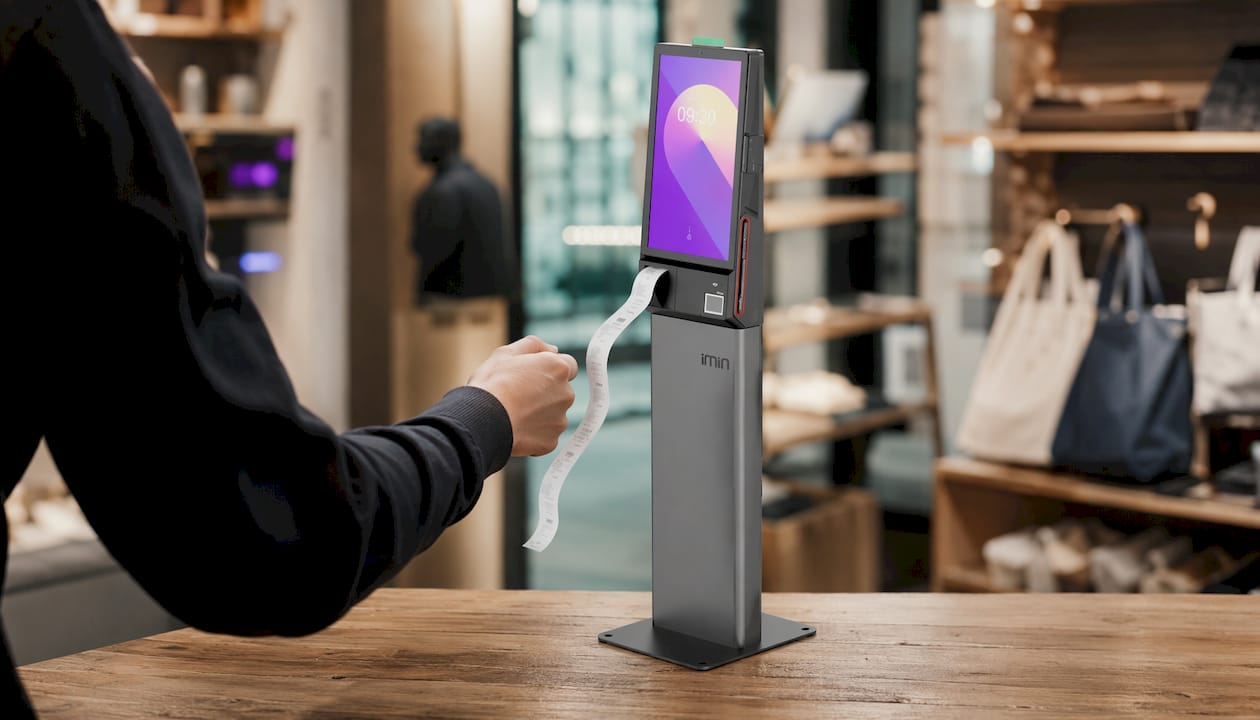
Ycr brings together PCI-compliant POS terminals, purpose-built accessories, and actively maintained software under one roof, with next-day delivery and same-day dispatch for UK businesses. Whether you are setting up a new site or replacing ageing hardware that no longer meets current cryptographic standards, Ycr’s range covers the full environment: terminals, card readers, printers, barcode scanners, cash drawers, and the mounting hardware that keeps devices secure and visible.
SAMTOUCH and EZEEPOS are updated to reflect current UK compliance requirements, and Ycr’s team can advise on configurations that reduce your PCI DSS scope from the outset. Trade accounts are available for resellers and system integrators who need reliable supply at volume. Browse the full range at ycr.co.uk or contact the team directly to discuss your site’s requirements.
Key takeaways
Strong POS data security requires layered technical controls, active compliance management, and staff training working together, not any single measure in isolation.
| Point | Details |
|---|---|
| Encrypt at capture | P2PE or SRED encrypts card data at the reader, keeping cleartext out of your systems entirely. |
| PCI DSS is mandatory | Every UK merchant accepting card payments must comply, with requirements covering encryption, access control, and monitoring. |
| Breach costs are severe | The average global breach cost reached nearly $4.4 million in 2025, alongside reputational and regulatory consequences. |
| Audit and patch continuously | Quarterly scans, annual penetration tests, and a documented patching schedule prevent configuration drift from creating exploitable gaps. |
| Ycr for compliant hardware | Ycr supplies PCI-standard terminals, accessories, and actively maintained POS software with next-day UK delivery. |