
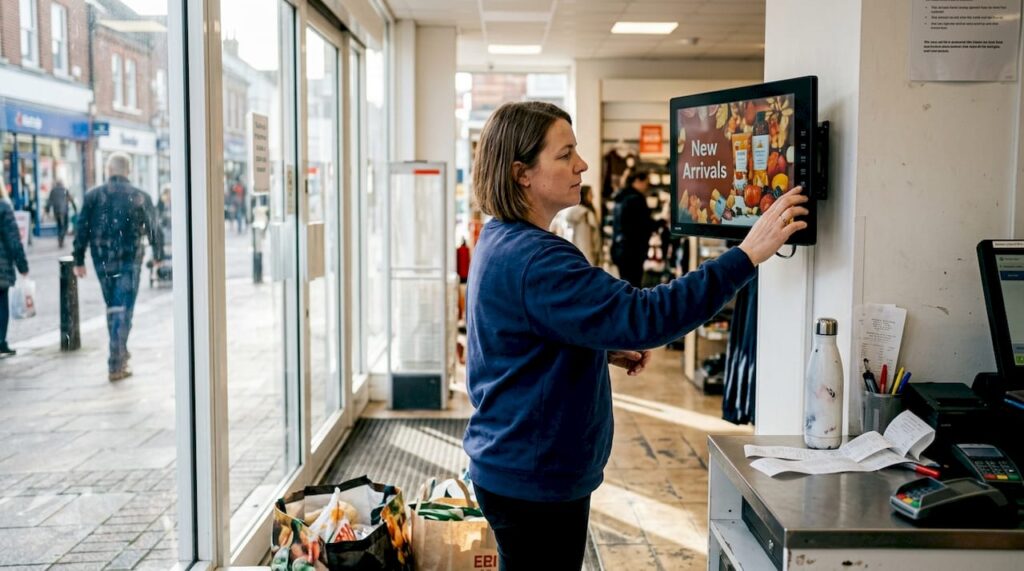
UK retailers are reporting a 31.8% average sales increase after switching from static displays to digital signage. That figure surprises most business owners who assume digital screens are simply a flashier version of a poster. The reality is quite different. Digital signage is a proven operational tool that shapes customer behaviour, drives impulse purchases, and delivers real-time flexibility that static displays simply cannot match. In this article, we cover what digital signage actually is, how it generates measurable results across UK retail and hospitality, and how to implement it effectively in your own venue or store.
Table of Contents
- What digital signage is and how it evolved
- How digital signage drives sales and engagement
- Applying digital signage in retail and hospitality environments
- Choosing and measuring the right digital signage solutions
- Our take: digital signage is more than screens, it is a business lever
- Take your business further with digital signage solutions
- Frequently asked questions
Key Takeaways
| Point | Details |
|---|---|
| Significant sales impact | Digital signage delivers up to 31.8% higher sales over static displays for UK retailers. |
| Data-backed customer engagement | Evidence shows venues using digital signage achieve more impressions, engagement, and upsell opportunities. |
| Strategy beats screens | Businesses that treat digital signage as an ongoing strategy, not a one-off display, see the largest and most lasting benefits. |
| Sector-specific best practices | Retailers and hospitality venues benefit most when content and implementation are tailored for their specific operational needs. |
What digital signage is and how it evolved
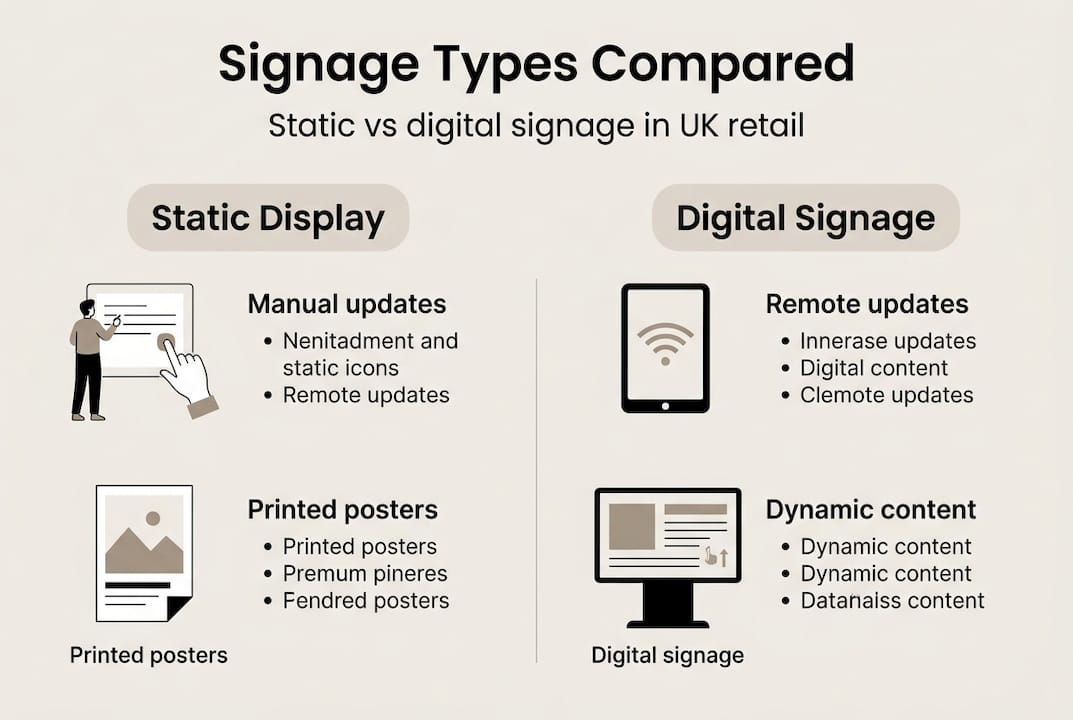
Digital signage refers to electronic display systems that show dynamic multimedia content, including video, images, animations, and live data feeds. Unlike a printed poster, the content can be updated remotely within minutes, scheduled automatically, and tailored to specific audiences or times of day. A breakfast promotion at 8am, a lunch deal at noon, and a happy hour offer at 5pm can all run on the same screen without anyone touching the display.
The shift from paper and static displays to digital systems has accelerated sharply across UK businesses over the past decade. Early adopters were large retailers and fast-food chains. Today, independent cafes, convenience stores, and local pubs are all making the move. The cost of entry has dropped considerably, and the content management software has become far simpler to operate.
Understanding defining digital signage properly helps you see why it sits in a different category to traditional advertising. It is not just a screen. It is a live communication channel between your business and your customers.
Static vs digital signage: a direct comparison
| Feature | Static display | Digital signage |
|---|---|---|
| Content updates | Manual, costly reprint | Remote, instant |
| Scheduling | Not possible | Fully automated |
| Multimedia support | None | Video, animation, live data |
| Long-term cost | High (reprinting) | Lower over time |
| Customer engagement | Limited | Significantly higher |
The operational advantages are clear, but the commercial impact is what really matters. Sales uplift of 31.8% compared to static displays is not a marginal improvement. It is a material shift in revenue performance.
Key reasons UK businesses are adopting digital signage:
- Ability to promote high-margin products at peak trading times
- Real-time updates for pricing, availability, and events
- Consistent brand presentation across multiple locations
- Reduced print costs and faster campaign turnaround
- Stronger visual impact in competitive retail environments
“Digital signage is not a technology upgrade. It is a customer communication strategy that happens to use screens.”
The businesses that treat it as the latter are the ones seeing the strongest returns.
How digital signage drives sales and engagement
Now that you know what digital signage is, let us turn to the most crucial question: does it truly make a difference for your business objectives?
The evidence from UK venues is compelling. UK retailers and hospitality operators consistently report uplifts ranging from 5% in smaller venues to over 31% in retail environments with well-executed campaigns. Stonegate, one of the UK’s largest pub operators, recorded 5 to 13% sales uplift during Euro 2024, alongside 110 million impressions generated through their digital signage network across venues.
Those numbers matter because they come from real trading conditions, not controlled experiments. They reflect what happens when customers are presented with visually engaging, timely, and relevant content at the point of decision.
Sales uplift benchmarks from UK digital signage deployments
| Sector | Reported sales uplift | Source context |
|---|---|---|
| UK retail (average) | 31.8% | Multi-retailer benchmark |
| Stonegate pubs (Euro 2024) | 5 to 13% | Event-led campaign |
| UK convenience stores | Up to 29.5% | Promotional screen pilots |
Digital signage influences behaviour in three distinct ways. First, it extends dwell time. Customers who stop to watch engaging content spend longer in your venue, which correlates directly with higher spend per visit. Second, it triggers impulse purchases. A well-placed screen near a till or queue area promotes add-ons and upgrades that customers would not have considered otherwise. Third, it supports upselling. Staff do not need to mention every special offer. The screen does it for them, consistently and without fatigue.
You can explore sales boost case studies from UK businesses to see how these principles play out in practice. The 29.5% sales boost recorded in convenience store pilots shows that the impact is not limited to large chains.
Key engagement benefits your business can expect:
- Higher average transaction values through visible upsell prompts
- Increased footfall conversion when window-facing screens attract passers-by
- Stronger event and seasonal campaign performance
- Reduced perceived wait times in queues, improving customer satisfaction
- Greater brand recall compared to static or verbal promotions
The data makes a strong case. The next step is understanding how to apply it in your specific environment.
Applying digital signage in retail and hospitality environments
With measurable benefits in sight, let us look at how real-world venues and stores apply digital signage for noticeable results.
The most common applications fall into four categories: menu boards, promotional campaign screens, real-time event displays, and wayfinding. Each serves a different purpose, but all share the same underlying principle. They deliver the right message to the right customer at the right moment.
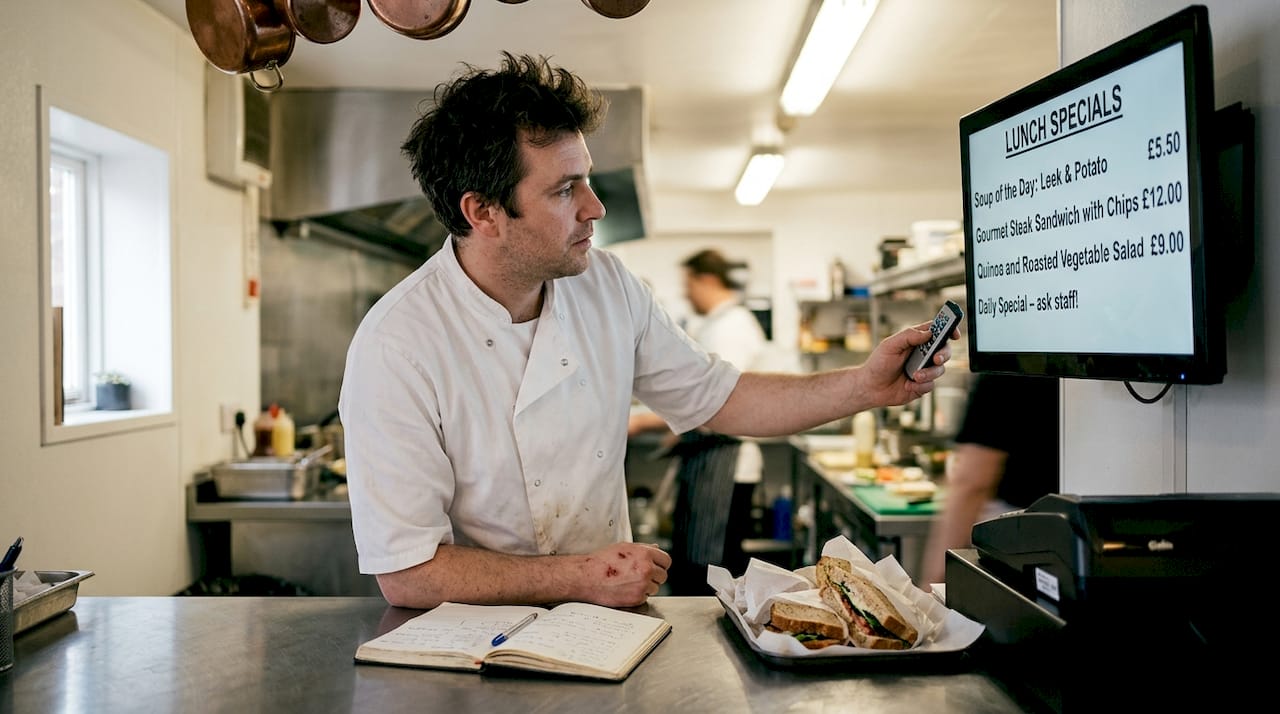
In hospitality, digital menu boards are the most immediate win. They allow you to update pricing, remove sold-out items, and highlight high-margin dishes without printing a single sheet. Stonegate pilot venues consistently achieved over 5% sales uplifts by pairing digital menus with event-led promotional content.
In retail, promotional screens near entrances and at point of sale are particularly effective. They capture attention during the decision-making window, which is often just a few seconds.
Steps to implement digital signage in your business:
- Assess your needs. Identify which areas of your venue would benefit most from dynamic content. High-traffic zones, queuing areas, and entry points are strong starting positions.
- Plan your content strategy. Decide what messages matter most: promotions, events, brand values, or product highlights. Rotate content regularly to keep it fresh.
- Choose appropriate hardware. Screen size, brightness, and connectivity matter. A screen that looks great in a dim office may be unreadable in a bright retail environment.
- Integrate with your existing systems. The best setups connect digital signage to your POS data, so pricing and availability update automatically.
- Train your staff. Even simple systems need a confident operator. A short briefing prevents content from going stale or displaying errors.
- Review and optimise. Set a monthly review to assess what content is driving results and what needs replacing.
Pro Tip: Avoid the temptation to fill every screen with every promotion at once. Customers process one clear message far more effectively than a cluttered display. Prioritise your highest-margin offer and give it space to breathe.
For guidance on impact in retail environments and practical advice on hospitality venue efficiency, both resources offer detailed next steps tailored to UK operators.
Choosing and measuring the right digital signage solutions
Seeing practical examples, business owners also need to choose the right solutions and ensure ongoing returns.
The hardware and software landscape for digital signage has expanded significantly. Choosing the wrong combination is one of the most common and costly mistakes. A screen with insufficient brightness in a window-facing position, or software that requires specialist IT support to update, will undermine your investment quickly.
When evaluating hardware, consider:
- Screen brightness. Measured in nits. Retail environments typically require 700 nits or above for clear visibility in natural light.
- Connectivity. Wi-Fi and LAN options allow remote content management. Screens that require USB updates create unnecessary operational friction.
- Durability. Commercial-grade screens are built for extended daily use. Consumer televisions are not, and the difference shows within months.
- Integration capability. Screens that connect to your POS system allow automatic content updates based on live stock and pricing data.
On the software side, look for platforms that offer intuitive scheduling, multi-screen management, and basic analytics. You should not need a designer to update a promotion.
Pro Tip: Before committing to a full rollout, run a pilot on one or two screens in your highest-traffic area. Measure the sales uplift over four weeks, then scale based on real data rather than assumption.
For measuring signage impact effectively, focus on these KPIs:
- Sales uplift per product category promoted
- Average transaction value before and after installation
- Customer dwell time in key zones
- Footfall conversion rate from window-facing screens
UK benchmarks suggest you should expect 5 to 30% sales lift with proper execution. If your results fall below this range after a reasonable trial period, the issue is almost always content quality or screen placement rather than the technology itself. Review your signage solution best practices regularly and adjust accordingly.
Our take: digital signage is more than screens, it is a business lever
After supporting retail and hospitality businesses through countless digital signage rollouts, one pattern stands out clearly. The businesses that treat digital signage as a communication strategy consistently outperform those that treat it as a decoration.
Most competitors install a screen, load it with generic brand imagery, and wonder why the results are modest. The businesses seeing 20% or 30% uplifts are using their screens to answer the customer’s unspoken question at every moment: “What should I buy next?”
That is a fundamentally different mindset. It means your content strategy is as important as your hardware choice. It means reviewing screen performance monthly, not annually. And it means connecting your signage to your trading data so that what appears on screen reflects what is actually happening in your business right now.
Strategic digital signage done well becomes invisible to the customer. They simply feel guided, informed, and more inclined to spend. That is the real lever. Not the screen itself, but the thinking behind what it shows.
Take your business further with digital signage solutions
Ready to make digital signage deliver true impact in your UK business?
At YCR Distribution, we supply commercial-grade digital signage hardware built specifically for retail and hospitality environments. Whether you are looking to install your first screen or scale an existing setup, our range covers everything from single-venue solutions to multi-site deployments. You can review the proven sales boost evidence from UK businesses similar to yours, or browse our full POS hardware range to find the right combination of screen, software, and support for your operation. Our team is ready to help you choose the right solution and get it working from day one.
Frequently asked questions
How much can digital signage increase sales in the UK?
UK retailers report an average 31.8% sales uplift after implementing digital signage, with hospitality venues like Stonegate recording 5 to 13% uplifts during event-led campaigns.
Does digital signage work for small hospitality venues?
Yes. Stonegate pilot venues achieved over 5% sales uplift even in smaller settings, with event-driven content proving particularly effective for pubs and bars.
What content should I display on my business’s digital signage?
Promotional offers, digital menu boards, real-time event updates, and branded messages are the most effective content types, particularly when scheduled to match peak trading periods.
How do I measure digital signage effectiveness?
Track sales uplift by product category, average transaction value, customer dwell time, and footfall conversion, then adjust your content schedule based on what the data shows each month.