

TL;DR:
- Choosing the right digital signage with POS integration boosts ROI and operational efficiency.
- Interactive digital menu boards increase customer engagement and reduce print costs in hospitality.
- Motion signage in retail significantly enhances sales, attention, and brand consistency across locations.
Choosing the right digital signage solution is one of the most consequential decisions a UK retail or hospitality business can make. The wrong choice means wasted spend, frustrated staff, and screens that customers simply ignore. The right choice, however, transforms how you communicate promotions, guide shoppers, and drive sales. Cloud CMS with POS integration delivers measurable ROI across both sectors. This guide walks you through the key selection criteria and five proven signage examples, so you can make a confident, ROI-focused decision.
Table of Contents
- Evaluating digital signage: key criteria for UK businesses
- Interactive menu boards: engaging hospitality customers
- Retail motion signage: driving sales and shopper attention
- Wayfinding and information screens: streamlining communication
- Product spotlight: trade digital signage for retail and hospitality
- What most UK businesses get wrong about digital signage ROI
- Explore industry-leading digital signage solutions for your business
- Frequently asked questions
Key Takeaways
| Point | Details |
|---|---|
| Cloud CMS is essential | Cloud content management simplifies updates and enables central control across venues. |
| POS integration drives real-time value | Connecting digital signage to POS systems delivers instant menu and offer adjustments. |
| Measure more than sales | True ROI includes print cost savings and improved staff efficiency, not just sales uplift. |
| Versatility maximises investment | Trade signage solutions adapt easily across both retail and hospitality businesses. |
| Customer engagement increases revenue | Dynamic signage captures attention and drives impulse purchases, boosting retail revenue. |
Evaluating digital signage: key criteria for UK businesses
Before you invest in any screen or software, you need a clear framework for comparison. Not all digital signage platforms are built the same, and the differences matter enormously once you are running a busy venue or managing multiple store locations.
The most important criteria to assess are:
- Ease of content management: A cloud-based content management system (CMS) lets you update screens remotely, instantly, and without technical expertise. If updating a promotion requires calling your IT provider, the system is already costing you money.
- POS integration: Real-time connection between your point of sale and your signage means pricing and availability changes happen automatically. No manual updates, no outdated menus on screen.
- ROI tracking: Look for platforms that allow you to measure sales uplift, print cost savings, and customer engagement metrics. What gets measured gets improved.
- Hardware flexibility: Retail and hospitality environments are physically different. Your signage hardware needs to suit portrait or landscape orientations, varying screen sizes, and different mounting requirements.
- Scalability: If you plan to expand, your signage platform must scale without requiring a full system replacement.
When comparing options, cloud CMS with POS integration consistently outperforms standalone systems on ROI. The ability to push a price change or a new promotion to every screen across multiple sites in seconds is a genuine operational advantage.
Pro Tip: Before shortlisting any supplier, ask for a live demonstration of their CMS. If it takes more than three clicks to update a promotion, it will create friction for your team every single day.
“The businesses that get the most from digital signage are the ones that treat the CMS as a daily operational tool, not a set-and-forget system.”
For a broader understanding of how signage fits into your overall customer strategy, the retail engagement guide from YCR is a useful starting point.
Interactive menu boards: engaging hospitality customers
For restaurants, cafes, takeaways, and pubs, digital menu boards are the single most impactful signage investment available. They do far more than display a list of dishes.
The core advantages for hospitality operators include:
- Real-time item updates: Sold out of the soup? Remove it from the board instantly. No crossed-out chalk, no awkward conversations with customers.
- Dynamic pricing: Adjust prices for lunch specials, happy hours, or seasonal menus without reprinting anything.
- Upsell prompts: Display high-margin add-ons, meal deals, or desserts at exactly the right moment in the customer journey.
- Print cost elimination: The savings on menus, posters, and promotional materials add up significantly over a year.
UK venues report up to 30% more engagement when they switch from static printed menus to dynamic digital displays. That is not just about aesthetics. It reflects how motion, colour, and timely content capture attention in a way that printed materials simply cannot.
The operational simplicity is equally compelling. When your digital menu boards are linked directly to your POS, a price change in your system reflects on every screen within seconds. Staff do not need to remember to update the board. It happens automatically.
Pro Tip: Schedule your upsell content to appear at peak times. Promote desserts between 12:30 and 2:00 pm during the lunch rush, and push cocktail specials from 5:00 pm onwards. Timed content consistently outperforms static displays.
For hospitality businesses exploring how to connect their boards to their till system, the POS menu integration options available through YCR are worth reviewing. You can also explore the broader digital signage impact across customer-facing environments.
Retail motion signage: driving sales and shopper attention
Menu boards are just the start. In retail environments, motion signage takes promotional communication to a different level entirely.
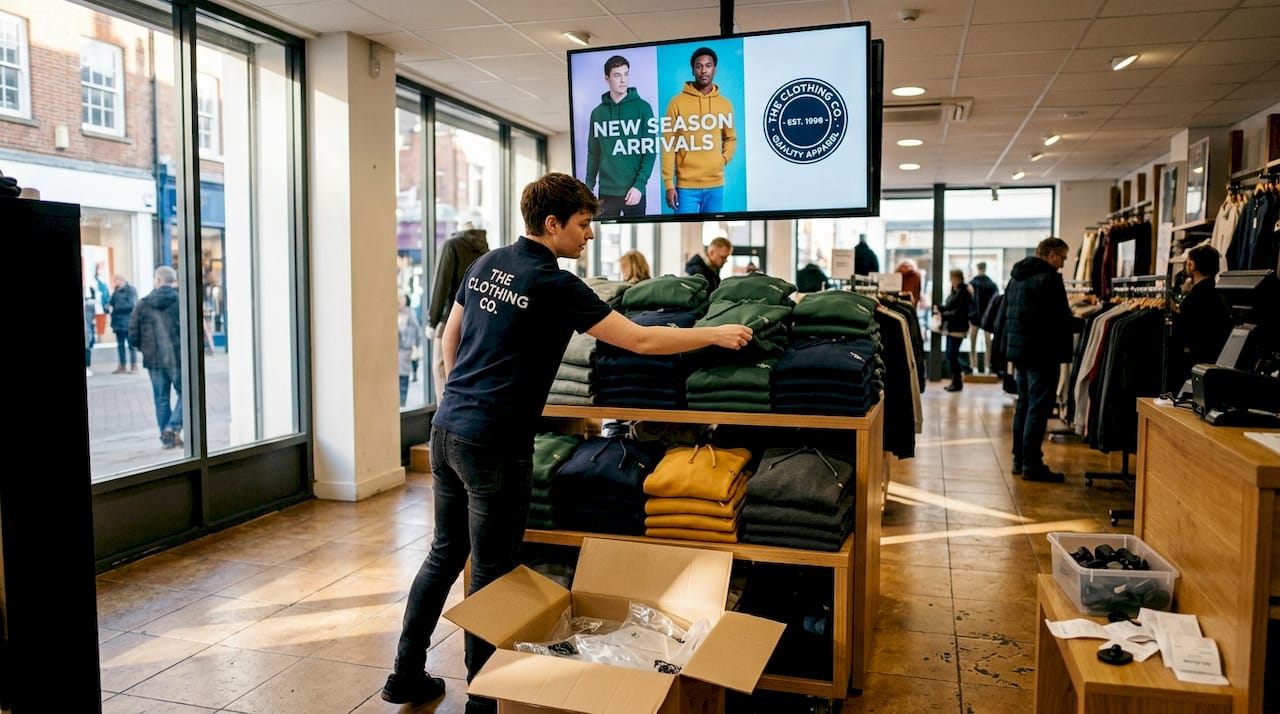
Animated content stops shoppers in their tracks. A static poster promoting 20% off is easy to walk past. A screen with motion graphics, bold colours, and a countdown timer is not. That difference in attention translates directly into sales.
The key benefits of retail motion signage include:
- Instant promotional updates: Change an offer across every screen in your store or chain from one dashboard.
- Reduced print dependency: No more waiting days for printed POS materials to arrive when you need to react to a competitor’s promotion.
- Seasonal agility: Switch from summer to back-to-school to Christmas promotions without any physical effort.
- Chain-wide consistency: Every location shows the same approved content, protecting your brand standards.
The numbers support the investment. Digital signage delivers a 31.8% sales boost in UK retail environments, making it one of the highest-return marketing tools available to store operators.
| Feature | Static signage | Digital motion signage |
|---|---|---|
| Update speed | Days (print lead time) | Seconds (cloud CMS) |
| Engagement rate | Low | High |
| Promotional flexibility | Limited | Unlimited |
| Print costs | Ongoing | Eliminated |
| ROI tracking | Difficult | Built-in analytics |
For a detailed breakdown of how motion signage drives revenue, the sales uplift case study on the YCR website is highly relevant. You can also explore retail technology examples to see how leading UK stores are applying these tools.
Wayfinding and information screens: streamlining communication
Beyond sales, digital signage also transforms in-store communications and navigation. This is an area that many businesses overlook, yet it has a direct impact on customer satisfaction and staff efficiency.
Wayfinding screens help customers find what they need quickly, reducing frustration and the number of times staff are interrupted with directional questions. In larger retail environments, this is a significant operational benefit.
Information screens serve a dual purpose:
- Customer-facing: Department locations, queue management, service updates, and event information.
- Staff-facing: Shift schedules, policy updates, safety notices, and operational alerts displayed in back-of-house areas.
The difference between paper-based and digital information systems is stark:
| Criteria | Paper-based | Digital screens |
|---|---|---|
| Update speed | Hours to days | Seconds |
| Accuracy | Prone to error | Centrally controlled |
| Staff time required | High | Minimal |
| Customer satisfaction | Moderate | Improved |
| Environmental impact | High (print waste) | Low |
Streamlined digital signage reduces confusion and improves both customer and staff communication measurably. When a customer can find the fitting rooms without asking three members of staff, everyone benefits.
For businesses ready to implement a full signage network, the signage systems overview at YCR covers available hardware and screen types. Pairing this with the right CMS software ensures your team can manage all screens from a single platform.
Product spotlight: trade digital signage for retail and hospitality
To round out the comparison, it is worth examining solutions that work seamlessly across both retail and hospitality environments. Trade digital signage platforms are designed with exactly this versatility in mind.
Where single-venue solutions can feel limiting as your business grows, trade-grade signage platforms are built for scale. The key characteristics include:
- Multi-site management: Control content across dozens of locations from one cloud dashboard.
- Role-based access: Give individual store managers the ability to update local promotions without affecting the master brand template.
- POS and staff system integration: Signage updates automatically when your inventory or pricing changes.
- Hardware agnostic: Works with a wide range of commercial-grade screens and media players.
- Rapid deployment: New locations can be onboarded to your signage network quickly, without specialist installation teams.
Cloud CMS signage solutions offer true scalability and integration across multiple venue types, which is why they are the preferred choice for expanding retail groups and multi-site hospitality operators.
Pro Tip: If you are planning to open new locations in the next 12 months, choose a signage platform that supports bulk screen provisioning. Setting up 20 screens should take minutes, not days.
For businesses sourcing at trade level, the trade signage solutions available through YCR are worth exploring. You can also review cost reduction insights to understand the full financial case for switching from print-based communications.
What most UK businesses get wrong about digital signage ROI
Here is an uncomfortable truth: most businesses measure digital signage ROI incorrectly. They look at sales uplift in the first month, see a modest improvement, and conclude the investment was underwhelming. They miss the bigger picture entirely.
The real ROI from digital signage comes from three sources, not one. Sales uplift is the visible metric. But print savings and staff efficiency are often where the biggest financial gains sit. A mid-sized restaurant group spending £800 per month on printed menus and promotional materials eliminates that cost almost entirely when they switch to digital boards.
Integration gaps are the other common mistake. When signage is not connected to your POS, someone has to manually update screens. That labour cost erodes your ROI quietly, every single week. The businesses that see the strongest returns from digital signage track multiple KPIs: revenue per customer, print spend, staff time on content updates, and customer satisfaction scores. Review the sales boost evidence and you will notice that the highest performers are those who treated signage as an integrated operational system, not a marketing add-on.
Explore industry-leading digital signage solutions for your business
If the examples above have given you a clearer picture of what digital signage can do for your operation, the next step is straightforward.
At YCR Distribution, we supply digital signage products suited to retail stores, restaurants, cafes, and multi-site operators across the UK. Whether you need a single interactive menu board or a full network of motion screens managed through CMS software solutions, we have the hardware and software to match your requirements. Pair your signage with our range of POS hardware options for a fully integrated system that updates automatically and keeps your communications sharp, accurate, and on-brand.
Frequently asked questions
How do digital signage solutions boost sales in retail stores?
Digital signage captures shopper attention through motion and dynamic content, prompting impulse purchases and driving up to 31.8% sales uplift in UK retail environments.
What is the best way to measure ROI from digital signage?
Track three metrics together: sales uplift, print cost savings, and staff time saved on content updates. Focusing only on sales and print savings gives a more accurate picture of total return.
Can digital signage be integrated with POS systems?
Yes. Cloud CMS platforms typically include native POS integration, allowing menu prices, item availability, and promotions to update automatically across all screens.
Do digital signage solutions reduce operational costs?
They eliminate ongoing print costs and reduce the staff time needed to manage physical promotional materials, with measurable ROI across both retail and hospitality settings.