
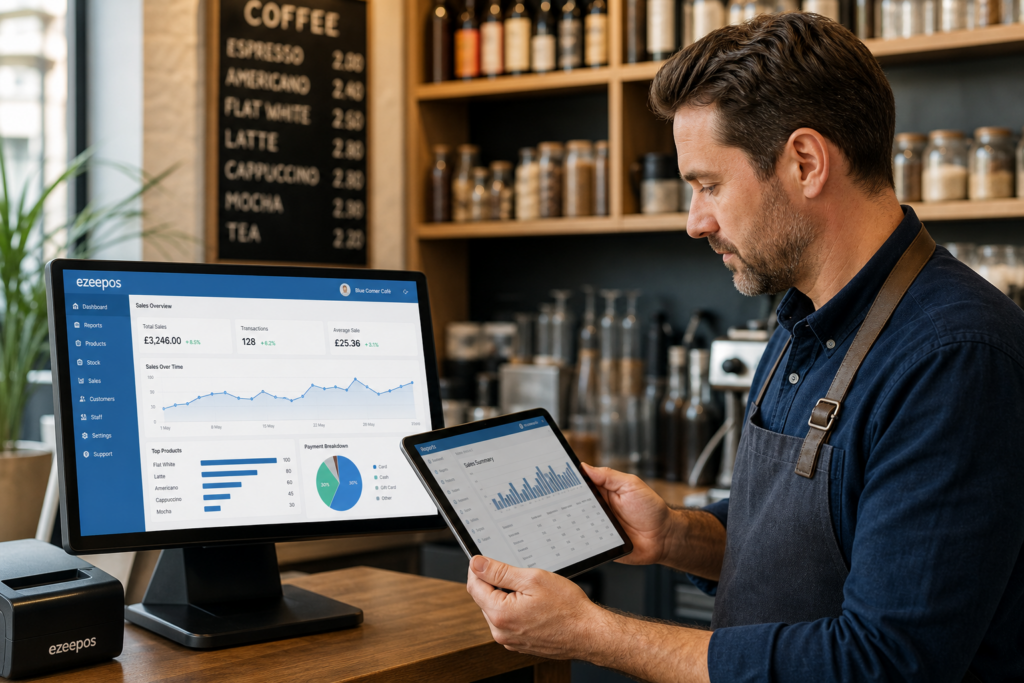
Why reporting matters more than many businesses realise
For many independent retailers, cafes, restaurants and takeaways, reporting is one of the most useful parts of an EPOS system, yet it is often overlooked until the business is already under pressure. Daily figures, busiest trading times, product sales and staff performance all tell a story that can help owners make better decisions.
With a modern EPOS setup, reporting is no longer something that only happens at the end of the month. It can become part of day-to-day management, helping businesses respond faster to changing demand, wider trading conditions and customer habits. That is where systems such as eZeePOS can add practical value for UK businesses that want clearer information without adding more admin.
If you are comparing options, it is worth looking beyond the till screen itself and asking what the reporting tools actually tell you, how easy they are to read and whether they are useful in a real working environment.
What good EPOS reporting should help you see
Useful reporting does not need to be complicated. In most businesses, the most valuable information is often the simplest:
- Which products or menu items are selling well
- What times of day are busiest
- Which days trade strongest or weakest
- How refunds, voids or discounts are being used
- Whether sales are changing week by week
- How different locations or departments are performing
These are the kinds of insights that help owners make practical decisions. For example, a cafe may discover that breakfast trade is strongest between 8am and 10am, while a gift shop might see that certain seasonal ranges are outperforming long-standing lines. In hospitality, a restaurant may notice which days need more staff on the floor, while a shop may use reports to adjust opening hours or promotional activity.
Turning figures into decisions, not just records
Reporting is only useful if it leads to action. A good EPOS report should do more than display totals. It should help answer questions such as: Do we need to order differently? Are we scheduling staff at the right times? Are discounts being used sensibly? Are some products taking up more shelf or menu space than they deserve?
This is why many business owners prefer reporting that is clear at a glance rather than heavily technical. When the information is easy to read, it is much more likely to be used regularly. That can lead to better rota planning, steadier cash flow management and a clearer view of how the business is actually trading.
Retail and hospitality need different reporting priorities
Although the principle is similar, the most useful reports depend on the type of business. A retailer often wants to understand product performance, basket trends and seasonal changes. A hospitality venue may care more about peak service periods, menu performance, table turnover or staff productivity during busy service.
That is why it helps to choose a system that suits the way you work. A single set of generic reports may be enough for some businesses, but others need a more tailored view of sales and trading patterns. A flexible EPOS system can help businesses keep reporting focused on what actually matters, rather than forcing every operator into the same layout.
Examples of reporting by business type
- Convenience stores: quickly identify fast-moving lines and sales spikes across the week
- Cafes: compare breakfast, lunch and quieter trading periods to plan staffing
- Restaurants: review service trends and menu performance across different shifts
- Takeaways: spot the busiest order periods and track sales by channel or menu section
- Gift shops: understand which product categories are driving regular footfall
These insights do not replace experience, but they can support better judgement. Business owners still know their customers best, yet clear reports can back up those instincts with practical evidence.
How reporting helps during busy or uncertain trading periods
Many UK businesses face uneven trading patterns, especially across seasonal peaks, holidays or weather-sensitive periods. Reporting becomes even more helpful when conditions change quickly. If sales dip unexpectedly, clear figures can show whether the issue is linked to a specific day, time or category. If trade improves, reports can show what is driving the change.
For example, a garden centre may see different patterns through the year. A hospitality venue may notice that bank holidays, school breaks or local events affect footfall. A retailer may find that a promotion is lifting sales in one category but weakening margins in another. Good reporting gives owners a way to look at those shifts calmly and respond with more confidence.
It is also useful for spotting recurring issues. If the same product keeps generating refunds, or if the same period of the week is always underperforming, that is a sign the business may need to review stock, staffing, pricing or layout.
Keeping reporting practical for smaller teams
For smaller businesses, the value of reporting lies in speed and clarity. Owners do not always have time to dig through complex dashboards. They need dependable information that can be checked quickly between customers, after service or at the end of the day.
This is where simple, well-organised reporting can make a real difference. When a team can see sales totals, bestsellers and trading patterns without extra admin, the business becomes easier to manage. It also helps when multiple people need to access the same information, such as a manager, supervisor or owner working off-site.
In practice, that can support:
- Faster end-of-day review
- Better staff planning
- More informed ordering and replenishment
- Clearer reviews of promotions or menu changes
- More consistent management across more than one site
What to look for when choosing reporting tools
Not every EPOS system presents data in the same way. Before choosing a setup, it is worth thinking about the reports you will actually use. A strong reporting tool should be easy to access, simple to understand and relevant to your business model. It should also save time rather than create more admin.
Ask whether the system allows you to review trends over time, compare periods and view the information most important to your business. If you are running more than one site, multi-site reporting may also be important, especially if you want to compare locations without working from separate spreadsheets.
For some operators, the best report is the one that can be checked in a few seconds before a busy shift starts. For others, it is the one that highlights sales changes early enough to adapt staffing or stock planning for the following week.
A practical step for growing UK businesses
If your business is already using an older till or a manual process, better reporting can be one of the most noticeable benefits of moving to a modern EPOS system. It gives you clearer insight with less effort and supports better day-to-day decisions across retail and hospitality.
YCR Distribution can help businesses explore EPOS options that make reporting more useful in practice, not just in theory. If you want a system that supports clearer decisions as you grow, take a look at www.ezeepos.co.uk to see how eZeePOS could fit your business.
Contact YCR Distribution at sales@ezeepos.co.uk or call 01924 438238.