
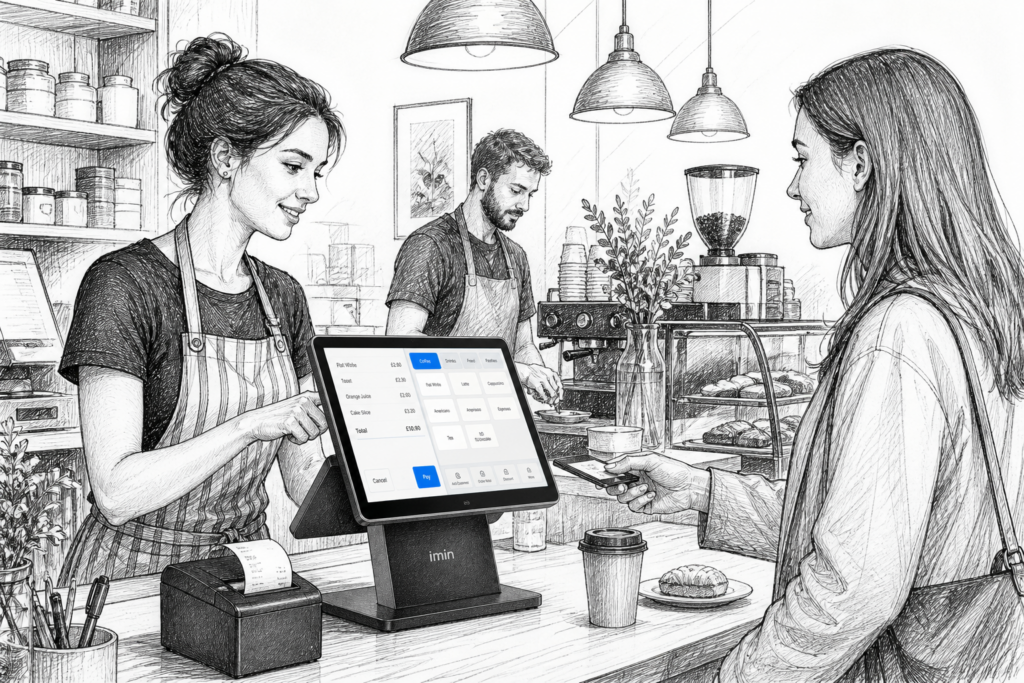
Retail and hospitality businesses are asking more from their point-of-sale hardware than ever before. A checkout system is no longer just there to take payments; it often needs to support product lookup, table service, customer interaction, queue management and faster day-to-day trading. That is one reason Android-based POS hardware has become a practical option for a growing number of UK businesses.
iMin Android POS terminals are part of that shift. Rather than relying on a traditional till or a basic office-style computer, many businesses now want a compact touchscreen POS terminal that feels easier for staff to use, simpler to deploy and more adaptable to changing trading needs. For EPOS resellers, installers and business owners, understanding where iMin fits can help make better hardware choices.
Why Android POS has become more relevant
Android POS is often considered by businesses that want a modern interface, straightforward operation and hardware that can suit compact counters or busy service areas. In practical terms, that can be useful in a café, takeaway, independent shop or hospitality venue where staff need a system that is quick to learn and easy to use under pressure.
Compared with older till hardware, Android POS terminals can provide a cleaner front-of-house experience. They are often designed as all-in-one devices, which helps reduce the number of separate boxes and cables sitting on the counter. For many businesses, that is not just about appearance. A tidier checkout can make the working area easier to manage and less prone to disruption.
Where iMin terminals can fit well
iMin Android POS terminals can suit a wide range of retail and hospitality environments, especially where the business wants a touchscreen POS setup rather than a traditional cash register. Typical use cases may include:
- independent shops and convenience stores
- cafés, coffee shops and quick-service counters
- bars and pubs with busy service periods
- takeaways and food-to-go counters
- small retailers looking to modernise a checkout point
These settings usually benefit from a system that is quick to navigate and simple for new staff to pick up. That matters during busy periods, seasonal peaks or when businesses rely on part-time teams.
What businesses tend to look for in a touchscreen POS terminal
When choosing any POS terminal, the most important question is not simply what the hardware looks like, but how it will perform in day-to-day use. A useful terminal should make transactions faster, help staff work more consistently and avoid unnecessary downtime.
For example, if a retailer is replacing an ageing till, the main need may be a more reliable and more intuitive interface at the counter. In hospitality, the focus may be on order entry, item modifications and keeping service moving without keeping customers waiting. iMin Android POS hardware is often considered because it sits within that practical middle ground between a basic tablet-style approach and a heavier traditional POS setup.
Practical benefits in real business use
The benefits of a product like iMin are usually easiest to understand in the real environment rather than in specification terms. A touchscreen terminal can help staff process transactions more naturally, reduce the time spent training new starters and make the checkout feel less intimidating for occasional users. A compact design can also be useful where counter space is limited.
For hospitality businesses, a touchscreen POS at front of house can improve service flow. Staff can take orders, amend items and move on quickly, which is especially important in venues where speed and accuracy matter. For retail businesses, the same style of terminal can help with item entry, promotions and customer-facing sales work at the till.
Why resellers and installers pay attention to hardware choice
For EPOS dealers and installers, an Android POS terminal is more than a product category. It is part of the wider solution they are putting in front of the customer. That means the terminal needs to be suitable for the route to market, the type of business and the level of support expected after installation.
Businesses often want guidance on whether to choose Android POS, Windows POS or another format. The right answer depends on the customer’s workflow, the software they plan to use and the environment the terminal will live in. A reseller who understands those needs can avoid over-specifying hardware or recommending equipment that complicates deployment unnecessarily.
YCR Distribution works with EPOS resellers, dealers and installers across the UK, supplying point-of-sale hardware and related technology to the trade. If you are planning a rollout or replacing older EPOS hardware, having access to an experienced UK POS distributor can make sourcing and support much easier. You can explore the wider range at www.ycr.co.uk.
Choosing the right iMin terminal for the job
Not every business needs the same type of terminal, even if they all want a modern touchscreen POS system. Before choosing iMin or any similar hardware, it helps to consider the trading environment, how many staff will use it and whether the system needs to support front-of-house, back-office or both.
Some of the key questions to ask are:
- Is the business replacing a traditional till or planning a completely new EPOS installation?
- Will staff need a simple checkout interface or a more flexible order-entry workflow?
- Is counter space limited?
- Will the terminal be used heavily throughout the day?
- Does the customer need hardware that is easy to deploy across one site or multiple locations?
These are the kinds of practical considerations that influence long-term satisfaction more than any single specification line.
A sensible option for modern POS projects
iMin Android POS terminals give UK businesses another route when planning a new POS system or upgrading older equipment. They are particularly relevant where the goal is to simplify the counter, improve usability and create a more modern front-of-house experience without making the installation more complicated than it needs to be.
For retail and hospitality businesses, that often means better day-to-day operation. For resellers and installers, it means having another commercial option that can be matched to the right customer, rather than forcing every project into the same hardware format.
If you are comparing touchscreen POS options or planning a broader EPOS upgrade, iMin is worth considering as part of the conversation. The real value comes from matching the device to the business need, the software environment and the support available behind it.
For more information about point-of-sale hardware and EPOS solutions, contact YCR Distribution on 01924 438238 or visit www.ycr.co.uk.