
TL;DR:
- A mobile catering POS in the UK manages compliance, inventory, and offline data for inspections.
- Offline functionality and reliable data sync are essential for remote and signal-poor outdoor events.
- Integrating compliance, payments, and inventory improves efficiency and eases inspection readiness.
Running a mobile catering business in the UK is far more demanding than it looks from the outside. Between managing queues, sourcing fresh ingredients, and staying on the right side of food safety regulations, the last thing you need is a payment system that slows you down or leaves you scrambling during a surprise inspection. Yet most vendors still think of their point of sale system purely as a way to take card payments. The reality is that a well-chosen mobile catering POS does far more than process transactions. It manages compliance records, keeps operations running without an internet connection, and gives you a complete picture of your business at the end of every event.
Table of Contents
- What is a mobile catering POS?
- Essential features for British mobile catering vendors
- Offline vs cloud-based: Ensuring reliability on the road
- How mobile catering POS transforms daily vendor operations
- A vendor’s perspective: What most POS guides miss
- Explore POS solutions tailored for mobile catering
- Frequently asked questions
Key Takeaways
| Point | Details |
|---|---|
| Compliance built-in | Modern mobile catering POS systems support digital food safety checks and inspection readiness not just payments. |
| Offline resilience matters | Your POS should work in low-connectivity areas and seamlessly sync data once online again. |
| Boost daily efficiency | Well-designed POS transforms UK mobile vendors’ workflow and customer experience. |
| Choose features wisely | Not all systems address UK compliance—vet for digital compliance and offline capability. |
What is a mobile catering POS?
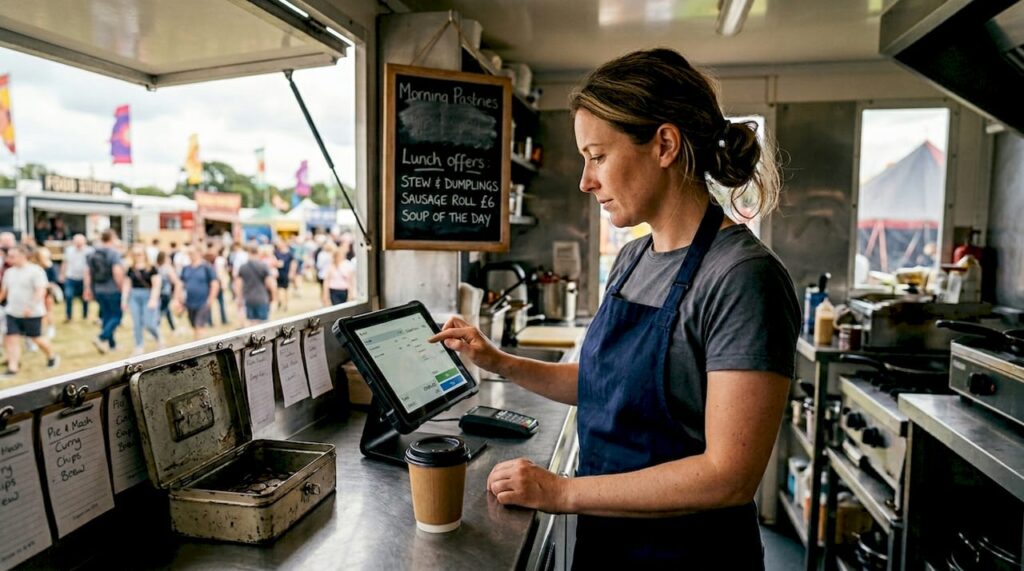
A traditional point of sale system is built for fixed settings. A restaurant counter, a retail checkout lane, a hotel reception desk. These environments offer stable power supplies, reliable broadband, and predictable workflows. Mobile catering is the opposite. You are working from a food truck parked at a festival, a market stall with no WiFi in sight, or a temporary pitch that changes every weekend. The hardware needs to be portable, rugged, and battery-friendly. The software needs to be flexible enough to handle all of that without falling apart.
A mobile catering POS is purpose-built for these conditions. It accepts card, contactless, and mobile payments through compact card readers and tablets, replacing the cash-only approach that used to dominate the street food scene. But the real distinction lies in what else it does. POS for catering efficiency goes well beyond the till. It encompasses digital order management, inventory tracking, and critically for UK vendors, compliance workflows.
“In the UK mobile-catering context, POS and adjacent digital tools are often expected to help with compliance-style workflows including maintaining food-safety records digitally and supporting inspection readiness, not just taking card payments.”
This shift from paper-based processes to digital records is significant. When a food safety officer arrives unannounced at your stall, the ability to pull up a complete digital log of temperature checks, allergen records, and cleaning schedules in seconds is the difference between a smooth inspection and a stressful one. A capable mobile catering POS replaces the folders of handwritten notes that many vendors still carry, replacing them with searchable, time-stamped digital records accessible from any device.
The best systems also work both online and offline, which matters enormously when you are working at a rural agricultural show or an urban street market with poor mobile signal. Data is stored locally on the device, then synced to the cloud when connectivity returns. For UK vendors, this is not a nice-to-have feature. It is fundamental.
Essential features for British mobile catering vendors
Not all POS systems marketed as “mobile” are genuinely suited to the demands of outdoor and event catering in the UK. Knowing which features to prioritise before you invest can save you a great deal of frustration and money.
Here are the core features every British mobile catering vendor should look for:
- Digital food safety records. Your POS or an integrated companion app should allow you to log and store safety checks digitally. NCASS describes their Digital Food Safety System as replacing paper records with digital checks and generating reports, working on any device even offline and syncing later. That is the standard to measure any solution against.
- Offline functionality. The system must continue processing orders, accepting payments, and logging records even without an internet connection. Cloud sync should happen automatically once connectivity is restored.
- Multi-device compatibility. You may work alone or with a small team. Your POS should run on tablets, smartphones, and countertop terminals without requiring different versions of the software.
- Rapid payment processing. Speed matters enormously at busy events. Card, contactless, Apple Pay, and Google Pay acceptance should be standard, with transaction times measured in seconds.
- Inventory tracking. Real-time stock deduction as items are sold prevents you from overselling and helps you plan restocking between events.
- Reporting and analytics. End-of-day sales reports, best-selling item breakdowns, and revenue summaries should be available instantly, even from a mobile browser.
- Post-event data sync. Once the event is over and you reconnect, all locally stored data should upload without manual intervention or risk of duplication.
Pro Tip: Before committing to any POS system, ask the provider to walk you through what happens when connectivity drops mid-transaction. If they cannot give you a clear, specific answer about which data is stored locally and how conflicts are resolved on sync, that is a warning sign worth taking seriously.
When setting up mobile POS for the first time, it is worth mapping your specific workflow first. Think about how many staff members will be taking orders simultaneously, whether you need kitchen display screens, and which compliance records you are required to maintain under your local authority’s requirements. The right system will fit around those realities, not force you to adapt your operation to match its limitations. Understanding the full range of mobile catering features available will help you make a more informed choice from the start.
Offline vs cloud-based: Ensuring reliability on the road
Internet connectivity at outdoor events in the UK is notoriously unpredictable. A well-attended food festival in a field might have hundreds of vendors and thousands of visitors all competing for limited 4G bandwidth. A market in a historic town centre might sit in a mobile signal dead zone. Building your entire operation around an always-on cloud connection is a risk you cannot afford to take.
Here is a practical comparison of the main approaches:
| Feature | Offline-first POS | Cloud-based POS | Hybrid POS |
|---|---|---|---|
| Works without internet | Yes, fully | Limited or not at all | Yes, core functions |
| Real-time cloud sync | No, deferred | Yes | On reconnection |
| Data conflict risk | Low if configured well | Not applicable | Moderate |
| Setup complexity | Moderate | Low | Moderate to high |
| Best suited for | Remote/rural events | Urban venues with strong signal | Mixed environments |
Temporary venues at festivals and markets require offline resilience and local data storage, and guidance consistently stresses that connectivity and reconnection timing affect whether orders, payments, and stock reports remain consistent once the device comes back online.
This is why it pays to probe beyond the marketing language. Some providers promote offline mode as a key differentiator, while others assume that strong mobile broadband is always available. The practical advice is straightforward: confirm what is stored offline including orders, inventory deductions, and payment status, and verify exactly how conflicts are resolved when the device syncs.
A cloud-based POS system has genuine advantages in stable environments. Updates are automatic, multi-location data is centralised, and reporting is accessible from anywhere. For a vendor who operates regularly in locations with strong 4G or 5G coverage, a cloud-first system with a solid offline fallback may be ideal. For those working frequently in remote or signal-poor locations, an offline-first system with cloud sync is the safer option.
Pro Tip: Invest in a dedicated 4G mobile broadband router for your stall or vehicle rather than relying solely on your phone’s hotspot. This gives your POS a dedicated, more stable connection and keeps your phone free for customer communications and social media. Keeping up with mobile POS trends in the UK will help you understand where connectivity solutions are heading over the next few years.
How mobile catering POS transforms daily vendor operations
The theoretical benefits of a mobile catering POS are well documented. The lived experience of using one day in, day out is where the real value becomes clear.
Consider a typical Saturday at a busy food festival. You arrive early, run through your temperature checks and opening safety records digitally on your tablet, and the data is logged and timestamped automatically. The event opens. Orders come in fast. Your POS tracks each item sold, deducting from stock in real time, so you know at a glance whether your most popular dish is about to run out before the lunchtime rush. Payments are processed in under five seconds per transaction, keeping the queue moving and your customers happy.

At midday, a food safety officer appears. You hand over the tablet. Every record from the morning is there, time-stamped and accessible, and the inspection is over in minutes rather than half an hour of rummaging through paper folders. The NCASS Digital Food Safety System is a strong example of the kind of tool that makes this possible, helping mobile traders manage compliance, complete and store safety checks digitally, access records anywhere, and remain inspection-ready at all times.
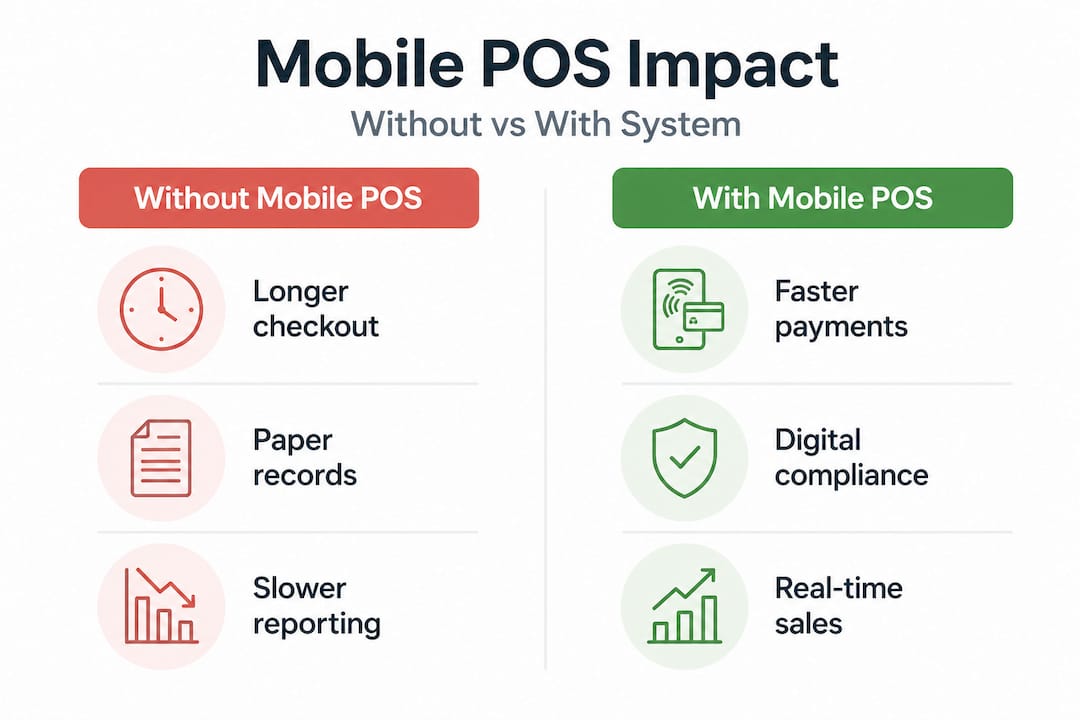
Here is what the operational improvements typically look like across a trading day:
| Area | Without mobile POS | With mobile POS |
|---|---|---|
| Payment processing | 15-30 seconds per transaction | Under 5 seconds |
| Compliance record access | Searching through paper folders | Instant digital retrieval |
| End-of-day stock count | Manual counting and recording | Automated report generated |
| Post-event reporting | Hours of manual reconciliation | Summary available immediately |
| Inspection readiness | High stress, inconsistent records | Calm, consistent, digital logs |
The benefits of mobile POS for UK hospitality businesses extend well beyond speed. Vendors report spending significantly less time on administrative tasks after each event, freeing up energy for menu development, sourcing, and marketing. Staff training time also reduces when the interface is intuitive and consistent across devices.
It is also worth noting the customer experience angle. A smooth, contactless payment followed by a digital receipt is what modern customers expect. Long queues caused by slow payment processing or cash-only policies push customers to competitors. A capable mobile catering POS eliminates both problems in one step.
A vendor’s perspective: What most POS guides miss
Most guides on mobile catering POS focus heavily on payment features and transaction speeds. Speed matters, obviously. But in our experience working with UK catering vendors, the biggest regrets we hear are almost never about payment processing. They are about compliance.
Vendors who have faced a poor inspection result often describe the same pattern: they chose a POS system based on how quickly it processed contactless payments, and only realised later that it offered nothing to support their food safety obligations. Digital compliance is not an optional add-on for a mobile food business in the UK. It is a legal and reputational necessity.
The second common regret is underestimating offline reliability. A system that works brilliantly in a test environment with strong WiFi can become completely unreliable at the kind of rural events where some of the most profitable trading happens. Vendors who learn this lesson after a bad experience at a festival often wish they had specifically tested their POS in a signal-poor environment before committing.
There is also a subtler trap worth naming. Some vendors choose their POS based on the lowest monthly fee, then discover that the features they actually need, things like offline sync, digital compliance logging, and multi-device support, are locked behind higher pricing tiers. Always check what is included at your chosen pricing level before signing up.
The POS efficiency insights that actually move the needle for mobile vendors come from integrating compliance, payments, and inventory into a single system rather than running three separate tools that do not communicate with each other. That kind of joined-up approach saves time every single trading day and removes the stress from situations you cannot control, like an unannounced inspection or a sudden drop in mobile signal.
Explore POS solutions tailored for mobile catering
If you are ready to move beyond a basic card reader and build a genuinely resilient, compliant mobile catering setup, the right starting point is understanding which software and hardware are designed with your specific needs in mind.
At YCR Distribution, we work with UK catering vendors to match them with POS software and hardware that fits how they actually trade, not how a generic system assumes they trade. Whether you run a food truck, a market stall, or a mobile catering unit at events across the country, solutions like EZEEPOS for takeaways are built around fast service, offline capability, and ease of use. For those who need robust portable terminals and tablets, our range of mobile POS hardware from trusted brands like SAM4S and iMin gives you the reliability and durability that outdoor trading demands. Get in touch with our team to discuss your setup and find the solution that keeps you trading confidently at every event.
Frequently asked questions
Can mobile catering POS systems work without WiFi or mobile signal?
Many mobile catering POS systems offer an offline mode, allowing you to take orders and process payments even when connectivity drops. Temporary venues such as festivals require this offline resilience, so always verify what specific data is stored locally before purchasing.
Is digital food safety management important for UK mobile caterers?
Yes, it is essential. Digital compliance tools help you maintain inspection-ready records and meet UK food safety regulations without relying on paper. The NCASS Digital Food Safety System is a widely used example of how mobile traders can manage compliance effectively.
What happens if data goes out of sync when an event ends?
Quality POS systems handle conflict resolution automatically, ensuring orders, stock deductions, and payment records align correctly once the device reconnects to the internet. Always confirm how conflicts resolve on sync before committing to a system.
Do all mobile POS systems support UK mobile catering compliance needs?
Not all do. Many general-purpose POS systems focus solely on payments and offer no food safety record-keeping features. Choose systems built with compliance as a core function, with digital checks and accessible record storage included as standard rather than as expensive add-ons.