
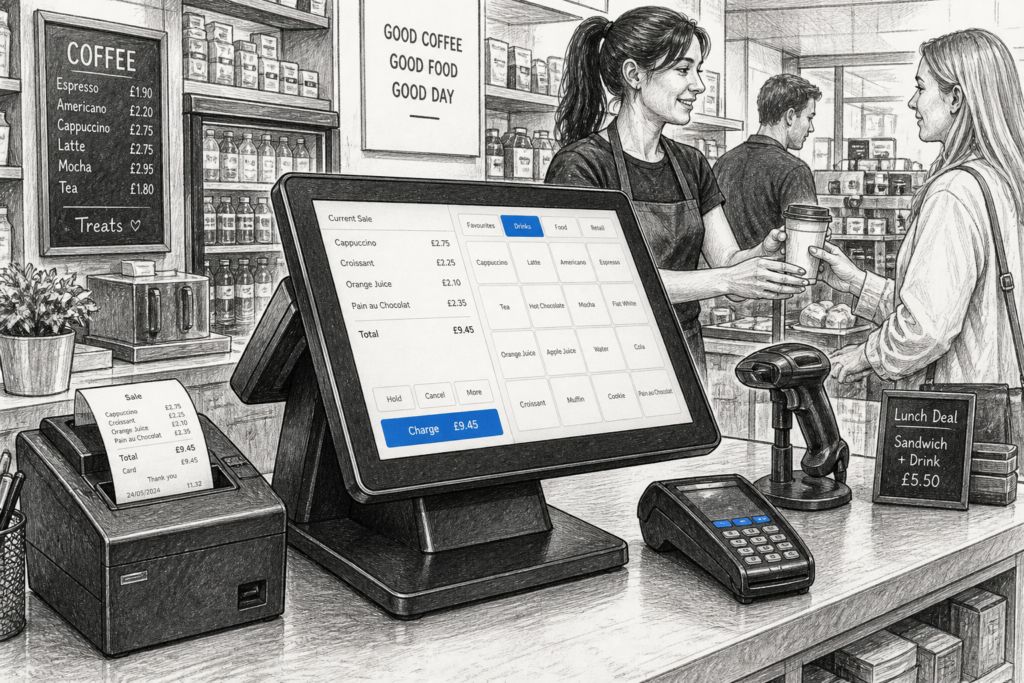
For many UK retailers, cafés, pubs and restaurants, the point of sale is no longer just the place where money changes hands. It is the front line of customer service, the hub for staff workflow and often the first part of the business to show its age when hardware starts to struggle.
That is why modern POS hardware matters. A dependable terminal, printer and supporting peripherals can make day-to-day trading smoother, reduce interruptions and give staff a system they can trust during busy periods. For businesses using POS systems UK-wide, the shift from basic tills to commercial EPOS hardware is less about technology for its own sake and more about keeping service moving.
What has changed at the point of sale?
Traditional tills were often designed to do one job: take payment and print a receipt. Modern retail EPOS and hospitality EPOS setups typically need to do much more. Staff may need to look up products, apply discounts, manage tables, split bills, print to the kitchen, handle card and cash transactions, and keep accurate sales records for the end of the day.
That increase in demand changes what businesses should expect from a POS terminal. A standard office computer or old till may cope for a while, but commercial environments place different pressures on hardware. Constant use, heat, spills, repeated tapping and long trading hours all create wear, so reliability becomes as important as screen size or appearance.
Why commercial-grade hardware makes a difference
Commercial POS equipment is built for the realities of retail and hospitality. It is chosen not only for performance, but for stability and practical use. A touchscreen POS terminal in a café or convenience store needs to be responsive enough for quick orders, simple enough for staff training and robust enough to handle repeated use throughout the day.
Likewise, a receipt printer in a busy bar or takeaway needs to keep up when the counter is under pressure. If printing slows down or fails, the effect is felt immediately at the till, at the counter or in the kitchen. That is why businesses upgrading EPOS hardware often focus on reliability first and features second.
Common reasons businesses replace ageing hardware
- Frequent downtime or reboots during trading hours
- Slow response times at busy tills
- Difficulty sourcing spare parts or suitable replacements
- Hardware that no longer suits the current software or workflow
- Poor support for multiple users, locations or service points
In many cases, the issue is not that the old hardware has completely failed. It is that the business has outgrown it. A small independent retailer may once have managed with a basic till, but seasonal trading, promotions and more complex reporting can quickly reveal the limitations of ageing equipment.
Windows POS versus Android POS
One of the most common conversations in the point of sale UK market is whether to choose Windows POS or Android POS hardware. The right choice depends on the business, the software in use and the wider installation. Hardware platform is only one part of the decision, but it can affect how long a system remains practical.
Windows POS systems are often chosen where compatibility with established software or more traditional business processes matters. Android POS terminals are increasingly popular where businesses want a more streamlined interface, flexible hardware options or a compact footprint. Neither is automatically better; what matters is matching the terminal to the environment and the application.
For EPOS dealers, installers and resellers, this is where product knowledge matters. The wrong hardware choice can create avoidable support calls later. The right recommendation can reduce disruption, simplify training and make future upgrades easier.
What to think about before upgrading
When planning a move to new POS hardware UK businesses should look beyond the headline product. A successful installation depends on how well the hardware fits the day-to-day operation.
- Trading environment: retail counters, table service, takeaway counters and kiosks all have different demands.
- Ease of use: staff need clear screens, simple navigation and sensible placement of peripherals.
- Durability: equipment should suit the pace and conditions of the business.
- Supportability: replacement parts, supplier advice and ongoing product availability all matter.
- Future growth: the system should leave room for extra lanes, sites or service points.
This is especially relevant for growing businesses where the original setup was designed for a smaller workload. A solution that was fine for one site may not be suitable for a second branch, a busier trading period or a broader menu or product range.
The role of UK distribution and support
For EPOS resellers, dealers and installers, local support can be just as important as the hardware itself. UK-based distribution helps reduce delays, improves access to product advice and makes it easier to source suitable hardware when a replacement is needed quickly. It also gives installers a better route to discuss compatibility, deployment and broader project planning before equipment is installed on site.
YCR Distribution works with the UK EPOS trade and supports businesses that need reliable point-of-sale hardware and related technology. As an experienced POS distributor UK customers can turn to, YCR supplies hardware for a range of retail and hospitality applications and helps partners build solutions that fit real-world use rather than just checking specification boxes.
Choosing hardware that supports the service, not just the sale
The best EPOS hardware is the equipment staff barely have to think about. It responds when needed, keeps working through busy periods and supports the pace of the business without getting in the way. In retail, that can mean faster checkout and better customer service. In hospitality, it can mean smoother order handling, clearer communication and less chance of mistakes at peak times.
As more businesses review their existing tills and EPOS systems UK-wide, the focus is shifting from price alone to total value in use. A dependable terminal or printer may not be the most visible part of the business, but it can have a very visible effect on service quality.
For more information about point-of-sale hardware and EPOS solutions, contact YCR Distribution on 01924 438238 or visit www.ycr.co.uk.