

Payment processing systems explained for retail and hospitality

Payment processing systems are the technology infrastructures that securely handle the transfer of funds from a customer’s payment method to a merchant’s bank account during an electronic transaction. Understanding how these systems work is not optional for retail and hospitality businesses. It directly affects checkout speed, cash flow timing, security exposure, and the cost of every sale you make. This article unpacks payment processing systems explained from the ground up: the two core phases, the three system layers, the main architecture types, and the practical trade-offs that matter most to operators in shops, restaurants, cafes, and takeaways across the UK.
How do payment processing systems work?
Payment processing operates in two main phases: authorisation and settlement. Authorisation completes in 1–2 seconds. Settlement takes 24–48 hours. Most business owners experience the gap between these two stages as confusion: the card reader beeps, the customer leaves, but the money does not arrive until the next day or the day after.
Authorisation: the real-time check
Authorisation is the instant verification stage. When a customer taps or inserts a card, the terminal sends encrypted payment data through a payment gateway to a payment processor. The processor forwards the request to the relevant card network (Visa or Mastercard), which routes it to the customer’s issuing bank. The issuing bank checks the account balance, fraud signals, and card status, then returns an approval or decline code. The entire exchange takes 1–2 seconds.
Settlement: where the money actually moves
Settlement is the delayed transfer stage. End-of-day batch processing groups all authorised transactions and sends them through the acquiring bank for clearing. The acquiring bank debits the issuing bank and credits the merchant’s account, typically within 24–48 hours. This batch model is why authorisation feels instant but funds arrive later.
| Stage | Who acts | Typical time |
|---|---|---|
| Authorisation | Issuing bank, card network, processor | 1–2 seconds |
| Clearing | Card network, acquiring bank | A few hours |
| Settlement | Acquiring bank to merchant account | 24–48 hours |
Understanding this timeline helps you plan cash flow accurately, particularly in hospitality where daily takings fund the next day’s stock orders.
What are the core components of a payment processing system?
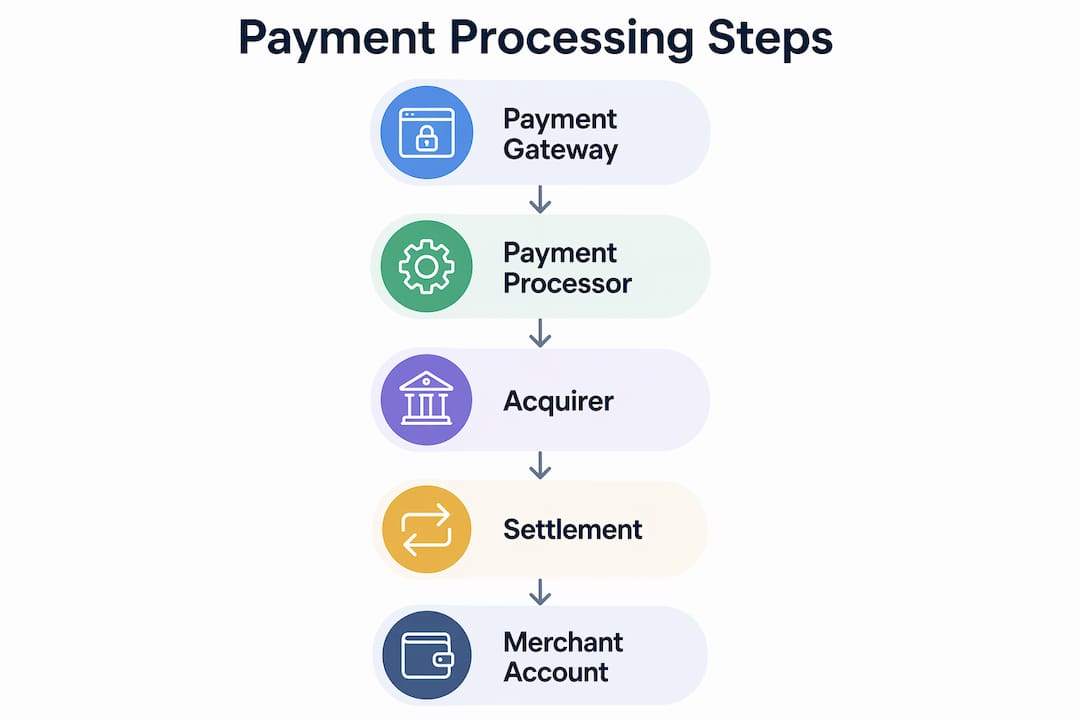
The payment ecosystem has three layers: the payment gateway, the payment processor, and the acquirer. Each layer has a distinct job. Confusing them leads to poor purchasing decisions when you are evaluating providers.
Payment gateway
The payment gateway is front-end software. It captures payment data at the point of sale or online checkout, encrypts it using tokenisation or TLS protocols, and passes it securely to the processor. In a physical retail or hospitality environment, the gateway is embedded within your POS terminal or card reader. For online businesses, it is the API layer connecting your website to the processing network.

Payment processor
The payment processor sits in the middle. It builds and routes the transaction message between the gateway, the card network, and the acquiring bank. The processor does not hold funds. It acts as the technical intermediary that formats data correctly for each card scheme and manages the communication flow.
Acquirer
The acquirer is the financial institution that holds your merchant account and manages settlement. It receives cleared funds from the card network and deposits them into your account after deducting processing fees. Without an acquirer, you cannot accept card payments.
Full-stack providers
Full-stack providers combine gateway, processor, and acquirer roles into a single service with one API and one dashboard. This simplifies management considerably. The trade-off is reduced flexibility: if your business has complex needs such as multi-currency processing or bespoke fraud rules, a full-stack provider may not offer the granular control that a layered architecture provides.
| Architecture | Best for | Key trade-off |
|---|---|---|
| Traditional layered (separate vendors) | High-volume, complex businesses | More control, more management overhead |
| Full-stack provider | Small to mid-size operators | Simpler setup, less customisation |
| POS-integrated system | Retail and hospitality operators | Unified data, dependent on one ecosystem |
Pro Tip: Choose your architecture based on your monthly transaction volume and operational complexity. A busy restaurant group with multiple sites needs more flexibility than a single-site café.
What types of payment processing systems suit retail and hospitality?
Payment processing architectures fall into four main models. Each suits a different business profile.
-
Merchant account with interchange-plus pricing. This model gives you a dedicated account with your acquiring bank. Fees are calculated as the card network’s interchange rate plus a fixed processor margin. The pricing is transparent and scales well. Merchant accounts suit businesses processing high volumes, as the per-transaction cost drops as volume rises.
-
Flat-rate processors. These charge a single fixed percentage per transaction regardless of card type. The fee structure is simple and predictable. Flat-rate models suit smaller businesses or those just starting out, where simplicity outweighs the cost savings of interchange-plus at scale.
-
POS-integrated systems. These consolidate the terminal hardware, POS software, and payment processing into one connected environment. Sales data, stock levels, and payment records update in real time within a single system. For retail shops and hospitality venues, this integration removes the manual reconciliation that separate systems require. Ycr’s POS integration approach for retail and hospitality is built around exactly this model.
-
Modular, API-driven architectures. Modern payment systems are increasingly modular. Businesses can connect specialist providers for fraud detection, international payments, or loyalty programmes via APIs, rather than relying on a single monolithic platform. This suits growing businesses that need to add capabilities without replacing their entire stack.
Pro Tip: Match your architecture to your growth plan. If you expect to open additional sites or expand online, choose a system that supports multi-location management and API connectivity from day one.
What are the benefits and considerations of modern payment processing?
The operational benefits of a well-chosen payment processing system are concrete and measurable.
- Faster checkout. Contactless and chip-and-PIN transactions complete in seconds. Shorter queues directly improve customer satisfaction in both retail and hospitality settings.
- Fraud detection. Advanced fraud detection using AI and compliance with PCI DSS (Payment Card Industry Data Security Standard) protect both the business and the customer. PCI DSS is the global security standard that governs how card data is stored, processed, and transmitted.
- Transparent fee structures. Interchange-plus pricing makes it straightforward to audit your processing costs. You can see exactly what the card network charges versus what your processor adds.
- Scalability. Modular systems let you add new payment methods, such as digital wallets or buy-now-pay-later options, without rebuilding your infrastructure.
- Unified reporting. POS-integrated systems consolidate payment data with sales and stock data, reducing end-of-day admin and improving accuracy.
The considerations are equally real. Implementation complexity rises with system sophistication. A modular, API-driven setup requires technical resource to configure and maintain. Full-stack providers reduce that burden but may lock you into a single ecosystem. Balancing checkout speed with security is the central challenge: adding friction to transactions for security reasons can reduce conversion, particularly in fast-paced hospitality environments.
Cost is also a factor that operators underestimate. Beyond the headline processing rate, consider terminal rental fees, monthly gateway charges, PCI compliance fees, and chargeback costs. A merchant services review of your current provider against alternatives every 12–18 months is a sound practice for any growing business.
Key takeaways
Payment processing systems work in two distinct phases, authorisation and settlement, and choosing the right architecture for your transaction volume and business model determines both your operational efficiency and your total cost of acceptance.
| Point | Details |
|---|---|
| Two-phase process | Authorisation takes 1–2 seconds; settlement takes 24–48 hours via batch processing. |
| Three system layers | Gateway, processor, and acquirer each play a distinct role in every transaction. |
| Architecture choice matters | Match your model (merchant account, flat-rate, POS-integrated, or modular) to your volume and growth plans. |
| Security and speed balance | PCI DSS compliance and AI fraud detection protect revenue without adding checkout friction. |
| POS integration reduces admin | Unified systems connect payment data with sales and stock, cutting manual reconciliation. |
What I have learned from watching businesses get payment processing wrong
Working with retail and hospitality operators across the UK for many years, the most common mistake I see is treating payment processing as a commodity purchase. Businesses compare headline rates, choose the cheapest option, and then discover six months later that their flat-rate processor charges a premium for contactless transactions above a certain value, or that their gateway does not support the loyalty integration they want to add.
The shift from legacy monolithic systems to modular API-driven architectures is genuinely significant. It gives operators real flexibility. But flexibility only has value if you know what you need to connect. I have seen small restaurant groups invest in modular setups they cannot fully use because they lack the technical resource to configure them properly.
My practical advice is this: start with your transaction volume and your reconciliation pain points. If you are spending more than 30 minutes a day manually matching payment records to your till reports, a POS-integrated system will pay for itself quickly. If you are processing high volumes and your current fees feel opaque, move to interchange-plus pricing and audit the difference.
The security side of payment processing is non-negotiable. PCI DSS compliance is not a box-ticking exercise. A single data breach costs far more than the annual cost of maintaining compliant infrastructure. Choose providers who make compliance straightforward, not providers who make it your problem to manage alone.
— John
Ycr’s integrated POS solutions for payment-ready retail and hospitality
Choosing the right payment processing architecture is only half the equation. The hardware and software you pair it with determines how smoothly it runs in practice.
Ycr supplies SAMTOUCH POS software with hardware as a fully integrated solution designed for retail and hospitality operators who need reliable, payment-ready systems from day one. SAMTOUCH connects your till, payment terminal, and back-office reporting into one environment, removing the reconciliation gaps that separate systems create. For businesses that already have hardware in place, SAMTOUCH without hardware delivers the same software capability on your existing setup. Ycr offers next-day delivery and same-day dispatch across the UK, so you are not waiting weeks to get operational.
FAQ
What is payment processing in simple terms?
Payment processing is the secure electronic transfer of funds from a customer’s payment method to a merchant’s bank account. It involves authorisation (instant approval) and settlement (delayed fund transfer, typically 24–48 hours).
How long does payment processing take?
Authorisation completes in 1–2 seconds. Settlement, where funds actually reach the merchant’s account, takes 24–48 hours due to end-of-day batch processing by the acquiring bank.
What is the difference between a payment gateway and a payment processor?
A payment gateway captures and encrypts card data at the point of sale. A payment processor routes that encrypted data between the gateway, card network, and acquiring bank to complete the transaction.
What types of payment processing systems are available?
The main types are merchant accounts with interchange-plus pricing, flat-rate processors, POS-integrated systems, and modular API-driven architectures. Each suits a different business size and transaction volume.
Is PCI DSS compliance mandatory for UK businesses?
PCI DSS compliance is required for any business that stores, processes, or transmits cardholder data. Non-compliance exposes businesses to fines, increased processing fees, and liability in the event of a data breach.