
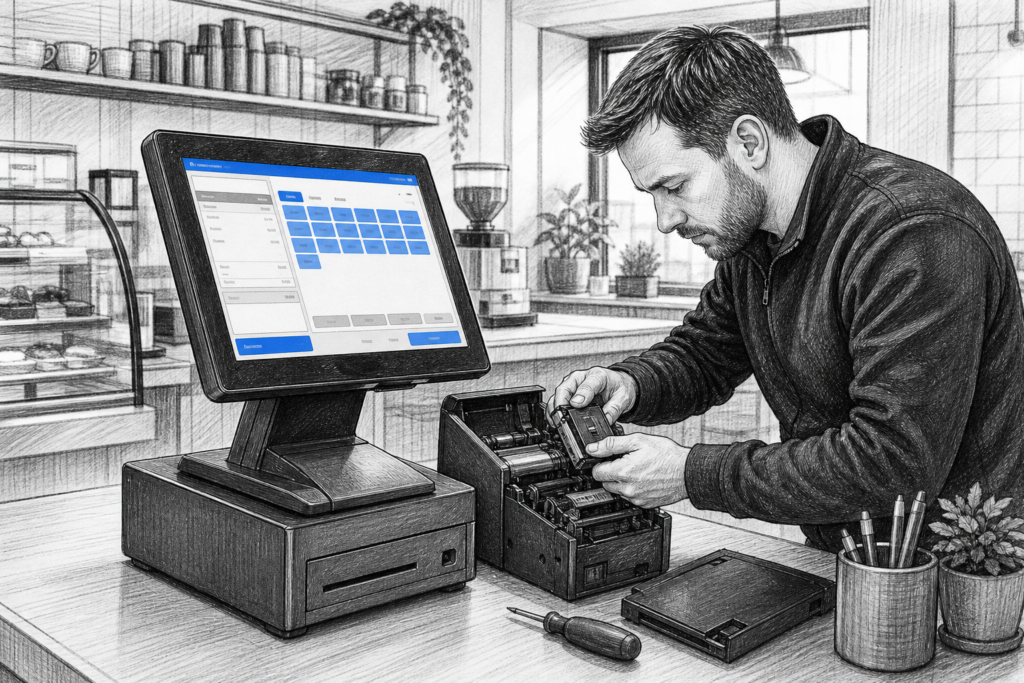
When a checkout terminal or receipt printer fails, the disruption is often felt immediately. Staff may have to slow down, move customers to another lane or fall back on manual workarounds, and in hospitality the same problem can affect order flow from the front counter to the kitchen. That is why repairability is becoming a more important consideration when choosing POS hardware for retail and hospitality businesses.
What repairability means in a POS environment
In simple terms, repairability is how easily a piece of point-of-sale hardware can be serviced, maintained or restored to working order. That may involve replacing a part, carrying out preventative maintenance, or swapping a component rather than replacing the entire device. In a commercial site, this can make a real difference to business continuity.
Repairability matters across the POS setup, including touchscreen terminals, receipt printers, customer-facing displays and the smaller parts that keep them operating. A system that is easier to service is usually easier for a dealer, installer or internal IT team to support over time.
Why businesses should care about serviceable hardware
Many businesses now expect their EPOS systems to do more than simply take payments. They are used to manage orders, apply discounts, print kitchen tickets, provide sales information and support day-to-day operations. If one part of that chain breaks down, the whole operation can be affected.
Serviceable POS hardware can help in several practical ways:
- reduce downtime at the checkout or till point
- support quicker diagnosis when problems occur
- allow worn parts to be replaced without changing the whole unit
- make planned maintenance more straightforward
- help businesses protect earlier investment in installed equipment
For independent retailers, cafés, pubs and busy hospitality sites, this is often just as important as raw specification. A terminal with modest but reliable specifications may be more useful in day-to-day operation than a more complex device that is difficult to maintain.
Where repairability matters most
Some POS hardware sees steady use throughout the day and is more likely to benefit from a service-friendly approach. Receipt printers are a good example. They work constantly in many environments, and their moving parts, cutters and print mechanisms are subject to wear. If components can be accessed and replaced sensibly, the printer may stay in service longer and require less disruptive intervention.
Touchscreen terminals also benefit from a practical design. In retail and hospitality, terminals are often expected to sit at the centre of operations for long trading hours. If a dealer or installer can support the device efficiently, it becomes easier to keep the site operational without replacing perfectly usable hardware too early.
Repairability is especially valuable in:
- convenience stores and independent retail
- cafés, restaurants and quick-service counters
- bars and pubs with busy service periods
- multi-site businesses that want consistent hardware support
- installed EPOS estates managed by resellers or service companies
How repairable hardware supports EPOS resellers and installers
For EPOS resellers and installers, repairable hardware can make support easier to plan and deliver. When a product family uses parts and assemblies that can be accessed or replaced more predictably, it may be simpler to maintain stock, service customer sites and manage replacement schedules.
This is one reason commercial POS equipment is usually a better fit than generic office hardware. A standard desktop PC or consumer tablet may work for a while, but it is not typically designed with the same emphasis on uptime, service access or long-term field support. Commercial POS hardware is intended for a different environment, where fast diagnosis and practical replacement options matter.
Balancing repairability with performance and design
Repairability should not be considered on its own. A suitable POS system still needs to meet the business’s day-to-day needs for speed, connectivity and usability. However, when two products appear similar on paper, the one that is easier to support can be the better commercial choice.
Businesses planning a new EPOS installation should think about questions such as:
- Can the hardware be serviced without unnecessary disruption?
- Are replacement parts or accessories available through the distributor or channel partner?
- Is the product family suitable for a managed rollout across several locations?
- Will the reseller or installer be able to support it effectively after deployment?
These are practical questions, not just technical ones. In many cases, the real value of a POS terminal or printer is not only how it performs on day one, but how well it can be maintained through repeated trading cycles.
Planning for the life of the system, not just the installation
Businesses often focus on the initial rollout of a POS system, but the longer-term plan matters just as much. Hardware may need regular cleaning, component replacement or phased upgrade over time. Choosing equipment with a clear support path can help reduce surprises later.
That is particularly relevant for operations with multiple tills, several kitchen printers or more than one site. Standardising on serviceable hardware makes it easier to train staff, support engineers and replace components in a controlled way. It can also help avoid the disruption of replacing a complete setup when only one part has become unreliable.
For organisations that view POS as critical infrastructure rather than a simple till, repairability is a sensible part of procurement. It supports uptime, protects investment and gives resellers and installers a better foundation for long-term support.
Choosing support that matches the hardware
Repairable hardware works best when it is backed by a distributor that understands the UK POS market. YCR Distribution supplies POS and EPOS hardware, software and related technology to resellers, installers and businesses across the UK, helping customers choose equipment that suits both the installation and the support model behind it.
That matters whether you are replacing an ageing terminal, planning a new hospitality EPOS rollout or looking for better ways to maintain an existing estate. The right hardware, supported properly, can make everyday service much easier to manage.
For more information about point-of-sale hardware and EPOS solutions, contact YCR Distribution on 01924 438238 or visit www.ycr.co.uk.