
POS system upgrade benefits for UK retail and hospitality
Upgrading your POS system is one of the highest-return technology decisions a UK retail or hospitality business can make. Studies indicate a very high ROI within the first year, driven by higher sales, lower costs, and sharper operational control. That figure is not a fluke. It reflects what happens when a business replaces a slow, siloed legacy setup with a system that connects payments, stock, staff, and customers in one place. The POS upgrade benefits go well beyond faster checkouts. Here is what you actually gain:
- Faster transactions with EMV chip readers and contactless payments, reducing queue times during peak hours
- Real-time sales analytics giving you live visibility into top sellers, slow movers, and peak trading periods
- Accurate inventory tracking that auto-decrements stock with every sale and flags reorder points automatically
- Integrated loyalty and CRM tools that personalise offers and increase repeat visits
- Cloud-based remote management so you can monitor any location from a phone or laptop
- PCI DSS and GDPR-compliant security replacing the vulnerabilities of older legacy systems
- Omnichannel integration connecting your in-store POS with ecommerce, accounting, and delivery platforms
A significant proportion of retail leaders ranked refreshing their POS as a top technology priority for 2025. The commercial case is clear.
What features do modern POS systems offer UK retail and hospitality businesses?
Today’s POS systems are a long way from the cash register with a card reader bolted on. The hardware and software now work as a single, connected platform, and the range of components available to UK businesses has expanded considerably.

On the hardware side, a modern POS setup typically includes touchscreen terminals, receipt printers, barcode scanners, customer-facing displays, and integrated payment terminals supporting chip, contactless, and digital wallet payments. Brands like SAM4S and iMin produce terminals built specifically for the demands of retail and hospitality environments, offering durability and processing speed that consumer-grade tablets simply cannot match. Honeywell and Zebra scanners add precision and speed to stock management, with devices like the Zebra DS9308 and Honeywell MS7190G handling high-volume scanning without the errors that slow manual entry introduces.
The software layer is where the real operational gains appear. Key features include:
- Sales reporting and analytics: Dashboards showing revenue by hour, product, and employee, with sales-reporting modules accounting for around 38% of POS software usage
- Inventory management: Real-time stock tracking, automated reorder alerts, and multi-location stock transfers
- Loyalty and CRM: Customer purchase history, points programmes, and targeted promotions built directly into the checkout flow
- Cloud access: Live data accessible remotely, enabling managers to act on sales trends without being on-site
- Omnichannel integration: Connections to ecommerce platforms, accounting tools like Xero or QuickBooks, and delivery aggregators
- Staff management: Employee-level permissions, clock-in tracking, and productivity reporting
Software solutions like SAMTOUCH and EZEEPOS are designed specifically for UK hospitality and retail, with interfaces that reduce training time and handle the specific workflows of restaurants, cafés, takeaways, and convenience stores. The user-friendly touchscreen design matters more than it sounds. A new member of staff who can process a transaction confidently within an hour costs far less in training time than one who needs days to navigate a clunky legacy interface.
Top business benefits of upgrading your POS system: what the data shows
The commercial case for a POS upgrade rests on four areas where the gains are measurable and consistent.
Sales and revenue growth
Faster checkouts directly increase the number of customers you can serve during peak hours. In a busy lunchtime café or a Saturday retail rush, shaving thirty seconds off each transaction adds up quickly. Beyond speed, POS analytics identify which products drive margin and which are dead weight on your shelves, enabling smarter promotions and pricing decisions. Businesses using POS data analytics can increase profit margins by approximately 5–10% through better stock and staffing decisions.
Inventory accuracy
Manual stock counts are expensive and error-prone. A modern POS updates inventory with every transaction, preventing both stockouts and the cash-flow drain of excess stock. For multi-site operators, centralised inventory management means you can transfer stock between locations from a single dashboard rather than making phone calls and updating spreadsheets.
Customer retention
Loyalty programmes integrated with POS increase repeat purchase rates and customer lifetime value. A customer who receives a personalised offer based on their purchase history is more likely to return than one who receives nothing. This was once the preserve of large retail chains with dedicated CRM teams. A modern POS puts the same capability into a neighbourhood café or independent clothing shop.
Labour efficiency
Automated reporting replaces hours of manual reconciliation. Staff spend less time counting stock and more time serving customers. Managers get end-of-day reports without staying late to compile them.
| Benefit | What changes | Impact |
|---|---|---|
| Transaction speed | EMV, contactless, touchscreen checkout | Shorter queues, more customers served |
| Inventory accuracy | Real-time auto-decrements, reorder alerts | Fewer stockouts and overstock situations |
| Profit margins | Analytics-driven stock and staffing decisions | 5–10% margin improvement |
| Customer retention | Integrated loyalty, personalised offers | Higher repeat visit rates |
| Labour costs | Automated reporting, streamlined reconciliation | Reduced manual admin time |
| Security | Encryption, tokenisation, EMV compliance | Lower fraud and chargeback exposure |
Statistic: 42% of retail leaders ranked refreshing their POS as a top technology priority for 2025, with a very high ROI in the first year is cited as the primary commercial driver.
What are the real risks and costs of a POS system upgrade?
A POS upgrade is not without friction. Understanding the challenges upfront is what separates a smooth transition from a costly one.
- Upfront investment: Hardware, software licences, installation, and staff training all carry costs. The total varies considerably depending on the number of terminals, the complexity of integrations required, and whether you are replacing hardware entirely or upgrading software only.
- Operational disruption: Switching systems mid-trading is risky. Even a well-planned cutover can cause slowdowns if staff are unfamiliar with the new interface or if data migration hits unexpected snags.
- Integration complexity: Connecting a new POS to existing accounting software, ecommerce platforms, or booking systems takes time and sometimes custom development. Compatibility issues are more common when the legacy system is old or poorly documented.
- Data migration risks: Customer records, product catalogues, and historical sales data need to transfer accurately. Errors here can affect stock levels, loyalty balances, and financial reporting.
- Security gaps during transition: Legacy POS systems carry real security vulnerabilities, but the upgrade period itself can introduce risk if the new system is not configured correctly from day one.
Planning and phased rollout are the most effective ways to reduce downtime and cost overruns. Involving staff early and running parallel systems briefly during the transition also helps.
Pro Tip: Schedule your cutover during your quietest trading period, not your busiest. A Monday morning in january is far less damaging than a Friday before a bank holiday weekend if something goes wrong.
How to plan a POS system upgrade without disrupting your business
A POS upgrade that goes wrong tends to go wrong in the planning stage, not the execution. The steps below reflect what works in practice for UK retail and hospitality businesses.
- Audit your current system: Document what your existing POS does well, where it fails, and what integrations it currently handles. This baseline prevents you from accidentally dropping a feature your team relies on.
- Define your objectives: Be specific. “Faster checkouts” is vague. “Reduce average transaction time by 20 seconds during the lunch rush” gives you something to measure against after go-live.
- Set a realistic timeline: Factor in hardware delivery, software configuration, data migration, and staff training. Rushing any of these stages is where costs escalate.
- Involve your team early: The staff who use the system daily will spot practical problems that managers miss. Their buy-in also makes training faster and adoption smoother.
- Plan a phased rollout: Where possible, run the new system on one terminal or one location before switching everything over. This limits exposure if something needs adjusting.
- Test thoroughly before go-live: Process test transactions, check that inventory updates correctly, confirm integrations with accounting and ecommerce platforms, and verify that end-of-day reports reconcile accurately.
- Monitor performance post-upgrade: Set a review point at 30 days and 90 days. Compare transaction times, stock accuracy, and staff feedback against your pre-upgrade baseline.
The upgrade workflow matters as much as the technology itself. A well-specified system installed badly will underperform a simpler system installed well.
How to select the right POS system and vendor for your UK business
The right POS system depends on your sector, your scale, and the specific workflows your business runs. A fast-casual restaurant has different needs from a multi-site convenience retailer, and a vendor who specialises in one may not serve the other well.
- Match the system to your sector: SAMTOUCH is built for hospitality and retail environments, with workflows designed around the specific demands of UK cafés, restaurants, and shops. EZEEPOS is tailored for takeaways and quick-service venues. Choosing a generic system and trying to adapt it to your sector costs time and often money.
- Check hardware compatibility: Your software needs to work with the physical devices you are running. SAM4S terminals, iMin devices, Honeywell scanners, and Zebra scanners are all widely used in UK retail and hospitality. Confirming compatibility before purchase avoids expensive surprises during installation.
- Evaluate vendor support: Next-day delivery and same-day dispatch matter when a terminal fails on a busy Saturday. Ask specifically about response times, replacement hardware availability, and whether support is UK-based.
- Verify compliance credentials: Your POS must meet PCI DSS standards for payment security and handle customer data in line with GDPR. Ask vendors for documentation, not just assurances.
- Understand the pricing model: Some vendors charge per transaction, others per terminal, others on a monthly licence. Calculate the total cost of ownership over three years, not just the upfront price.
- Assess scalability: A system that works for one site should be able to grow with you. Centralised management across multiple locations, consistent pricing and promotions, and unified reporting are features worth prioritising if expansion is on your roadmap.
Vendor selection criteria should always include sector-specific functionality, UK compliance, and the quality of post-sale support. Hardware reliability is equally important. The hardware upgrade decision affects daily operational reliability as much as the software choice does.
Ycr Distribution has supplied POS hardware and software to UK retail and hospitality businesses for over three decades, distributing SAM4S and iMin hardware alongside SAMTOUCH and EZEEPOS software. Their integrated POS solutions cover everything from single-site cafés to multi-location retail operations, with credit accounts and next-day delivery available for resellers and business owners alike.
Why security and compliance are driving POS upgrades across the UK
Security is the factor that turns a “we should probably upgrade” conversation into an urgent one. Industry experts identify security as the leading motivation for POS upgrades in UK retail and hospitality, ahead of efficiency gains and new features.
Legacy POS systems present specific, well-documented risks. Older software rarely receives security patches, leaving known vulnerabilities unaddressed. Magstripe-only payment processing lacks the fraud protection of EMV chip technology. Customer data stored on-premise without encryption is exposed to breach risk in a way that GDPR makes commercially and legally dangerous.
Modern POS systems address these risks through end-to-end encryption, tokenisation of card data, and EMV-compliant payment processing. Tokenisation means that actual card numbers are never stored on your system. Even if a breach occurred, the data would be worthless to an attacker. Employee-level permissions and transaction logging also reduce internal fraud risk, with risk alerts flagging suspicious activity before losses occur.
PCI DSS compliance is not optional for any business that accepts card payments. The standard requires encrypted transmission of cardholder data, restricted access controls, and regular security testing. Most legacy systems cannot meet these requirements without expensive retrofitting, and some cannot meet them at all. A modern POS handles PCI DSS compliance as part of its standard configuration, removing a significant administrative and financial burden.
GDPR adds a further layer. Customer data collected through loyalty programmes, digital receipts, and CRM features must be stored securely, processed lawfully, and deleted on request. A modern POS with proper access controls and audit trails makes GDPR compliance manageable. An old system with no audit trail makes it nearly impossible. For more detail on network security in POS systems, the requirements and best practices are worth reviewing before any upgrade decision.
Ready to upgrade? Ycr has the hardware and software to make it happen
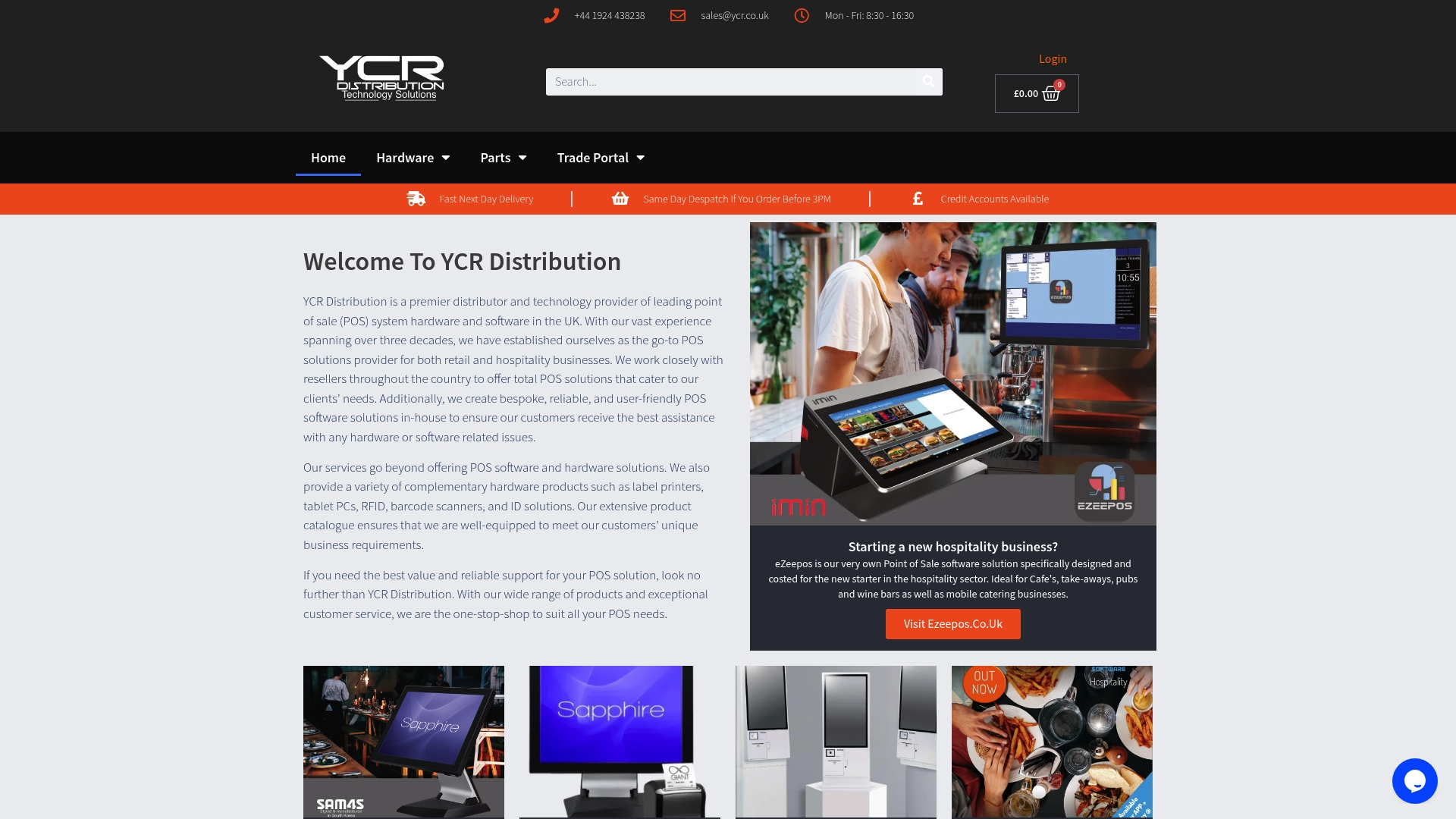
Ycr Distribution supplies the full range of POS hardware and software UK retail and hospitality businesses need, from SAM4S and iMin terminals to Honeywell and Zebra scanners, alongside SAMTOUCH and EZEEPOS software built for the UK market. Whether you need a complete system or a software upgrade to work with your existing hardware, Ycr offers next-day delivery, credit accounts, and UK-based support.
Explore the SAMTOUCH POS software with hardware bundle for a complete retail or hospitality setup, or browse the EZEEPOS for takeaways solution if you run a quick-service venue. For scanner upgrades, the Honeywell MS7190G and Zebra DS9308 are both stocked for same-day dispatch.
Key takeaways
Modern POS upgrades deliver measurable commercial returns for UK retail and hospitality businesses, with the right system, when properly implemented, can deliver a very high ROI in the first year.
| Point | Details |
|---|---|
| ROI is fast and measurable | Studies show ROI exceeding 500% in the first year through higher sales and lower operating costs. |
| Analytics drive margin gains | POS sales-reporting features account for around 38% of software usage; businesses using them see 5–10% profit margin improvements. |
| Security is the urgent driver | Legacy systems cannot meet PCI DSS and GDPR requirements; modern encryption and tokenisation close these gaps. |
| Planning prevents disruption | Phased rollout, staff involvement, and off-peak cutovers are the most effective ways to reduce transition risk. |
| Vendor and hardware fit matter | Sector-specific software like SAMTOUCH or EZEEPOS, paired with compatible hardware from SAM4S, iMin, Honeywell, or Zebra, outperforms generic solutions. |