

TL;DR:
- Food costs are the largest controllable expense in UK restaurants, often wasted during prep, storage, or receipt. Implementing disciplined inventory controls, including accurate receiving, FIFO rotation, and regular counts, can significantly reduce waste and improve profitability. Long-term success depends on making processes simple, visible, and owned by staff, supported by appropriate POS technology.
Food costs are the single biggest controllable expense in any UK restaurant, yet most losses happen quietly, in the walk-in fridge, at the goods-in door, and during prep. UK food waste reporting consistently shows the hospitality sector contributing a significant share of avoidable losses, most of which stem from poor controls rather than unavoidable circumstances. This guide walks you through everything you need to build a practical, repeatable inventory management process that your whole team can follow, from receiving deliveries to identifying problem areas and closing the gaps that cost you money every single week.
Table of Contents
- Why efficient inventory management matters
- Core components of a practical inventory system
- Step-by-step: Setting up and executing inventory control
- Troubleshooting common mistakes and optimising results
- What to expect: Results of effective inventory management
- Why most inventory systems fail (and what truly works)
- Streamline inventory with the right POS tools
- Frequently asked questions
Key Takeaways
| Point | Details |
|---|---|
| Reduce costly food waste | Controlling inventory cuts waste from preparation errors, spoilage, and plate returns. |
| Follow a reliable process | Using simple workflows for receiving, rotating, and counting brings immediate clarity. |
| Regular training matters | Ongoing staff involvement ensures your system is actually used and gets results. |
| Upgrade with the right tech | Modern POS tools and software speed up counts and support smarter ordering. |
Why efficient inventory management matters
Every kilogram of food that goes into the bin represents money you already spent. When you add labour, packaging, and utilities to that calculation, the real cost of waste is almost always higher than operators realise. Poor inventory practices multiply this problem at every stage: over-ordering because you don’t know what’s already in stock, letting deliveries go unchecked so quantities are wrong from the start, and allowing stock rotation to slip so older items spoil behind newer ones.
The scale of the challenge in the UK is significant. Hospitality and food service accounts for 11% of total UK food waste by weight, against a national estimate of 10.2 million tonnes. That proportion signals how much room the sector has to improve, and it gives UK restaurant operators a strong motivation to act. Every control you put in place moves your business away from that average.
The sources of waste fall into three clear categories:
- Preparation errors: Trimming too generously, incorrect portioning, and mis-en-place that doesn’t get used before service.
- Spoilage: Stock that passes its usable date due to bad rotation or over-ordering.
- Plate waste: Portion sizes or dishes that don’t meet guest expectations, leading to uneaten food returned to the kitchen.
Robust inventory management directly addresses the first two categories and gives you the data to tackle the third through menu adjustment. When you combine strong controls with the right hospitality solutions, you also create a system that improves menu consistency, speeds up ordering decisions, and makes supplier conversations far more productive. The financial gains show up quickly, often within the first month of disciplined implementation.
Core components of a practical inventory system
Before you can run a great inventory process, you need to assemble the right building blocks. Most operators underestimate how much a clear structure, rather than sophisticated technology, drives results. You need the right tools, assigned responsibilities, and a physical layout that supports accurate counting.
A practical inventory control system for restaurants combines accurate receiving, enforced FIFO rotation, clearly set par levels, and disciplined cycle counts. These four pillars work together. Skip any one of them and the whole system develops blind spots.
Here is a summary of the core components and what each one does for your operation:
| Tool or process | What it does | Why it matters |
|---|---|---|
| Inventory count sheets | Records stock levels by category and location | Creates a baseline and tracks movement |
| Designated counters | Assigns responsibility for accuracy | Prevents inconsistency between counts |
| Par levels | Sets minimum and maximum quantities for each item | Guides ordering and prevents over-stocking |
| FIFO rotation | Ensures oldest stock is used first | Reduces spoilage and extends shelf life |
| POS/software integration | Links sales data to stock depletion | Highlights variance between expected and actual usage |
| Structured storage layout | Organises stock by type and location | Speeds up counting and exposes problems immediately |
Storage layout deserves particular attention. Many kitchens organise shelving by habit rather than by logic, making counts slow and inaccurate. When your count sheets mirror your physical storage layout, staff move through the process quickly and discrepancies stand out immediately because they’re in context. Pair this with menu management through your POS and you start to see how sales patterns link directly to stock consumption.
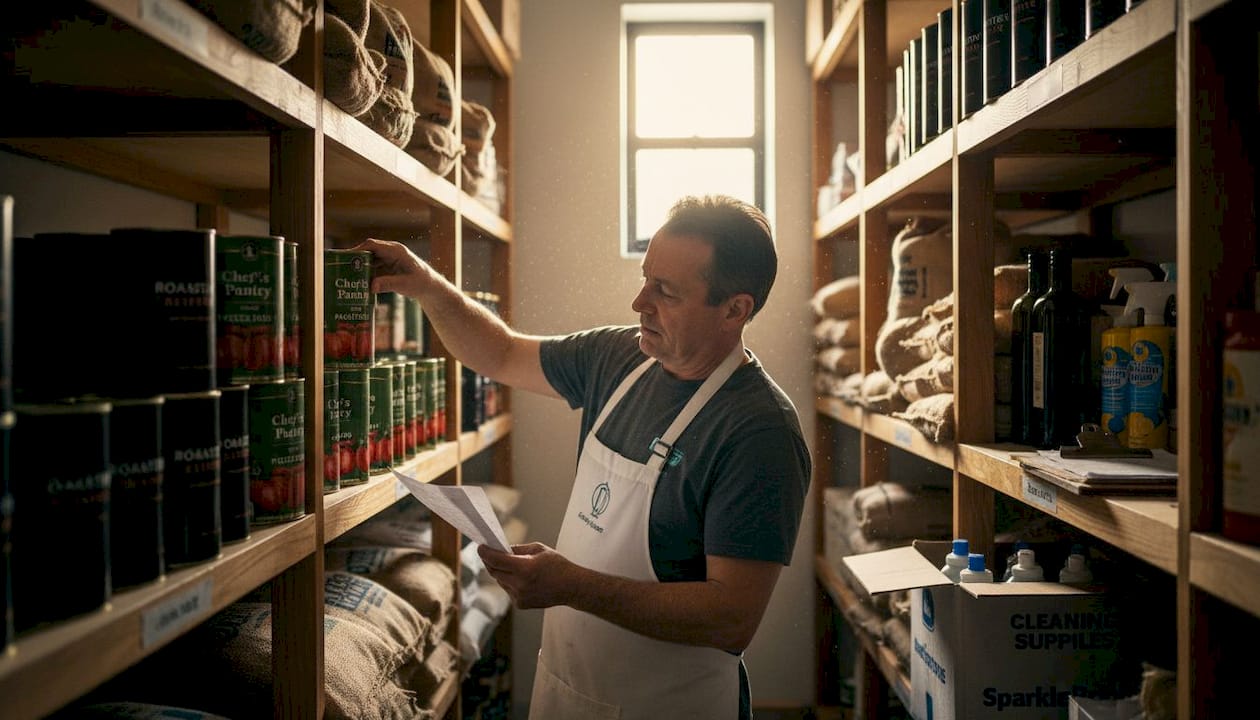
Pro Tip: Organise your inventory count sheets to follow the exact physical order of your storage areas, from front to back, shelf by shelf. This single change can cut counting time by up to a third and reduces the risk of skipped items.
Par levels need to be reviewed regularly, not set once and forgotten. Seasonal menus, promotional periods, and supplier changes all shift your ideal minimum and maximum quantities. Build a monthly review of par levels into your calendar alongside your food cost analysis.
Step-by-step: Setting up and executing inventory control
Implementation is where most plans stall. The following steps give you a clear sequence to follow, whether you’re starting from scratch or tightening up an existing process.
1. Establish your count sheets and assign ownership.
Create sheets that list every ingredient by storage area. Assign a specific staff member to each area and make them responsible for accuracy. Consistency in who counts what area reduces variance over time.
2. Control the receiving process from day one.
Receiving process weaknesses are a frequent root cause of inventory inaccuracy, cascading into wrong ordering and avoidable waste. Before any delivery is stored, check and weigh items against the purchase order (not just the packing slip). Record temperatures for chilled and frozen goods. Note any shortages, substitutions, or quality issues immediately and contact the supplier the same day.
3. Enter received quantities before staff store items.
This is where most operations lose data. Once a delivery is put away, the opportunity to accurately record it drops significantly. Make it a non-negotiable rule that quantities are logged first, then stock is stored.
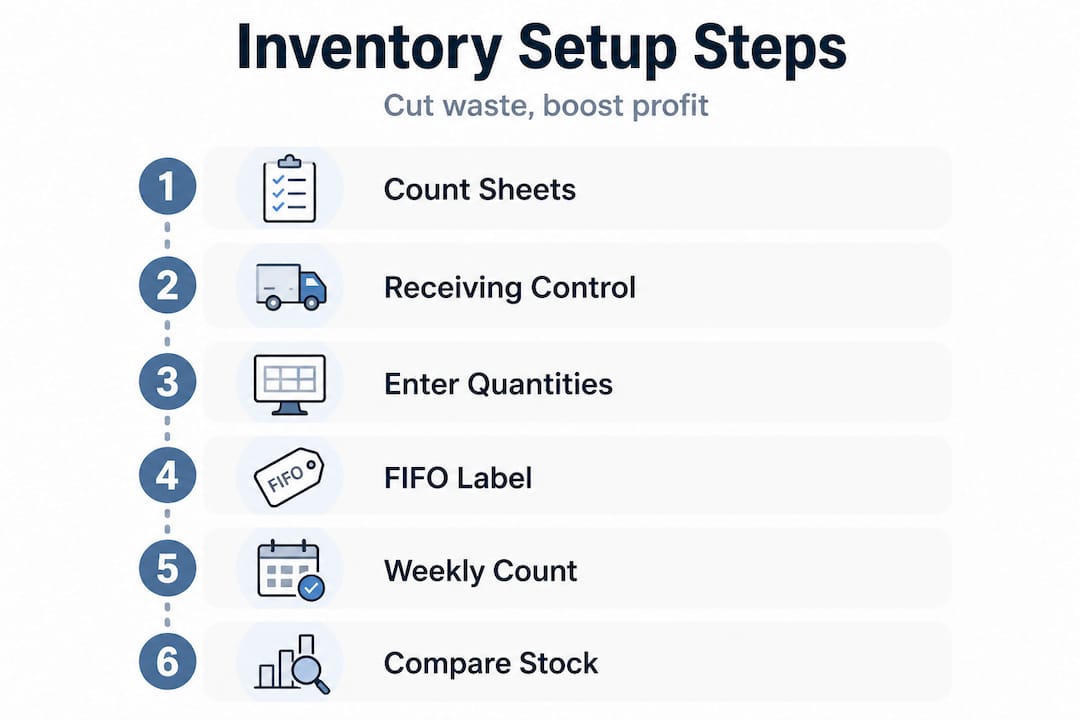
4. Enforce FIFO date-labelling throughout every storage area.
Every item that enters your walk-in, dry store, or freezer should be date-labelled on arrival. Older stock goes to the front. New stock goes behind it. Train every team member on this, not just the chefs.
5. Set your weekly counting cadence and stick to it.
Count at the same time each week, ideally at the end of trading before a major delivery day. This gives you a true picture of what you’ve consumed and what you need.
6. Compare actual stock to theoretical stock.
Your POS system or recipe costings give you a theoretical usage figure based on what was sold. Compare this to what actually left the shelves. Any significant gap is a flag for waste, theft, or portioning errors.
Pro Tip: Enter received quantities into your system the moment deliveries arrive, before the driver leaves if possible. Having a designated receiving station with a tablet or terminal speeds this up enormously and removes the temptation to “do it later.”
The table below compares the three most common approaches to tracking inventory:
| Method | Speed | Accuracy | Cost | Best suited for |
|---|---|---|---|---|
| Manual paper sheets | Slow | Moderate | Very low | Small independent sites |
| Spreadsheet tracking | Moderate | Good | Low | Multi-item menus with dedicated admin time |
| POS-integrated software | Fast | High | Medium to higher | Busy restaurants wanting real-time data |
Integrating inventory tracking with your improving POS efficiency system is the most reliable path to accurate data, but even a well-run manual process delivers results if the discipline is there. For a broader look at what integrated POS solutions for hospitality can do for your operation, it’s worth understanding what’s available before committing to a method.
Troubleshooting common mistakes and optimising results
Even well-intentioned systems develop problems over time. Knowing what to look for makes the difference between a system that drifts and one that sharpens with use.
The most common errors in UK restaurant inventory management are:
- Skipping the receiving check: Accepting deliveries without verifying quantities or quality, then discovering discrepancies only during a count.
- Inconsistent counting cadence: Doing counts when convenient rather than on a fixed schedule, which makes trend data unreliable.
- Neglecting FIFO in busy periods: When service pressure builds, staff take the nearest item rather than rotating properly, and spoilage rises silently.
- Using a single person for all counts: This creates dependency and removes any cross-check on accuracy.
- Failing to act on variance data: Identifying a discrepancy but not investigating the cause means the same error repeats.
Unexplained shrinkage (the gap between what should be there and what actually is) needs a structured response. Start by checking your receiving records, then your FIFO compliance, then your waste log. Work through the chain systematically rather than assuming theft as the first cause. Often, the answer is an unrecorded delivery, a portioning drift, or a labelling error.
“Neglecting to immediately record what arrives at the goods-in door is one of the most common and most costly mistakes in restaurant inventory. The receiving stage is where inaccuracy enters the system, and everything downstream is affected by it.” Adapted from receiving controls guidance.
Team involvement is essential for long-term improvement. When staff understand why the process matters, not just how to do it, compliance improves markedly. Hold a brief team briefing when you launch the system, explain what you’re measuring and why it affects the business, and share results regularly. A team that sees waste figures improving has a reason to maintain the discipline.
Quick optimisation tactics that produce real results:
- Review your waste log weekly and identify any single ingredient appearing repeatedly.
- Adjust par levels quarterly to reflect seasonal shifts in your menu.
- Cross-train at least two staff members to count each storage area accurately.
- Use retail POS best practices as a reference point when reviewing how your technology supports your processes.
- Introduce a brief pre-close check of high-value perishables every night.
What to expect: Results of effective inventory management
Operators who implement and maintain a structured inventory process consistently report measurable improvements within the first one to three months. The changes are practical and financial rather than theoretical.
In the first month, most restaurants see a reduction in over-ordering as par levels are properly set and receiving records become reliable. Orders align more closely with actual consumption, reducing the volume of stock that enters the kitchen unnecessarily. This alone can cut food costs by several percentage points.
By month two, spoilage levels typically drop noticeably. FIFO compliance improves with regular reinforcement, and the waste log starts to reveal which specific items or processes are the remaining problem areas. These are the conversations you can now have with your kitchen team backed by data.
By month three, you have enough trend data to have better conversations with suppliers. You know your actual consumption patterns and can negotiate more accurately on volume and delivery frequency. You also have a clearer picture of which menu items consistently deliver good margin versus those that create disproportionate waste.
The 11% share of total UK food waste attributed to hospitality is a sector-wide figure. Your operation doesn’t have to contribute at the average rate. Businesses that implement proper controls consistently perform significantly better than the sector norm, which means both lower costs and a stronger position when sustainability matters to your guests and your supply chain. Connecting your inventory process to your POS solutions for hospitality gives you the reporting tools to measure this progress over time and share it with confidence.
Why most inventory systems fail (and what truly works)
Here is what we’ve seen repeatedly over many years of working with UK hospitality operators: the technology is rarely the problem. Restaurants invest in software, scanners, and integrated POS systems, and then the results plateau or disappear entirely after six weeks. The system didn’t fail. The habit did.
The myth of the “set and forget” inventory system is genuinely damaging. Operators assume that once a process is documented and a system is installed, it will run itself. It won’t. Inventory management is a discipline, not a feature. It requires consistent human behaviour, every delivery, every shift, every week.
The uncomfortable truth is that a manually run spreadsheet process with full team buy-in will outperform an expensive software system that no one uses consistently. The tool amplifies the process. It does not replace it.
What actually works is making the process fast, visible, and owned. Fast means the count sheets match the physical layout and counting takes twenty minutes, not two hours. Visible means variance data is shared with the team, not just reviewed by management. Owned means specific people are accountable for specific areas and they know it.
Long-term adherence comes from two things: making the right behaviour easy and making the impact of the wrong behaviour obvious. When a receiving error shows up clearly in the week’s variance report, and that’s discussed openly with the team, standards improve without confrontation. When counting is simple and takes little time, people actually do it.
If you’re ready to integrate restaurant technology solutions that support rather than replace these habits, the gains compound quickly. But start with the discipline. The technology will have far more to work with.
Streamline inventory with the right POS tools
Running a tighter inventory process becomes significantly easier when your technology is built for the demands of a busy kitchen and service environment.
At YCR Distribution, we supply essential POS hardware and hospitality POS software specifically designed to support UK restaurants, cafes, and takeaways. From barcode scanners that speed up goods-in verification to integrated POS terminals that link sales data directly to stock levels, our solutions are built to reduce counting errors and give you accurate information in real time. We offer next-day delivery and same-day dispatch, so improving your system doesn’t have to wait. Speak to our team about the right setup for your operation and start making inventory management a genuine competitive advantage.
Frequently asked questions
What is the FIFO method in restaurant inventory?
FIFO stands for “First In, First Out” and means you always use the oldest stock first, preventing spoilage and keeping food safe by ensuring nothing sits unused at the back of the shelf.
How often should a UK restaurant do inventory counts?
Counting inventory on a fixed weekly cadence is the minimum recommended practice, with high-value or fast-moving items checked more frequently to catch discrepancies before they compound.
What is the biggest cause of food waste in restaurants?
Preparation errors, poor stock rotation leading to spoilage, and plate waste are the primary drivers, with hospitality food waste in the UK largely attributable to these controllable factors.
What controls should be in place when receiving deliveries?
Always count and weigh deliveries before signing off, check temperatures for chilled and frozen items, compare quantities to your purchase order rather than the packing slip, and enter received quantities into your system the same day without exception.