
Restaurant POS trends 2026: the UK operator’s guide
The defining shift in restaurant POS trends for 2026 is not about flashier screens or more menu options. It is about whether your system can function as a dependable, real-time integration hub that connects every part of your operation. UK operators are making that judgement call right now, and the technology landscape has changed enough to make the decision genuinely consequential.
Here is what is driving the agenda this year:
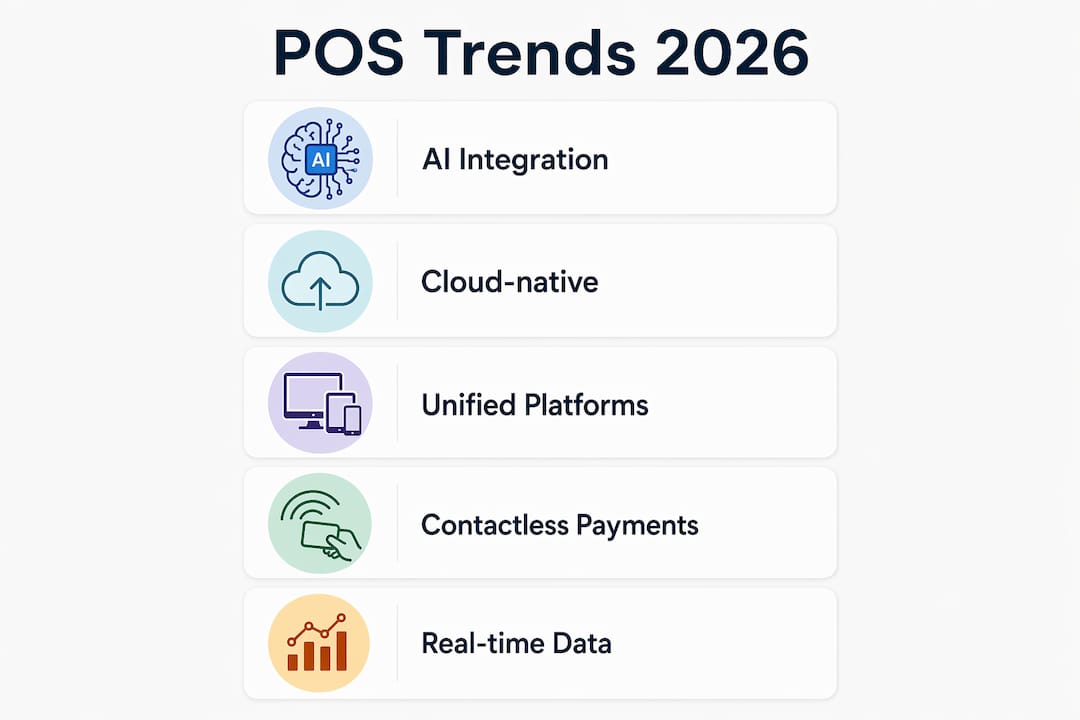
- AI in back-of-house operations is moving from pilot project to standard practice, with a majority of operators actively using or piloting AI for reporting and analytics by mid-2026
- Cloud-native, composable platforms are replacing fragmented tech stacks, centralising menus, pricing, inventory, and loyalty across every channel
- Contactless and mobile payments are now fully embedded into POS infrastructure, removing friction at the point of settlement
- Real-time data orchestration between front-of-house and back-of-house systems is the feature operators scrutinise most during procurement
- Unified commerce platforms that cover ordering, loyalty, and fulfilment in a single ecosystem are replacing the patchwork of disconnected tools many venues still run
Table of Contents
- What does the UK restaurant POS landscape look like in 2026?
- Core technology trends transforming restaurant POS right now
- Enterprise venues versus SMBs: the POS requirements diverge sharply
- How to upgrade your POS effectively in 2026
- How Ycr’s solutions align with 2026 POS priorities
- Key takeaways
What does the UK restaurant POS landscape look like in 2026?
44% of UK restaurant operators plan to replace or significantly upgrade their POS this year. That figure comes from Hospitality Technology’s 2026 POS Software Trends Study, and it reflects something most operators already feel: the cost of staying on an inadequate system has quietly overtaken the cost of switching.
The pain points are consistent. Shallow integrations that claim to connect but break under pressure. Reporting that arrives hours late when real-time decisions are needed. Innovation that requires bespoke engineering every single time a new channel or partner is added. These are not edge cases; they are the daily friction that erodes margins and staff morale simultaneously.
The 2026 UK POS market has moved beyond bright features. Operators now scrutinise platforms for stability, openness, and real-time data capability rather than chasing isolated functionality they may never fully use.
What operators want from a modern POS system in 2026 breaks down into a clear set of priorities:
- Data accessibility: the ability to pull real-time transaction data without extra fees or workarounds
- Integration reliability: connections that hold under load and across multiple locations
- API quality: documented, versioned, and observable, not a black box
- Offline resilience: the system must keep trading when the internet drops
- Security: PCI DSS compliance and clear data ownership terms
One in five operators surveyed by Informa Foodservice identified data silos among vendors as one of their biggest tech stack challenges this year. That number points directly at the fragmentation problem. The operators who are winning are those who stopped treating their POS as a cash register with extras and started treating it as the operational nervous system of their business.
Core technology trends transforming restaurant POS right now
AI is no longer experimental
Back-of-house AI adoption has surged during 2026, with a majority of operators adopting or piloting AI for reporting and analytics by mid-year. Among active users, most report reductions in food and labour costs, indicating noticeable operational improvements. Those are not marginal gains; they show up directly on the profit and loss account.
AI-driven inventory and scheduling tools cut order errors to near zero and free staff from supplier auditing and data entry, letting them focus on guests instead. The catch is that AI amplifies whatever data quality it finds. Feed it inconsistent, poorly defined POS data and it produces expensive guesswork rather than useful intelligence.
Cloud-native architecture
Legacy on-premise systems cannot support the pace of change operators now expect. Cloud-native platforms allow continuous feature deployment, centralised oversight across multiple sites, and faster AI model updates without scheduled downtime. For a group running several sites across the UK, that means a menu change or pricing update rolls out everywhere simultaneously rather than requiring a technician visit to each location.
Composable, unified commerce platforms
Composable platforms centralise menus, pricing, inventory, and loyalty across every channel, eliminating the inconsistencies that surface when ordering, delivery, and in-venue systems do not share the same data. The architectural model is borrowed from retail, where it solved exactly the same problem: disconnected channels producing inconsistent guest experiences. Restaurants are now applying it to fulfilment, guest identity, and real-time capacity management.

Contactless and mobile payments fully embedded
Contactless payments and digital wallets are no longer a bolt-on feature. By 2026 they are embedded directly into POS infrastructure, with payment and transaction data unifying automatically across outlets. Real-time settlement visibility reduces accounting friction and removes the end-of-day reconciliation headaches that still plague venues running older hardware.
Real-time order orchestration
The shift from batch data uploads to real-time event streams between kitchen display systems, stock management, and the POS terminal is one of the less visible but most operationally significant trends of 2026. Back-of-house technology now drives competitive advantage through AI-assisted kitchen displays, automated stock forecasting, and live labour management, functions that were manual or delayed as recently as two years ago.
Pro Tip: 86% of operators now report they are comfortable using AI in daily operations. If your current POS cannot feed clean, consistent data to an AI layer, you are not behind on AI adoption; you are behind on data infrastructure, and that is the problem to fix first.
Enterprise venues versus SMBs: the POS requirements diverge sharply
The technology trends above apply to every venue, but how you implement them depends heavily on your scale and operational complexity.
Enterprise venues (multi-site groups, large hotels with food and beverage operations, stadium concessions) face a different set of problems to an independent restaurant. Their priorities centre on:
- Uptime commitments and integration SLAs that are contractually enforceable
- Rigorous security standards, including PCI DSS compliance and clear data ownership terms
- The ability to build proprietary middleware or API layers to accommodate complex, bespoke workflows
- Centralised reporting across locations without sacrificing site-level granularity
- Scalability that does not require re-engineering every time a new site or channel is added
Larger venues increasingly build their own middleware to sit between the POS and the broader tech stack, moving beyond vendor lock-in and accommodating workflows that off-the-shelf platforms cannot handle cleanly.
Small and medium businesses (independent restaurants, cafés, takeaways, small pub groups) have different constraints and different priorities:
- Cloud-based systems with low upfront cost and minimal IT overhead
- Easy deployment without specialist engineers on site
- Good telephone and remote support, because there is rarely an internal IT team
- Offline resilience, since a dropped connection cannot mean a closed till
- Essential integrations (online ordering, loyalty, delivery aggregators) without the complexity of enterprise middleware
For SMBs, the build-versus-buy debate resolves quickly in favour of buying a well-supported platform. The question is which platform has the cleanest data model and the most reliable integrations for the channels that matter to that specific venue. AI and automation fit differently at this scale too: the priority is not predictive demand forecasting across fifty sites but accurate stock alerts and labour scheduling for a team of ten.
How to upgrade your POS effectively in 2026
The operators who get this right treat POS selection as a platform decision, not a feature chase. Here is a practical roadmap for the upgrade process.
Start with your data. Before you evaluate a single vendor, audit what your current system actually produces. Are item identifiers consistent? Do timestamps match across systems? Is there a clear ownership structure for your transaction data? AI implementation fails when POS data quality is poor, and no amount of clever software fixes a dirty data foundation.
Scrutinise integration capability, not integration claims. Ask vendors to demonstrate, not describe, how their API works. Specifically, look for:
- Real-time or near real-time data streams, not batch uploads
- Observable pipelines where you can monitor and verify data accuracy
- Documented webhooks and event streams
- Versioning and change management processes
- Sandbox environments for testing before go-live
Plan a phased implementation. A full POS replacement during a busy trading period is a recipe for operational chaos. Identify a lower-volume window, run parallel systems briefly if the budget allows, and train staff before the cutover rather than on the day.
Check payment compatibility thoroughly. Your new POS must handle contactless, Apple Pay, Google Pay, and any loyalty card or app your guests already use. Settlement data should flow automatically into your accounting system without manual reconciliation steps. For venues using integrated ordering apps across multiple channels, confirm that the POS can receive and route those orders in real time.
Demand clear data ownership terms. Some vendors charge extraction fees or restrict access to your own transaction history. That is a deal-breaker. Your data is a business asset, and any platform that treats it as a retention mechanism is not a partner.
Pro Tip: Treat your POS selection as a platform investment rather than a hardware purchase. The system you choose will determine which AI tools you can run, which delivery partners you can connect, and how quickly you can respond to market changes. Choose the platform first; the hardware follows.
How Ycr’s solutions align with 2026 POS priorities
Ycr has supplied POS hardware and software to UK hospitality operators for over three decades, and the product range maps directly onto the trends reshaping the market this year.
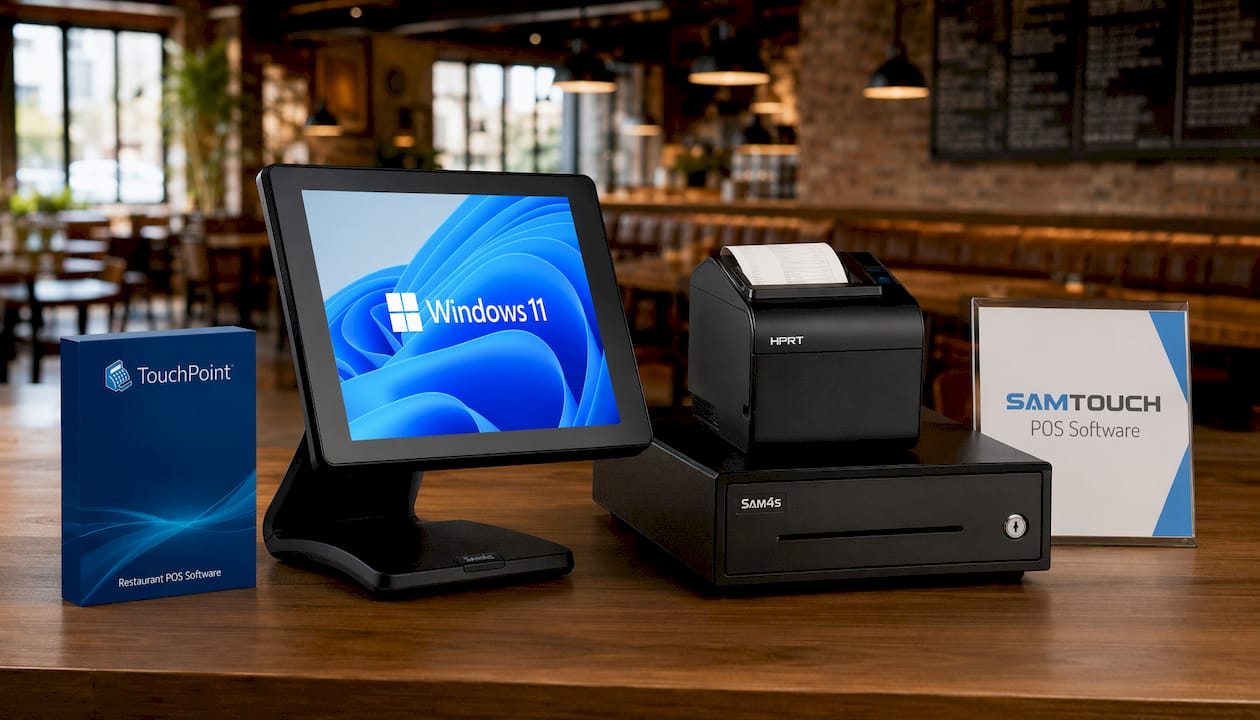
The core of Ycr’s hospitality offering covers the full stack that 2026 demands:
- SAMTOUCH POS software, designed specifically for hospitality and retail, with integrated payment processing and real-time reporting built in. Available as a complete hardware and software bundle or as software only for operators integrating with existing terminals
- EZEEPOS, Ycr’s purpose-built solution for takeaways and cafés, covering takeaway operations and café and bistro environments with a straightforward interface that staff can learn quickly
- SAM4S hardware, distributed by Ycr as a trusted UK channel partner, covering terminals and peripherals built for the demands of busy hospitality environments
- iMin devices, compact Android-based POS terminals suited to mobile and tableside ordering scenarios where space and portability matter
- Honeywell scanners, including the Honeywell MS7190G and Honeywell Youjio HF600, for stock management and goods-in workflows that feed clean data into the POS
- Zebra barcode scanners, including the Zebra DS9308, for high-volume scanning in kitchen and stockroom environments
- Digital signage, from outdoor freestanding displays to wall-mounted advertising screens and double-sided window displays, supporting the guest-facing communication layer that modern venues need alongside their POS
Ycr also offers credit accounts, next-day delivery, and same-day dispatch, which matters more than it sounds during a POS upgrade. When a terminal fails mid-service or a scanner needs replacing before the weekend rush, waiting a week for a courier is not an option.
For operators at the planning stage, Ycr’s POS hardware supplier checklist covers the procurement criteria in detail, and the POS software range gives a clear view of the software options available for different venue types.
Key takeaways
The single most important decision UK restaurant operators face in 2026 is whether their POS functions as a real-time integration platform or merely as a transaction terminal, because that choice determines everything from AI capability to payment flexibility.
| Point | Details |
|---|---|
| Upgrade intent is high | 44% of operators plan to replace or significantly upgrade their POS in 2026, driven by integration failures and data access problems. |
| AI adoption has accelerated sharply | A majority of operators have adopted or are piloting back-of-house AI systems by mid-2026; most report reductions in food and labour costs. |
| Data quality comes before AI | AI tools fail when POS data is inconsistent or poorly defined; clean data foundations must come before any AI implementation. |
| Enterprise and SMB needs diverge | Large venues build proprietary middleware for complex workflows; SMBs prioritise cloud-based platforms with reliable support and offline resilience. |
| Platform thinking beats feature chasing | Operators who treat POS as a strategic platform gain control over data, integration speed, and adaptability to new channels and tools. |