- +44 1924 438238
- sales@ycr.co.uk
- Mon - Fri: 8:30 - 16:30

Retail Automation: Enhancing Efficiency in UK Businesses
Running a busy hospitality venue in the United Kingdom often means juggling stock checks, staff scheduling, and long queues at the till all at once. The demand for quicker, error-free service grows every year, making outdated processes feel even more limiting. Retail automation uses technology to perform routine tasks once handled manually, freeing your team to focus on genuine connections with customers and smarter business decisions. This guide explains exactly how modern automation transforms operations, clarifies the real impact for UK retailers, and shows where to start for maximum returns.
Table of Contents
- Defining Retail Automation And Its Core Purpose
- Why This Matters For Your UK Business
- The Real-World Impact
- Key Types Of Retail Automation Solutions
- How Automation Works Within Retail Environments
- Benefits And Limitations For UK Retailers And Hospitality
- Critical Risks, Costs, And What To Avoid
Key Takeaways
| Point | Details |
|---|---|
| Retail Automation Enhances Efficiency | By automating routine tasks, businesses can redirect staff to focus on enhancing customer service and strategic initiatives. |
| Customer Experience is Improved | Faster checkouts and personalised recommendations contribute to a more satisfying shopping experience for customers. |
| Data Quality is Crucial | Effective automation relies on accurate data; poor data quality can lead to significant operational failures. |
| Integration Challenges Must be Addressed | Legacy systems can complicate the integration of new technology, requiring careful planning and investment to ensure compatibility. |
Defining Retail Automation and Its Core Purpose
Retail automation represents a fundamental shift in how businesses operate behind the scenes and at customer touchpoints. Rather than replacing your team entirely, it uses technology to perform routine tasks that previously required manual labour, freeing your staff to focus on what matters: building relationships with customers and solving problems.
At its core, retail automation encompasses three main categories:
- Robotics and physical automation for warehouse operations, stock management, and sorting tasks
- Artificial intelligence and data analytics for personalised recommendations and predictive inventory planning
- Self-service and digital solutions including automated checkouts, payment systems, and customer service platforms
The purpose goes beyond just cutting costs. Automation technology integrates AI and advanced tools to transform how you manage inventory, process transactions, and understand customer behaviour. When properly implemented, these systems work together to create smoother operations across your entire business.
Here is a quick comparison of core retail automation categories and their primary business impacts:
| Automation Category | Main Technologies Involved | Key Business Impact |
|---|---|---|
| Robotics & Physical Automation | Warehouse robots, sorters, conveyors | Accelerates stock handling and accuracy |
| AI & Data Analytics | Machine learning, predictive software | Improves decision quality and personalisation |
| Self-Service & Digital Solutions | Kiosks, mobile payment, chatbots | Enhances customer experience and convenience |
Why This Matters for Your UK Business
You’re operating in a competitive market where customers expect faster service, accurate stock information, and seamless checkout experiences. Retail automation delivers exactly that. It reduces the time staff spend on repetitive tasks like stock counts, till reconciliation, and manual order processing.
Better inventory management means fewer stockouts and overstock situations. Faster checkout processes mean shorter queues and happier customers. Using point-of-sale systems strategically helps you capture accurate sales data that reveals what customers actually want to buy.
The Real-World Impact
When you automate checkout processes, you’re not eliminating jobs—you’re redeploying people to areas where they add genuine value. A staff member previously stationed at a till can now help customers find products, answer questions, or manage the shop floor more effectively.
Automation also delivers insights. Every transaction, every inventory movement, every customer interaction generates data that helps you make smarter business decisions.
Retail automation isn’t about replacing people; it’s about enabling your team to do more meaningful work whilst improving customer satisfaction.
The integration does require planning and investment, but the payoff appears quickly in improved operational efficiency and reduced costs. UK retailers who embrace this now are gaining a significant competitive edge.
Pro tip: Start with automation in your highest-pain areas—whether that’s checkout bottlenecks, inventory management, or customer service—rather than trying to overhaul everything at once.
Key Types of Retail Automation Solutions
Retail automation isn’t one-size-fits-all. Different parts of your business have different automation needs, and understanding the main categories helps you identify where to start.
Checkout and Payment Automation
Self-service checkouts and automated payment systems have become standard expectations. These reduce queue times, cut labour costs, and minimise human error during transactions. Customers appreciate the speed, particularly during peak trading hours.
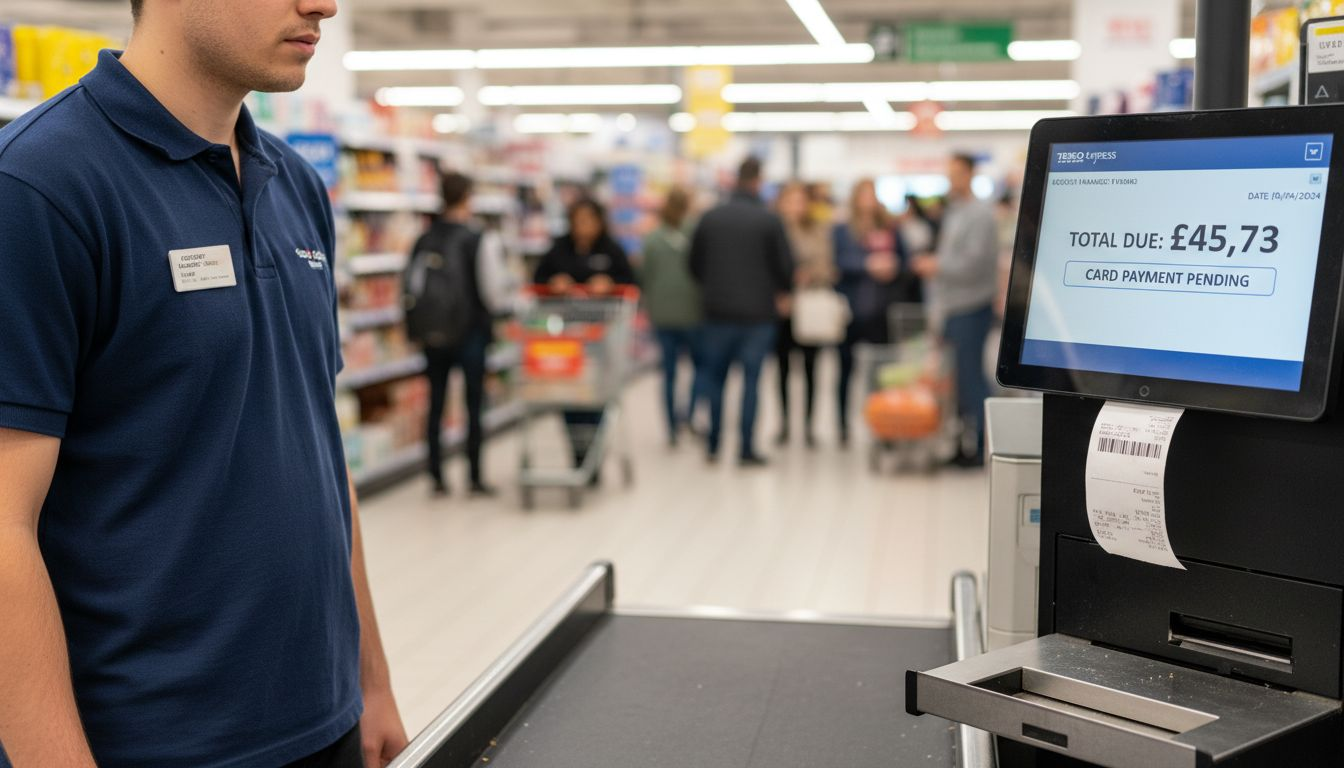
Mobile payment integration and contactless options make transactions frictionless. Your staff can focus on customer service rather than processing payments manually.
Inventory Management Systems
Real-time inventory tracking gives you accurate stock levels across all locations instantly. This prevents overselling, reduces shrinkage, and eliminates those moments when you tell customers “we don’t have it in stock”.
Automated reordering systems trigger purchase orders when stock reaches predetermined thresholds. You’re never caught out with empty shelves or excessive backstock.
Order Fulfillment and Warehouse Automation
Retail automation solutions optimise workflows and order processing, making your entire supply chain smoother. Robotic systems in warehouses sort, pick, and pack orders faster and more accurately than manual processes.
For hospitality and retail businesses with delivery operations, automated fulfillment dramatically cuts processing times and shipping errors.
Analytics and Data Automation
Every transaction generates valuable data. Automated analytics platforms analyse customer behaviour, sales trends, and inventory patterns without requiring manual reporting.
You gain insights such as:
- Which products sell best at specific times
- Customer purchasing patterns and preferences
- Seasonal demand fluctuations
- Staff productivity metrics
Workflow and Process Automation
Technologies automating retail operations extend beyond the shop floor into back-office functions. Marketing campaigns, staff scheduling, employee onboarding, and finance tasks all benefit from automation.
Repetitive administrative work disappears, freeing your team for strategic initiatives.
Customer Service Automation
Chatbots and AI-powered systems handle routine customer queries instantly. FAQs, order tracking, returns processing—all automated and available 24/7 without staffing costs.
When customers need human help, they’re directed to your team with full context already loaded.
Successful retailers combine multiple automation types to create a seamless experience across every customer touchpoint.
The best approach combines these solutions. Exploring retail technology examples shows how top performers integrate multiple automation types into cohesive systems.
Pro tip: Map your current manual processes and identify where errors, delays, or high labour costs occur—those pain points are your best candidates for automation investment.
How Automation Works Within Retail Environments
Retail automation doesn’t operate in isolated pockets. Instead, multiple systems communicate seamlessly to create a unified operation where information flows automatically between different parts of your business.
Here’s what happens behind the scenes when a customer makes a purchase.
The Integration Framework
Automation relies on connected systems that talk to each other constantly. Your point-of-sale system links to inventory management, suppliers, marketing platforms, and financial software. When one system detects a change, it triggers actions in others instantly.
This integration eliminates manual data entry and reduces errors dramatically. Information moves once and updates everywhere simultaneously.
Real Transaction Flow
Consider a typical transaction:
- Customer completes a purchase at the till
- Sale data transmits to inventory management immediately
- System checks stock levels against reorder thresholds
- If stock is low, a purchase order generates automatically
- Supplier receives the order and confirms delivery
- Customer receives a targeted promotion based on their purchase history
- Financial records update for accounting
All of this happens in seconds without anyone manually processing anything.
How Data Flows Through Systems
Integrating multiple systems like point-of-sale and inventory management ensures consistent decision-making across your business. When automated systems have access to real-time data, they make better choices about pricing, stock, and customer communications.
AI and machine learning continuously learn from this data, improving forecasting accuracy over time. The system predicts demand before it happens based on historical patterns and seasonal trends.
Edge Computing and Local Processing
Advanced technologies reduce latency by processing data locally near where customer interactions occur. This means your till responds instantly, shelf monitoring systems update in real-time, and customer service tools access information without delay.
Local processing also increases resilience. If your main server experiences issues, individual locations continue operating smoothly.
Customer Engagement Automation
Automation triggers communications automatically. A customer who regularly buys coffee receives an offer before they typically reorder. Someone browsing winter coats gets a relevant email nudge.
These triggered interactions feel personalised but cost you nothing to send manually.
Automation works best when systems talk to each other constantly, sharing data that enables intelligent decisions without human intervention.
The beauty of this architecture is that once configured correctly, your business runs more consistently and efficiently than any manual process could achieve.
Pro tip: Start by mapping which systems currently operate separately in your business, then prioritise integrating the ones that cause the most manual work or data duplication.
Benefits and Limitations for UK Retailers and Hospitality
Automation offers genuine advantages for UK retailers and hospitality venues, but it’s not a magic solution. Understanding both sides helps you make realistic investment decisions.
The Clear Benefits
Operational efficiency stands at the top. Automating routine tasks frees your team to focus on customer service and strategic work. Staff spend less time on till reconciliation, stock counting, and order processing—tasks that add no real value.
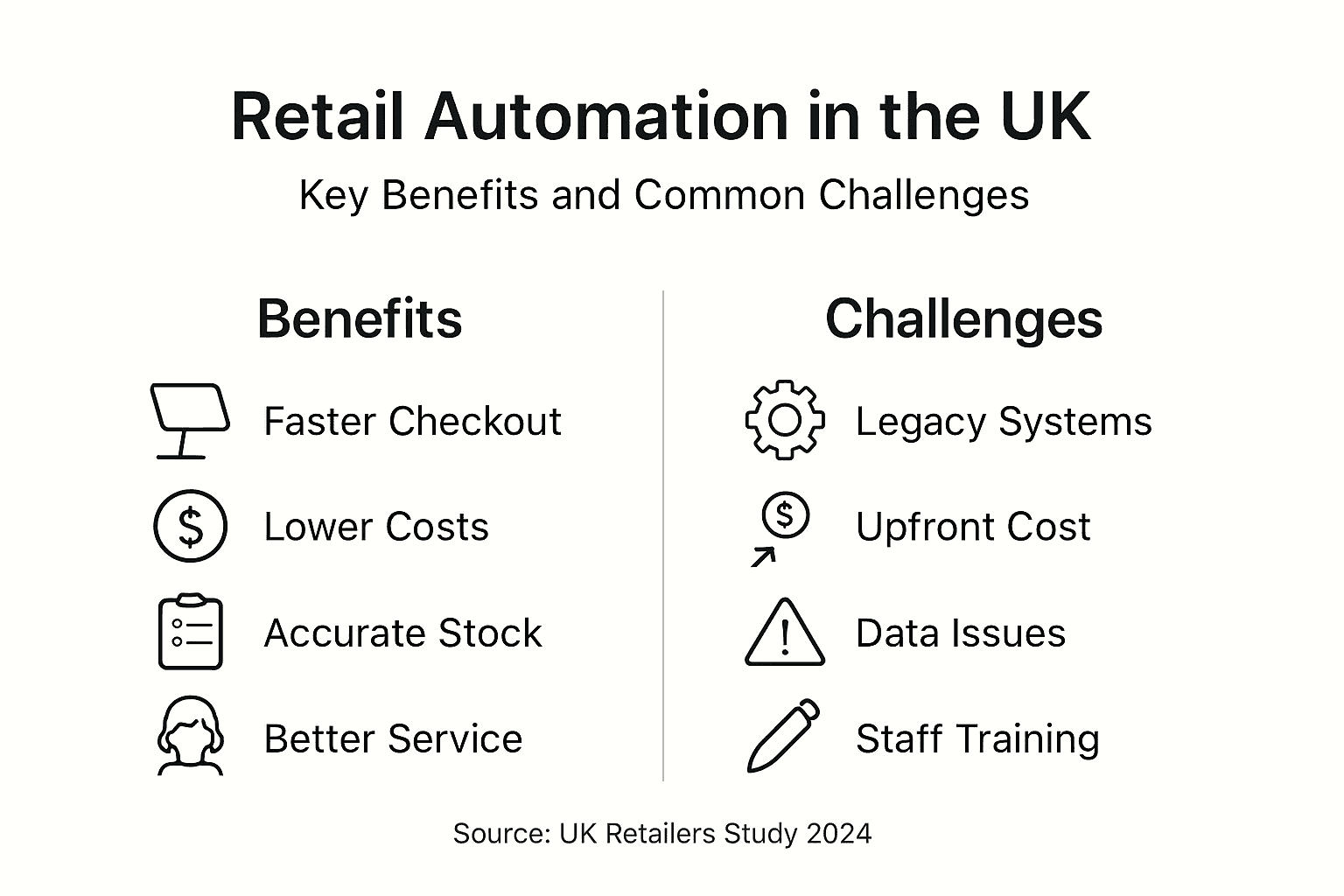
Your margins improve through reduced labour costs and fewer errors. Less shrinkage, better inventory control, and faster decision-making all flow from automation.
Demand forecasting becomes more accurate when AI analyses your historical sales data. You stock what customers actually want, avoiding overstock and stockouts.
Customer Experience Improvements
Faster checkouts mean shorter queues, especially during peak times. Self-service options appeal to customers who prefer them. Personalised recommendations based on purchase history feel relevant and helpful.
24/7 automated customer service handles routine queries instantly, without staffing costs.
Real Limitations You’ll Face
Not every UK business starts from a level playing field. Legacy systems create headaches. If your current infrastructure doesn’t integrate well, connecting new automation tools becomes expensive and complex.
Upfront investment costs significant money. You’re paying for hardware, software, implementation, and staff training all at once—before you see returns.
Workforce concerns are real, though different than you might expect. Automation leads to job evolution rather than pure job loss. Your team needs retraining to work alongside automated systems effectively.
The Organisational Challenge
Integration complexity often surprises business owners. Multiple systems must work together seamlessly, which requires careful planning and often external expertise.
Staff resistance appears when people fear job loss or struggle with new technology. Change management requires communication and time.
The benefits include:
- Faster transaction processing
- Reduced administrative burden
- Better inventory accuracy
- Improved decision-making with real-time data
- Lower operational costs over time
Automation works best when you view it as evolution, not revolution—gradual integration that improves your business whilst supporting your team through change.
Success requires matching automation to your actual needs rather than adopting technology for its own sake.
Pro tip: Calculate your actual return on investment before committing—factor in staff training, system integration, and ongoing support costs alongside the efficiency gains you expect.
Critical Risks, Costs, and What to Avoid
Automation investments can go badly wrong if you ignore the pitfalls. Understanding common mistakes helps you avoid expensive failures and protect your business.
The Cost Reality
Automation requires serious upfront spending. Hardware like self-checkout kiosks, barcode scanners, and servers costs thousands. Software licensing, implementation, and customisation add more. Then comes staff training, which takes time and money.
Many retailers underestimate total cost of ownership. You’re not just buying equipment; you’re investing in integration, maintenance, updates, and ongoing support.
The Data Quality Problem
Garbage in, garbage out. Poor data quality undermines even well-designed automation systems. Inconsistent product information, missing prices, or incorrect inventory counts cause automated decisions to fail spectacularly.
Managing data quality and avoiding siloed systems becomes essential before implementing automation. Clean, accurate data across your entire business is the foundation.
You can’t automate broken processes. Fixing data issues before automating saves enormous headaches later.
Below is a summary of common retail automation challenges and effective countermeasures:
| Challenge | Typical Cause | Recommended Solution |
|---|---|---|
| Integration issues | Legacy systems incompatibility | Invest in middleware or upgrades |
| Data quality problems | Inconsistent records | Clean and standardise data upfront |
| Staff resistance | Change anxiety, unclear benefits | Provide training and clear communications |
| Unexpected costs | Overlooked maintenance/integration | Conduct thorough cost analysis |
Integration Nightmares
Connecting new automation tools to legacy systems causes problems. Your current till, inventory system, and accounting software may not communicate easily with new platforms.
Integration complexity often exceeds initial expectations, requiring specialist expertise and additional investment.
The Workforce Dimension
Don’t ignore staff implications. Automation changes working conditions and job requirements significantly. Ethical considerations include worker protection, fair labour standards, and avoiding job displacement without retraining.
Automation intensifies workload for remaining staff if not carefully managed. Surveillance and monitoring systems can feel invasive and damage morale.
Common mistakes to avoid:
- Implementing automation without staff input or training
- Ignoring legacy system compatibility issues
- Deploying systems without establishing data quality standards
- Automating processes that haven’t been optimised manually first
- Overlooking ongoing maintenance and support costs
- Creating isolated systems that don’t communicate
Management Resistance
Your leadership team may resist change, fearing disruption or uncertain returns. Getting stakeholder buy-in before investing prevents projects stalling halfway through.
Automation fails most often when businesses focus on technology rather than people, processes, and data quality that make technology actually work.
Successful retailers plan carefully, involving staff throughout, and approaching automation as gradual evolution rather than sudden overhaul.
Pro tip: Pilot automation in a single department or location first, measure actual results honestly, then scale what works rather than committing everything at once.
Unlock the True Potential of Retail Automation with YCR Distribution
Are you ready to overcome the common challenges of integrating automation technology into your retail or hospitality business? The article highlights key pain points including complex system integration, legacy infrastructure compatibility, and the need for reliable, real-time data to improve inventory management and customer experience. At YCR Distribution, we understand that transforming your operations requires more than just technology – it demands trusted, tailored solutions that seamlessly connect hardware, software, and accessories.
Discover how our extensive range of point of sale (POS) hardware and software can help your UK business streamline checkout processes, enhance inventory accuracy, and empower your team to deliver exceptional service. With over 30 years of expertise, we offer leading brands like SAM4S and iMin alongside bespoke software such as SAMTOUCH and EZEEPOS designed specifically for the unique demands of retail and hospitality. Don’t let integration hurdles or legacy systems hold you back – take the next step toward efficiency and competitive advantage today by visiting YCR Distribution and explore solutions that evolve your business with confidence.
Frequently Asked Questions
What is retail automation and how does it benefit businesses?
Retail automation uses technology to perform routine tasks that were previously done manually. It enhances efficiency, reduces labour costs, and allows staff to focus on customer service and strategic initiatives.
What types of systems are involved in retail automation?
Retail automation encompasses several systems, including robotics for warehouse operations, artificial intelligence for data analytics and personalised recommendations, and self-service solutions like automated checkouts and payment systems.
How can automation improve inventory management?
Automation enables real-time inventory tracking and automated reordering systems, which help prevent overselling and stockouts. This leads to better stock accuracy and operational efficiency.
What are the potential challenges when implementing retail automation?
Common challenges include integration issues with legacy systems, data quality problems, and workforce resistance. Proper planning, staff training, and ensuring data consistency can mitigate these risks.