- +44 1924 438238
- sales@ycr.co.uk
- Mon - Fri: 8:30 - 16:30

Role of POS software in retail: streamline UK operations
Most UK retail and hospitality owners view POS software as a glorified till, yet cloud-based POS systems are projected to reach £10.6 billion by 2032, transforming how businesses manage everything from inventory to customer relationships. This article reveals how the right POS software streamlines operations, ensures compliance with UK regulations, and enhances customer experiences. You’ll discover practical guidance on selecting systems, implementing solutions effectively, and avoiding costly mistakes that plague many UK businesses during deployment.
Table of Contents
- Understanding The Core Role Of POS Software In Retail And Hospitality
- Key Features And Compliance Requirements For UK Retail POS Software In 2026
- Comparing Cloud-Based And Legacy POS Systems: Benefits And Challenges
- Practical Steps To Selecting And Implementing POS Software For Your UK Retail Or Hospitality Business
- Explore POS Solutions Tailored For UK Retail And Hospitality
- Frequently Asked Questions
Key takeaways
| Point | Details |
|---|---|
| POS software drives growth | Modern systems integrate sales, inventory, and compliance management to streamline retail and hospitality operations across the UK. |
| Cloud systems offer flexibility | Cloud-based solutions with offline modes provide real-time data access whilst maintaining reliability during internet outages. |
| Compliance is mandatory | UK businesses must ensure GDPR and PCI compliance through proper POS security features and data protection protocols. |
| Testing prevents failures | Thorough edge case testing and staff training on refunds, voids, and payment exceptions eliminate expensive operational errors. |
Understanding the core role of POS software in retail and hospitality
POS software represents the digital backbone that processes sales transactions whilst managing the operational complexities of retail and hospitality businesses. Modern systems extend far beyond simple payment processing, integrating inventory control, customer relationship management, staff scheduling, and regulatory compliance into unified platforms. For UK businesses navigating competitive markets, POS systems serve as mission-critical infrastructure that determines operational efficiency and customer satisfaction levels.
The functionality spectrum of contemporary POS software encompasses several interconnected domains. Sales processing forms the foundation, capturing transaction data whilst triggering inventory updates and generating real-time financial reports. Payment handling integrates multiple methods including contactless, chip and PIN, mobile wallets, and traditional card payments. Customer data management builds detailed profiles tracking purchase history, preferences, and loyalty programme participation. Compliance features ensure adherence to GDPR data protection requirements and PCI security standards mandatory for UK businesses.
Cloud-based POS systems offer flexibility and integration capabilities but remain vulnerable to internet outages, whilst legacy systems provide offline reliability at the cost of higher maintenance expenses and limited features. The distinction matters significantly for UK retail operations where connectivity varies by location. Cloud platforms enable real-time synchronisation across multiple sites, automatic software updates, and remote management capabilities that reduce IT overhead. Legacy systems operate independently of internet connections, ensuring uninterrupted service during network failures but requiring manual updates and local data storage.
The shift towards cloud-based architecture with offline functionality represents the optimal compromise for most UK businesses. These hybrid approaches maintain local transaction processing during connectivity lapses whilst synchronising data when connections restore. You gain cloud benefits without sacrificing operational continuity during the inevitable network disruptions that affect British high streets and hospitality venues.
Core POS software functions include:
- Transaction processing with multiple payment method support
- Real-time inventory tracking and automated reordering triggers
- Customer relationship management and loyalty programme integration
- Staff management including scheduling, permissions, and performance tracking
- Financial reporting with VAT calculations and audit trails
- Compliance monitoring for GDPR data protection and PCI security standards
Key features and compliance requirements for UK retail POS software in 2026
UK retail and hospitality businesses face stringent regulatory requirements that POS software must address through built-in compliance features and security protocols. GDPR and PCI compliance are mandatory considerations when selecting systems, as violations carry substantial penalties and reputational damage. Data protection regulations require explicit customer consent for information collection, secure storage with encryption, and clear procedures for data access requests and deletion. Payment card industry standards mandate end-to-end encryption, tokenisation of sensitive card data, and regular security audits.
Security architecture within modern POS platforms employs multiple layers protecting against breaches and fraud. User authentication controls limit system access based on staff roles, preventing unauthorised transactions and data viewing. Network security features include firewall protection, secure connections for payment processing, and intrusion detection systems. Data encryption safeguards information both in transit and at rest, ensuring customer payment details remain protected even if physical hardware is compromised.

Offline functionality emerges as a critical feature distinguishing robust systems from inadequate solutions. UK businesses experience connectivity interruptions from various sources including broadband outages, mobile network failures, and infrastructure maintenance. Systems lacking offline capabilities force businesses to halt operations during outages, directly impacting revenue and customer satisfaction. Proper offline modes cache transaction data locally, process payments through stored credentials, and synchronise information automatically when connections restore.
Integration capabilities determine how effectively POS software connects with accounting platforms, ecommerce systems, supplier databases, and marketing tools. Seamless data flow between systems eliminates manual entry errors, provides unified reporting, and enables sophisticated business intelligence. Payment processing reliability requires redundant systems and multiple processor options, ensuring transactions complete successfully even when primary payment gateways experience issues.
Pro Tip: Before purchasing any POS system, simulate edge cases including failed payments, partial refunds, voided transactions, and network outages to verify the software handles exceptions gracefully without losing data or confusing staff.
Staff training on exception handling prevents the costly mistakes that plague businesses using sophisticated systems without proper preparation. Testing edge cases and training employees on refunds, voids, and payment failures reduces operational errors that damage customer relationships and create accounting headaches. Common scenarios requiring specific training include processing returns without receipts, handling split payments across multiple methods, managing loyalty point adjustments, and resolving transaction disputes.
Essential POS features for UK compliance and operations:
- GDPR-compliant customer data management with consent tracking
- PCI-certified payment processing with end-to-end encryption
- Offline transaction processing with automatic synchronisation
- Multi-site inventory management with real-time stock visibility
- VAT calculation and reporting aligned with HMRC requirements
- Audit trails documenting all system changes and transactions
Comparing cloud-based and legacy POS systems: benefits and challenges
The architectural choice between cloud-based and legacy POS systems fundamentally shapes operational capabilities, cost structures, and growth potential for UK retail and hospitality businesses. Understanding the nuanced trade-offs enables informed decisions aligned with specific business requirements and strategic objectives.
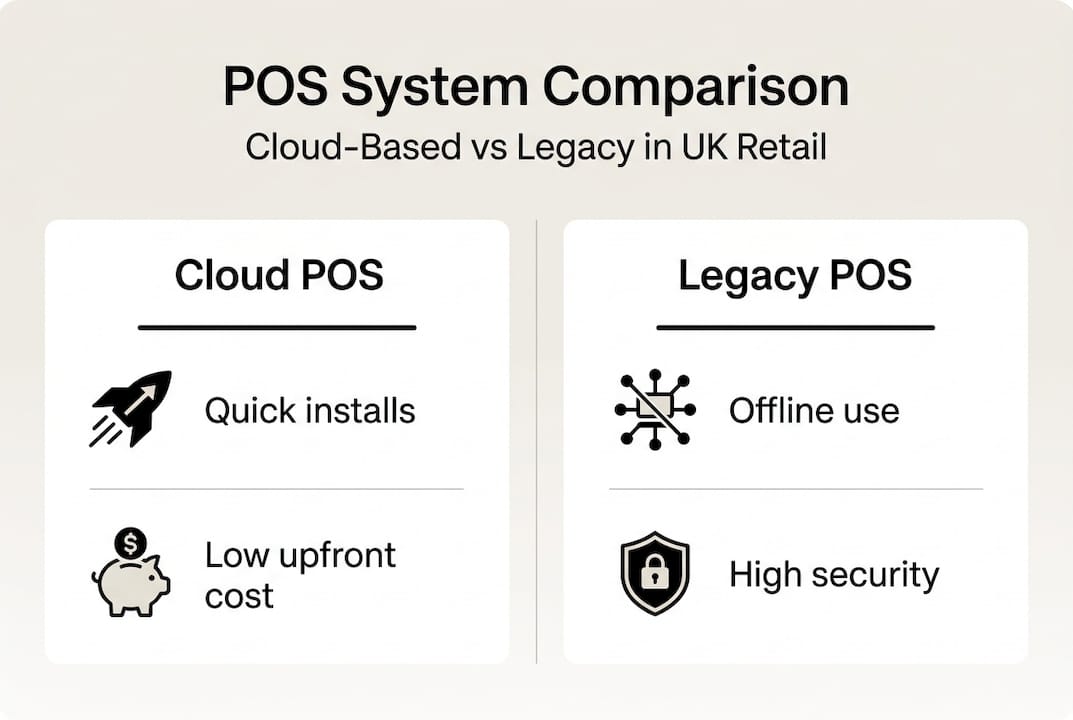
| Feature | Cloud-based POS | Legacy POS |
|---|---|---|
| Upfront cost | Lower initial investment with subscription pricing | Higher capital expenditure for hardware and licences |
| Reliability | Internet-dependent but improving with offline modes | Operates independently of network connectivity |
| Updates | Automatic software updates and feature additions | Manual updates requiring technician visits |
| Scalability | Easy expansion across multiple locations | Complex and expensive to scale operations |
| Data access | Real-time access from any location | Limited to on-site terminals |
| Maintenance | Vendor-managed with minimal IT requirements | Ongoing local IT support and hardware maintenance |
Scalability considerations favour cloud platforms for businesses planning expansion or operating multiple sites. Cloud POS market growth projections of 22.7% annually reflect increasing adoption driven by flexibility advantages and lower total ownership costs. Adding new terminals or locations requires minimal infrastructure investment, whilst centralised management enables consistent policies and real-time visibility across the entire operation. You can monitor sales performance, adjust pricing, and manage inventory from any device with internet access.
Legacy systems maintain relevance for specific scenarios despite higher costs and maintenance requirements. Businesses in areas with unreliable internet connectivity benefit from the guaranteed uptime that local processing provides. Some operators prefer the perceived security of keeping sensitive data on-premises rather than trusting cloud storage. However, the obsolescence risk grows as vendors discontinue support for older hardware and software versions, leaving businesses vulnerable to security exploits and compatibility issues.
Outage risks represent the primary concern with cloud-based systems, though modern platforms mitigate this through sophisticated offline modes. When internet connections fail, quality systems continue processing transactions locally, storing data that synchronises automatically once connectivity restores. The challenge lies in ensuring your chosen platform implements offline functionality properly, as some vendors offer limited capabilities that restrict transaction types or payment methods during outages.
Pro Tip: Consider hybrid deployments combining cloud-based management with local processing servers, providing cloud flexibility whilst maintaining operational continuity during extended outages affecting your area.
Future-proofing investments requires evaluating vendor roadmaps and industry trends shaping POS technology evolution. Modern systems from established UK providers incorporate emerging technologies including artificial intelligence for demand forecasting, contactless and biometric payments, and advanced analytics identifying sales patterns. Legacy systems rarely receive these innovations, gradually falling behind competitor capabilities and customer expectations.
Maintenance realities differ dramatically between architectures. Cloud platforms shift responsibility to vendors who manage servers, apply security patches, and resolve technical issues remotely. Your team focuses on business operations rather than IT troubleshooting. Legacy systems require dedicated technical staff or expensive service contracts covering hardware repairs, software updates, and security maintenance. The hidden costs accumulate over time, often exceeding the subscription fees for equivalent cloud solutions.
Practical steps to selecting and implementing POS software for your UK retail or hospitality business
Selecting appropriate POS software requires systematic evaluation aligning system capabilities with specific business requirements and operational realities. Rushing decisions or prioritising cost over functionality creates expensive problems requiring costly replacements or workarounds.
- Assess your operational requirements by documenting current processes, pain points, and growth objectives across sales, inventory, customer management, and reporting needs.
- Research UK-specific compliance requirements including GDPR data protection, PCI payment security, and VAT reporting to ensure shortlisted systems meet mandatory standards.
- Request demonstrations from multiple vendors, testing actual workflows including edge cases like refunds, voids, split payments, and offline scenarios that reveal system limitations.
- Verify integration capabilities with existing tools including accounting software, ecommerce platforms, supplier systems, and marketing automation ensuring seamless data flow.
- Evaluate vendor support quality by checking response times, UK-based assistance availability, training resources, and customer reviews from similar businesses.
- Conduct pilot testing with a subset of terminals and trained staff, monitoring performance metrics and gathering feedback before full deployment.
- Develop comprehensive training programmes covering standard transactions, exception handling, troubleshooting, and security protocols for all staff levels.
- Implement phased rollouts starting with less critical locations or departments, allowing refinement before expanding to high-volume operations.
- Establish monitoring systems tracking key performance indicators and scheduling regular reviews identifying optimisation opportunities.
Testing edge cases before purchase prevents discovering critical limitations after deployment when switching costs become prohibitive. Simulate scenarios including payment processor failures, inventory discrepancies, customer disputes, and network outages to verify the system handles exceptions gracefully. Staff should understand how to process transactions manually during system failures and reconcile data once systems restore.
Post-implementation monitoring ensures the system delivers expected benefits and identifies issues requiring attention. Track metrics providing objective performance assessment rather than relying on subjective impressions.
| Metric | Target | Measurement frequency |
|---|---|---|
| Transaction processing time | Under 30 seconds per sale | Weekly average |
| Inventory accuracy rate | Above 98% match with physical counts | Monthly audit |
| System downtime | Less than 0.5% of operating hours | Daily monitoring |
| Payment failure rate | Below 1% of attempted transactions | Weekly tracking |
| Staff error rate | Under 2% of transactions requiring correction | Bi-weekly review |
Local UK support becomes crucial when technical issues arise during peak trading periods. Vendors offering 24/7 assistance from UK-based teams resolve problems faster than those relying on overseas call centres operating different time zones. Detailed workflow documentation helps staff navigate complex scenarios independently, reducing support dependency whilst maintaining service quality.
Continuous training addresses staff turnover and system updates introducing new features or modified workflows. Schedule regular refresher sessions covering common mistakes, new capabilities, and best practices emerging from operational experience. Create reference materials including quick guides for exception handling, troubleshooting flowcharts, and contact information for technical support.
Enabling offline payment processing before launch prevents revenue loss during inevitable connectivity issues affecting UK businesses. Configure systems to cache customer data, process transactions locally, and queue synchronisation tasks executing automatically when connections restore. Test offline functionality thoroughly under realistic conditions including extended outages lasting several hours.
Explore POS solutions tailored for UK retail and hospitality
YCR Distribution brings over three decades of expertise as the UK’s leading independent POS value-added reseller, combining hardware excellence with sophisticated software solutions designed specifically for British retail and hospitality operations. Our platforms incorporate the compliance features, offline capabilities, and integration flexibility discussed throughout this guide.

Explore our comprehensive POS software solutions including SAMTOUCH and EZEEPOS, purpose-built for hospitality and retail environments with robust UK compliance and reliable offline modes. Our systems integrate seamlessly with the hardware infrastructure supporting your operations, from terminals and tablets to barcode scanners and receipt printers. Review our POS hardware terminology guide to understand the ecosystem components, then consult our detailed hardware checklist ensuring complete operational readiness for your 2026 deployment.
Frequently asked questions
What is the difference between cloud-based and legacy POS systems?
Cloud-based POS systems operate through internet-connected servers, offering real-time data access, automatic updates, and lower upfront costs whilst requiring reliable connectivity. Legacy systems run locally on dedicated hardware, providing offline reliability and data control but demanding higher initial investment and ongoing maintenance expenses. Modern cloud platforms increasingly incorporate offline modes that process transactions locally during outages, combining the benefits of both approaches for UK businesses.
How can I ensure my POS system complies with UK regulations?
Select POS software explicitly designed for UK markets with built-in GDPR data protection features including consent management, encryption, and data access controls. Verify PCI compliance certification for payment processing, ensuring the system meets current security standards. Consult with UK-based support teams who understand local regulatory requirements and can guide configuration ensuring ongoing compliance as regulations evolve.
What are key features to look for in POS software for hospitality businesses?
Prioritise offline transaction processing maintaining operations during internet outages common in hospitality venues. Seek flexible payment handling supporting contactless, mobile wallets, and split bills accommodating diverse customer preferences. Ensure robust inventory integration tracking ingredients and supplies with automated reordering triggers. Look for customer management tools enabling loyalty programmes and personalised marketing driving repeat visits.
How do I avoid common costly mistakes when implementing POS software?
Test edge cases including payment failures, refunds, voids, and network outages before purchase, verifying the system handles exceptions without data loss or confusion. Train all staff thoroughly on standard transactions and exception handling, creating reference materials for complex scenarios. Monitor key metrics including transaction speed, inventory accuracy, and system downtime, addressing issues immediately. Enable and test offline payment processing before launch, ensuring revenue continuity during connectivity problems.