
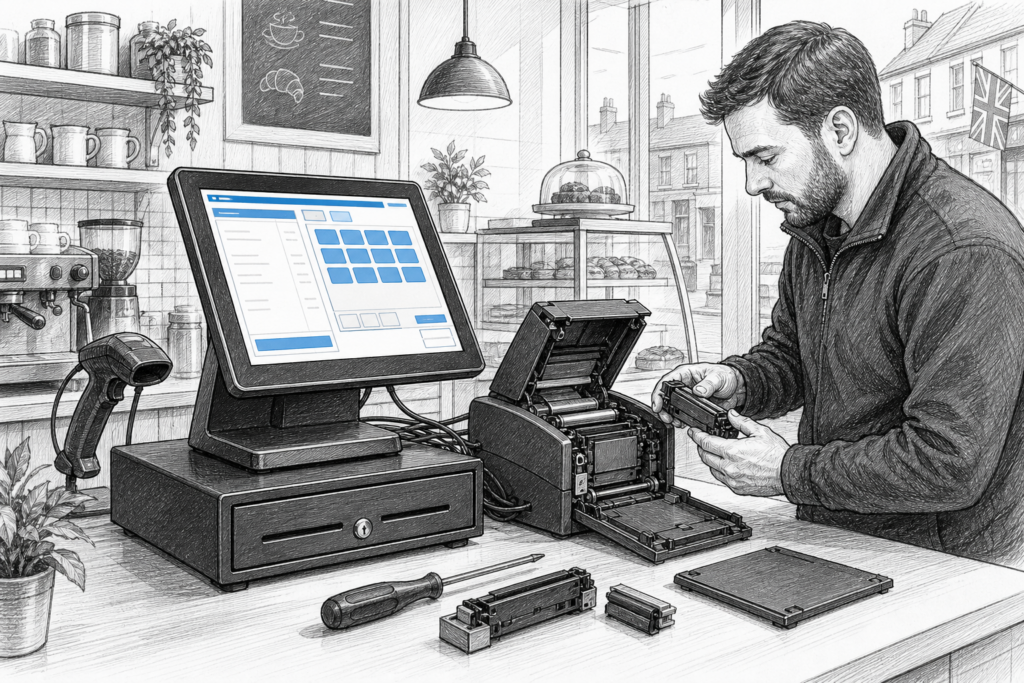
When a point-of-sale system fails during a busy trading period, the cost is rarely limited to the hardware itself. Lost sales, longer queues, frustrated staff and avoidable support calls can all follow. That is why serviceability has become an increasingly important factor in POS systems UK buyers should consider, especially where equipment is used all day in retail or hospitality environments.
For many businesses, the most suitable EPOS hardware is not simply the newest or most powerful option. It is the equipment that can be installed sensibly, maintained efficiently and returned to service quickly when something wears out. In practical terms, that means thinking about repairable components, accessible cabling, standardised printers and terminals that can be supported by a reseller or installer without replacing an entire system.
What serviceable POS hardware really means
Serviceable hardware is equipment designed with maintenance in mind. Instead of treating the terminal, printer or peripheral as a sealed unit, the system should allow key parts to be accessed, checked and replaced when necessary. In a busy shop, café or restaurant, this approach can reduce downtime and help owners extend the useful life of installed EPOS equipment.
That is especially relevant for businesses that run multiple tills or have more than one site. Standardising the hardware mix makes it easier to hold spares, train staff and support replacements. It also helps EPOS installers and dealers diagnose faults more quickly, because the same components and layouts are used across the estate.
Why repairability matters in day-to-day trading
Point-of-sale equipment is used constantly. Receipt printers are opened and closed repeatedly, touchscreens are tapped all day, and customer-facing hardware is expected to withstand spills, knocks and general wear. Over time, the parts most exposed to movement or heat tend to be the first to need attention.
Choosing hardware with a clear maintenance path can help businesses in several ways:
- reduce the need for full unit replacements when one component fails
- shorten engineer visit times
- make it easier to keep a spare printer or terminal ready
- support planned maintenance rather than emergency replacement
- help resellers and installers provide better long-term support
For retail EPOS, this can mean keeping a checkout open while a printer mechanism or another component is changed. In hospitality, where fast service is critical, it can help front-of-house and kitchen stations stay operational during peak periods.
The role of replacement components
Replacement components are a practical option when the underlying hardware is still suitable for the site. In receipt printers, for example, parts such as internal mechanisms or cutter assemblies can be relevant where supported by the product design and the supplier’s technical information. Rather than replacing a complete unit unnecessarily, a dealer or service company may be able to restore functionality through targeted maintenance.
This approach has particular value for businesses that have invested in a consistent hardware platform. If the terminal footprint, printer format and peripherals are already appropriate for the counter or kitchen, replacing only the worn part can preserve the installation layout and reduce disruption.
That said, compatibility must always be checked carefully. EPOS dealers and installers should verify the exact model and part reference before ordering any replacement item. The advantage of working with an experienced POS distributor UK businesses can rely on is that technical guidance is available before a replacement decision is made.
Planning hardware with support in mind
Supportable hardware is not only about physical repair. It is also about how easy the system is to specify, install and manage over time. A well-planned POS installation usually takes into account:
- how the terminal will be mounted or positioned
- how cables and power supplies are accessed
- which peripherals are interchangeable across sites
- how quickly a fault can be isolated
- whether replacement parts or compatible units are available
This matters for both retail and hospitality. A convenience store may need a dependable counter terminal with minimal maintenance interruptions. A restaurant may need dependable front-of-house hardware that can cope with repeated service cycles and frequent peripheral use. In both cases, the aim is to make maintenance predictable rather than disruptive.
Why UK resellers and installers should lead the conversation
UK EPOS resellers, dealers and installers are often best placed to design a serviceable system from the outset. They can recommend hardware families that are known for maintainability, plan spare units for critical locations and advise on the best combination of terminal, printer and customer-facing display for the environment.
That local expertise also helps when an existing installation needs refreshing. Sometimes the right answer is a complete hardware refresh. In other cases, it may be more sensible to replace only the weakest elements and keep the rest of the platform in place. Serviceable design gives businesses more options, which is particularly useful for multi-site operators and businesses trying to avoid unnecessary disruption.
A more sustainable way to manage EPOS equipment
Serviceability also supports a more measured approach to hardware lifecycle management. Instead of treating POS equipment as disposable, businesses can plan around maintenance intervals, component replacement and phased upgrades. That can make budgeting easier and reduce avoidable waste, while still keeping the checkout or service point performing properly.
For YCR Distribution, this approach reflects the practical realities of the point of sale industry. Whether the requirement is for a complete POS terminal, a printer, a spare part or guidance on a supported installation, the key is to match the hardware to the way the business actually works.
For more information about point-of-sale hardware and EPOS solutions, contact YCR Distribution on 01924 438238 or visit www.ycr.co.uk.
Choosing serviceable hardware is ultimately about protecting uptime, reducing avoidable disruption and making support easier over the long term. For UK retailers and hospitality operators, that can be just as important as screen size, connectivity or aesthetics.