
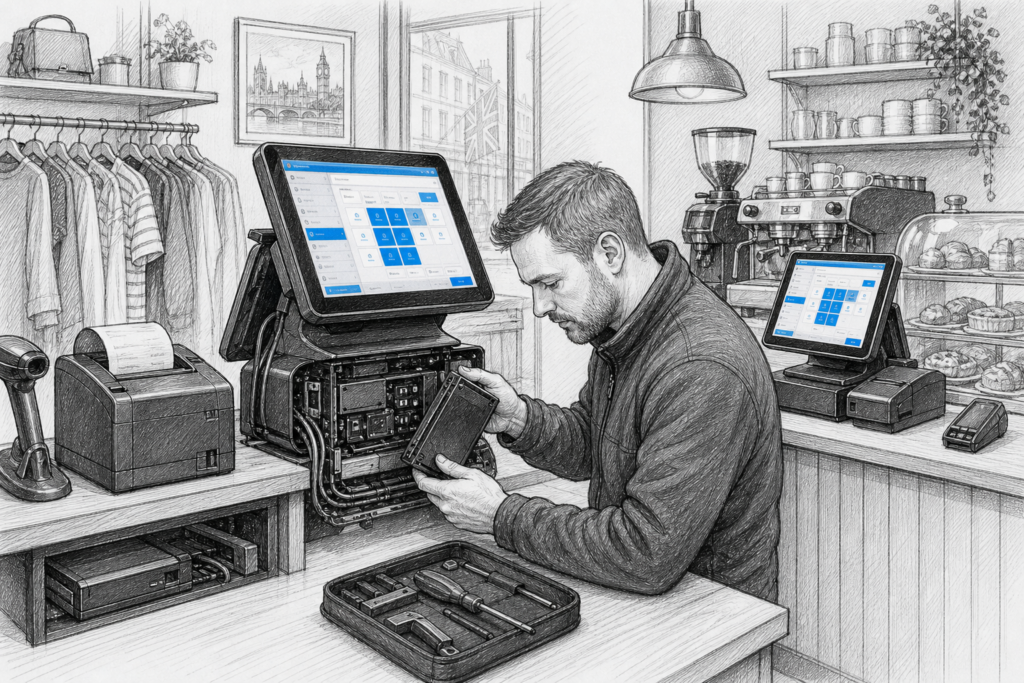
When a point-of-sale system goes down, the problem is rarely just technical. It can slow queues, interrupt order taking, create pressure on staff and affect customer service at the busiest moment of the day. That is why serviceable POS hardware matters so much for UK retailers, cafés, restaurants, bars and multi-site operators. The right equipment is not only about performance at the counter; it is also about how easily it can be maintained, repaired and kept in service.
What serviceable POS hardware really means
In practical terms, serviceable hardware is equipment that can be supported over time without replacing the entire installation every time a small part fails. That might mean a device with accessible components, a design that supports easier diagnostics, or a product range that allows replacement parts and peripherals to be sourced without major disruption.
For EPOS resellers and installers, this is important because a system that can be maintained properly is easier to support throughout its working life. For the end user, it can mean less downtime, fewer emergency replacements and a more predictable support experience.
Why repairability matters in busy trading environments
Retail and hospitality environments place continuous demands on point-of-sale hardware. Touchscreen terminals, receipt printers and customer-facing devices are used all day, often by multiple staff members. Over time, wear can affect key parts such as printers, touchscreen panels, power supplies, cables and internal mechanisms.
Where hardware is built with serviceability in mind, a distributor or support partner can often help identify whether a fault is limited to a specific part rather than the whole unit. That can be especially valuable in:
- independent shops with a small number of terminals
- restaurants and takeaways that rely on one or two main ordering points
- multi-site businesses standardising on the same hardware family
- resellers managing the installed base of several customers
In other words, serviceable equipment supports both immediate continuity and long-term planning.
Extending the working life of EPOS equipment
Many businesses replace POS hardware earlier than they need to, simply because they are unsure whether a fault can be fixed. In some cases, the issue is not the entire terminal at all, but a component, peripheral or connection problem. Replacement parts, maintenance accessories and compatible peripherals can all play a role in extending the life of an installation.
This approach is particularly relevant for businesses that want to avoid unnecessary disruption. If a system has been reliable overall, there is often value in keeping it in service for longer as part of a planned replacement cycle, rather than replacing everything at once.
Examples of common service priorities
- receipt printer mechanisms and cutter components
- cables and power connections
- screen protection and front-of-house wear items
- mounting or peripheral components
- spare units for critical checkout or order points
This does not mean every part should be repaired indefinitely. It does mean that a well-supported installation can be managed more intelligently.
What resellers and installers should look for
EPOS professionals often judge hardware on how well it fits the specific site, but serviceability should be part of that assessment too. A terminal that looks suitable on paper may be less attractive if it is difficult to support once installed. The same applies to receipt printers and other peripherals that are subject to heavy daily use.
Useful questions to consider include:
- Can the hardware be maintained without replacing the entire workstation?
- Are replacement parts or compatible components available through an established supply chain?
- Is the product family intended for commercial use rather than general office use?
- Can support be delivered in a way that suits the business’s opening hours and trading pattern?
These questions help reduce the risk of installing equipment that becomes difficult to support later.
The commercial value of supportable hardware
For business owners, serviceability is not just a technical detail. It affects uptime, staff confidence and the cost of keeping the front end of the business running. A supported POS installation can be easier to standardise across multiple sites, easier to train staff on, and easier to troubleshoot when something does go wrong.
It also supports better planning. Instead of treating every failure as an urgent replacement project, businesses can build a maintenance and refresh strategy around actual usage, known weak points and the age of the installation. That is particularly useful in hospitality EPOS, where the pace of service leaves little room for avoidable disruption.
Why UK-based POS support makes a difference
Access to UK distribution and support can make serviceable hardware even more valuable. When resellers and installers can rely on product knowledge, replacement components and practical advice from a UK point-of-sale distributor, they are better placed to keep customer sites operating smoothly. That matters whether the requirement is a single replacement part, a like-for-like hardware swap or planning a wider refresh.
YCR Distribution works with EPOS resellers, dealers, installers and end users across the UK, helping them source POS hardware, peripherals and related technology with supportability in mind. For businesses that want to reduce downtime and keep systems maintainable, that local knowledge can be as important as the hardware itself.
For more information about point-of-sale hardware and EPOS solutions, contact YCR Distribution on 01924 438238 or visit www.ycr.co.uk.
Choosing serviceable POS hardware is ultimately about protecting day-to-day trading. In retail, hospitality and other customer-facing environments, the best installation is not just the one that performs well on day one, but the one that can be supported intelligently for years afterwards.