
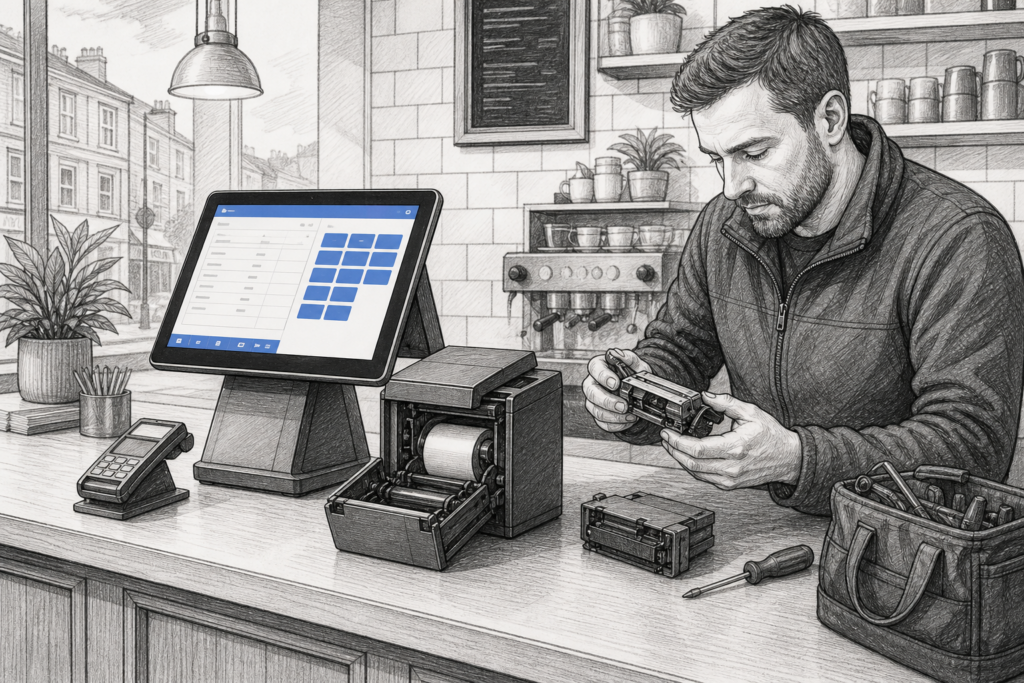
When a point-of-sale terminal or receipt printer starts to fail, the real issue is often not the fault itself but what happens next. If the equipment is difficult to repair, a small problem can quickly become a full replacement project, with disruption at the checkout or front counter. That is why serviceable POS hardware matters so much for UK retailers, cafés, restaurants and the EPOS dealers who support them.
Serviceability is about more than simply being able to swap a machine out. It is about choosing hardware with sensible access to replacement parts, a clear support path and a design that helps installers keep systems running for longer. For businesses that rely on stable trading hours, that can make a noticeable difference.
Why serviceability should be part of the buying decision
It is easy to focus on screen size, processor type or connectivity when choosing POS hardware. Those details matter, but they are only one part of the picture. A terminal or printer also needs to be practical to maintain. Commercial environments place constant demands on equipment: repeated touches, spills, dust, paper jams, cable movement and long operating hours. Over time, the most important question becomes how the hardware can be supported.
For a reseller or installer, serviceable equipment can reduce time spent diagnosing issues and improve the likelihood of a straightforward repair. For a retailer or hospitality operator, it can mean fewer interruptions at the till, a lower chance of full system replacement and better continuity across the estate.
What serviceable POS hardware looks like in practice
In point of sale UK environments, serviceable hardware is usually designed with practical maintenance in mind. That may include accessible printer mechanisms, replacement cutters, removable components, modular sub-assemblies or parts that can be swapped without disturbing the whole installation. In some cases, it can also mean a terminal family that shares components across different configurations, making support simpler for dealers and service engineers.
A serviceable design does not need to be complicated. In fact, the best examples are often the ones that make routine maintenance feel unremarkable. If a thermal print head, cutter or other internal part can be replaced sensibly, there is a better chance that the hardware remains useful for longer instead of being retired early.
Common areas where serviceability matters
- Receipt printers that need routine maintenance or component replacement
- Touchscreen terminals used throughout long trading days
- Checkout hardware in multi-site retail environments
- Front-of-house EPOS equipment in cafés, pubs and restaurants
- Spare units held by dealers for rapid turnaround support
Why this matters for resellers and installers
EPOS resellers and installers are often judged not just on the original installation but on how well they help a customer after the system goes live. If a device can be supported efficiently, it becomes easier to provide a dependable service without unnecessary delays. That is particularly valuable when supporting independent retailers, hospitality venues and multi-site operators who may not have in-house technical teams.
Serviceable hardware can also improve consistency across deployments. If a reseller knows that a product family is easier to maintain, it becomes simpler to standardise recommended configurations. That can reduce training time, simplify stock holding for spares and make future support less reactive.
For businesses with multiple locations, there is another benefit: similar hardware across all sites makes it easier to plan replacements and keep the user experience familiar for staff. That matters in hospitality, where a team may need to move between tills, counters or terminals during a busy shift.
Extending the working life of POS equipment
Not every fault means a full replacement is required. In many cases, the most economical and practical response is to repair the affected part and keep the rest of the device in service. This approach can be particularly useful for printers and other peripherals that experience heavy daily use.
Extending the working life of a device also supports more sustainable equipment planning. Rather than replacing an entire unit because of a single worn component, businesses can focus on keeping well-specified hardware in use for as long as it remains suitable. That makes good commercial sense for retailers and hospitality operators alike.
Some of the strongest use cases for serviceable equipment include:
- Sites that cannot afford prolonged checkout downtime
- Businesses using EPOS hardware in secure or difficult-to-access counter positions
- Installations where identical replacements are needed quickly
- Customers who want to maximise the value of existing hardware investments
The role of the printer in a serviceable EPOS setup
Receipt printers are one of the clearest examples of why serviceability matters. They are working parts of the EPOS system, and they often handle more day-to-day wear than many other devices. Paper handling, cutter use and thermal print components all affect ongoing performance. When a printer is built with maintenance in mind, the installer has a better chance of restoring service efficiently.
This is also why it pays to think about the full installation rather than just the terminal itself. A well-chosen POS setup should make it easy to replace a worn peripheral, keep spare parts available where appropriate and reduce the chance of a complete counter outage caused by one failing device.
Choosing hardware with support in mind
For UK businesses, the best POS hardware is rarely the most complicated. It is the hardware that fits the way the site operates, can be supported by the reseller and can be maintained without unnecessary disruption. That is true whether the system is being installed in a small café, a busy convenience store or a multi-site hospitality group.
YCR Distribution works with EPOS resellers, installers and business customers across the UK to supply point-of-sale hardware and related technology with practical support in mind. If you are planning a new installation or reviewing existing equipment, it is worth considering not only what a device can do today, but how it will be supported tomorrow.
For more information about point-of-sale hardware and EPOS solutions, contact YCR Distribution on 01924 438238 or visit www.ycr.co.uk.
To explore approved product families and replacement parts, browse the YCR store at store.ycr.co.uk.