
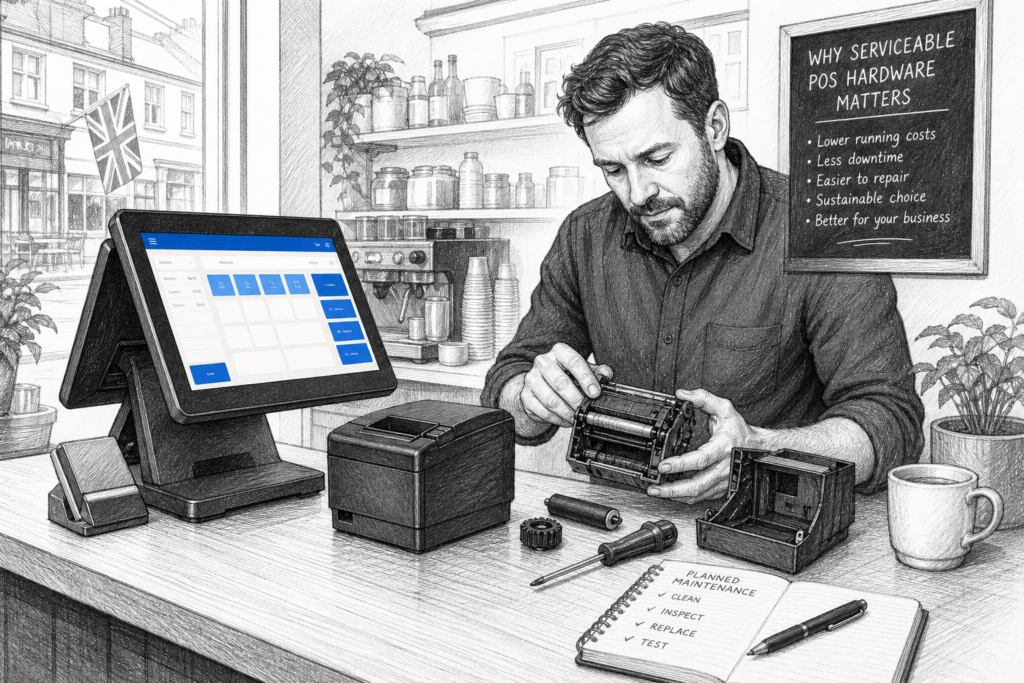
When a point of sale system stops working, the impact is immediate. Staff are slowed down, queues build, orders are delayed and a simple hardware fault can affect the whole customer experience. That is why serviceable POS hardware matters so much for UK retail and hospitality businesses. It is not just about buying a terminal, receipt printer or peripheral that performs well on day one; it is about choosing equipment that can be supported, repaired and kept in service for longer.
For EPOS installers, dealers and business owners, serviceability is one of the most practical purchasing decisions you can make. It affects how long the hardware will remain useful, how easily faults can be diagnosed and whether a replacement part can be fitted without disrupting the whole counter setup.
What serviceable POS hardware means in practice
Serviceable hardware is designed with maintenance in mind. That can include modular components, accessible internal parts, clear replacement pathways and a product structure that makes it easier to isolate a fault. In everyday terms, that means a damaged part does not always force a full device replacement.
In a retail shop, this could mean a printer mechanism or cutter can be replaced instead of removing the entire printer. In hospitality, it could mean a terminal can be maintained rather than swapping out an entire front-of-house unit because one component has failed. For businesses with multiple checkouts or tills, that can help reduce waste, simplify support and keep a consistent hardware standard across the estate.
Why repairability matters at the checkout
Point of sale hardware works hard. It faces constant power cycles, print jobs, customers leaning over counters, spills, heat, dust and day-to-day wear. Even good commercial equipment will eventually need maintenance. The question is whether the hardware has been selected with that reality in mind.
A serviceable system can help businesses in several ways:
- reduce downtime when faults occur
- extend the working life of installed equipment
- avoid unnecessary full-unit replacement
- make stock management easier for resellers and installers
- support planned maintenance rather than emergency replacement
For a café, restaurant, convenience store or garden centre, being able to restore a checkout quickly can be more valuable than replacing an entire terminal because of a single failed part.
Where serviceable hardware makes the biggest difference
Receipt printers
Receipt printers are among the most heavily used devices in many EPOS installations. They can be run through thousands of transactions over time, particularly in hospitality and busy retail. Being able to replace components such as the internal mechanism or cutter, where supported by the product design, can make a major difference to ongoing support. That approach can help businesses keep a known printer model in service rather than changing the entire setup.
This is one reason many installers pay close attention to printer families, spare parts and long-term maintenance options when choosing hardware for a new site or a multi-site rollout. For more on the range of printer options available from YCR Distribution, see the desktop receipt printers collection.
Touchscreen POS terminals
Touchscreen terminals are the front line of the POS system. If a terminal is built in a way that supports maintenance, resellers and support teams can often resolve issues more efficiently. That matters when a business is replacing older hardware or standardising equipment across branches.
In practical terms, serviceability can support longer lifecycle planning. Instead of viewing every fault as a reason to replace a complete terminal, businesses can take a more measured approach based on the condition of the hardware and the parts involved.
Printer components and spares
For EPOS installers and service companies, replacement parts are often part of best-practice support. They can be especially useful where sites have a consistent hardware standard and need to maintain productivity without waiting for a complete system changeover. YCR Distribution’s printer components category is a useful place to review the kinds of parts that support this approach.
Choosing hardware with support in mind
One of the most overlooked questions in POS planning is not whether the system works, but how it will be supported after installation. A business may be happy with a touchscreen terminal or receipt printer when it is first deployed, but the real value appears later, when the hardware has been in daily use for months or years.
That is why EPOS dealers and installers often look beyond initial specifications. They consider whether hardware has good parts availability, whether the design suits the environment and whether the supplier can help with guidance if a component needs replacing. This is particularly important for businesses that cannot afford lengthy disruption, such as busy restaurants, takeaway counters or convenience stores with limited spare capacity.
Planning for longevity rather than replacement
There is a strong commercial case for extending the useful life of POS equipment. It can help reduce unnecessary capital spend, lower environmental waste and make support more predictable. It also gives businesses more time to plan upgrades properly instead of being forced into an emergency replacement when hardware fails unexpectedly.
That does not mean every fault should be repaired at component level. Some devices will be better replaced, especially if they are outdated or no longer fit the business requirements. But where hardware is serviceable, businesses and installers have more options. They can choose between repair, part replacement, refurbishment and full replacement based on the actual situation, not just the age of the device.
The value of UK-based POS support
For UK retailers and hospitality operators, local support can make a practical difference. Being able to speak to a distributor that understands EPOS hardware, keeps spare parts in mind and works with resellers and installers helps reduce uncertainty when a fault appears. It also supports better planning for future replacements, especially in businesses running standardised hardware across several locations.
YCR Distribution works with EPOS resellers, dealers, installers and end users across the UK, helping them source suitable POS hardware and related components for real-world commercial environments. That kind of support is especially useful when the goal is not only to buy new equipment, but to keep existing installations running effectively for as long as possible.
For more information about point-of-sale hardware and EPOS solutions, contact YCR Distribution on 01924 438238 or visit www.ycr.co.uk.