
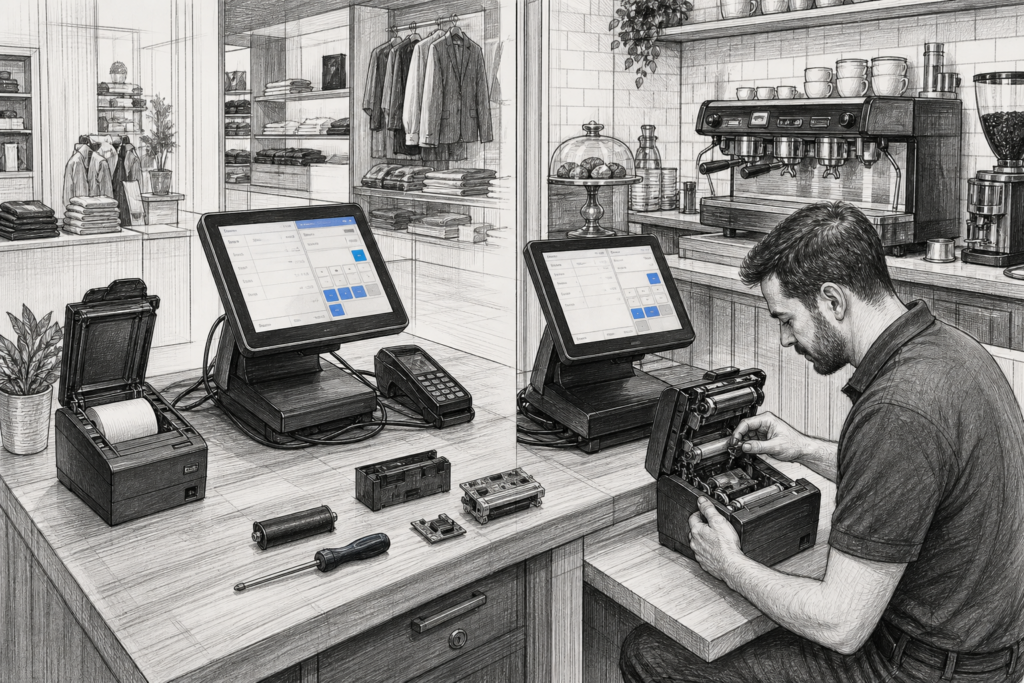
When a till or EPOS terminal stops working during busy service, the difference between a quick fix and a prolonged outage is often down to how serviceable the hardware is. For UK retailers, cafés, pubs, restaurants and installers, that means looking beyond appearance and headline specifications to think about repairability, spare parts, modular design and access to support.
Serviceable POS hardware matters because point-of-sale equipment is not an isolated office device. It sits at the heart of trading, payment handling, order processing and customer service. If a terminal, receipt printer or internal component can be repaired or replaced quickly, a business is far more likely to keep trading smoothly with less disruption for staff and customers.
Why serviceability should be part of the buying decision
Many businesses focus first on screen size, processing power or operating system. Those are all important, but they are only part of the picture. In the real world, a POS installation also needs to be maintained by someone who understands the hardware and can obtain replacement parts when needed.
A serviceable POS setup is one that can support the full life of the installation rather than forcing an unnecessary full replacement when one part fails. That can make a practical difference in several ways:
- shorter downtime when a component fails
- easier maintenance for resellers and installers
- better value from existing EPOS infrastructure
- less disruption to staff during peak trading
- more predictable planning for future upgrades
For businesses with multiple locations, serviceability also helps standardisation. If the installed hardware uses common parts or well-supported components, it becomes easier to keep a consistent estate running across different sites.
What serviceable POS hardware looks like in practice
Serviceable hardware is not just about whether a device can be opened up. It is about whether the system has been designed with maintenance in mind. That can include access to replacement screens, printer mechanisms, power supplies, cables, cutters, mounting hardware and other internal or peripheral parts.
In a typical retail EPOS or hospitality POS environment, the most useful signs of serviceability include:
Modular components
Devices that separate the main computing section from peripheral items can be easier to support. If a printer or display section can be replaced without changing the entire terminal, the whole installation becomes more practical to maintain.
Clear parts availability
Resellers and installers benefit when parts and accessories are available as identifiable items rather than being locked inside a sealed unit. This is especially helpful in sites that depend on the same terminal day after day.
Support for replacement peripherals
Some environments need to replace a receipt printer, customer display or mounting element without changing the core POS system. That flexibility helps businesses extend the working life of the original hardware.
Familiar, commercial-grade design
Purpose-built POS hardware generally makes more sense than a consumer tablet or office computer adapted for checkout use. It is usually designed with daily trading, cleaning and repeated physical interaction in mind.
The role of replacement parts and components
Replacement parts can be particularly valuable for EPOS dealers and service companies. A printer cutter blade, thermal print head, internal board or other component may be enough to restore a device that would otherwise be removed from service. In the right circumstances, replacing a component is faster and more economical than replacing the whole unit.
This approach also supports sustainability. Businesses that extend the life of installed hardware reduce unnecessary waste and avoid replacing equipment that still has plenty of useful life left in the field. For many UK operators, that is a sensible commercial choice as well as a practical one.
It is worth remembering, though, that parts should only be used where compatibility has been verified. Good support from a UK distributor or knowledgeable reseller helps avoid guesswork and keeps servicing plans realistic.
Why this matters in retail and hospitality
Retail and hospitality sites feel hardware problems differently, but both depend on the checkout point working reliably. A convenience store may need to keep queues moving at a busy counter. A café or restaurant may need to keep orders flowing between front of house and the kitchen. In both cases, a terminal failure can affect service far beyond the till point itself.
That is why serviceable hardware is valuable in so many settings:
- Retail: support for busy tills, queue-sensitive trade and multi-lane checkout areas
- Hospitality: resilience in order-taking, table service and fast-turnaround environments
- Multi-site operators: easier standardisation and better planning for replacements
- EPOS resellers and installers: simpler support, maintenance and lifecycle management
When hardware can be maintained properly, staff spend less time dealing with technical disruption and more time serving customers.
Planning for the long term, not just the installation day
A good EPOS project should consider more than the immediate setup. If a business wants the installation to last, it should think about how the hardware will be supported in year two, year three and beyond. That means asking whether spare parts are available, whether the design is practical to repair and whether the supplier understands the realities of ongoing maintenance.
This is where UK-based distribution and reseller support becomes especially important. Access to technical advice, replacement components and informed product guidance can reduce downtime and help businesses make better decisions when a failure does happen. YCR Distribution works with EPOS resellers, installers and business owners across the UK to help match the right hardware to the right environment, whether that involves a complete terminal, a printer replacement or a supporting component.
If you are planning a new installation or managing an existing one, serviceability should be part of the conversation from the start. It is one of the simplest ways to protect an EPOS investment and keep trading interruptions to a minimum.
For more information about point-of-sale hardware and EPOS solutions, contact YCR Distribution on 01924 438238 or visit www.ycr.co.uk.