
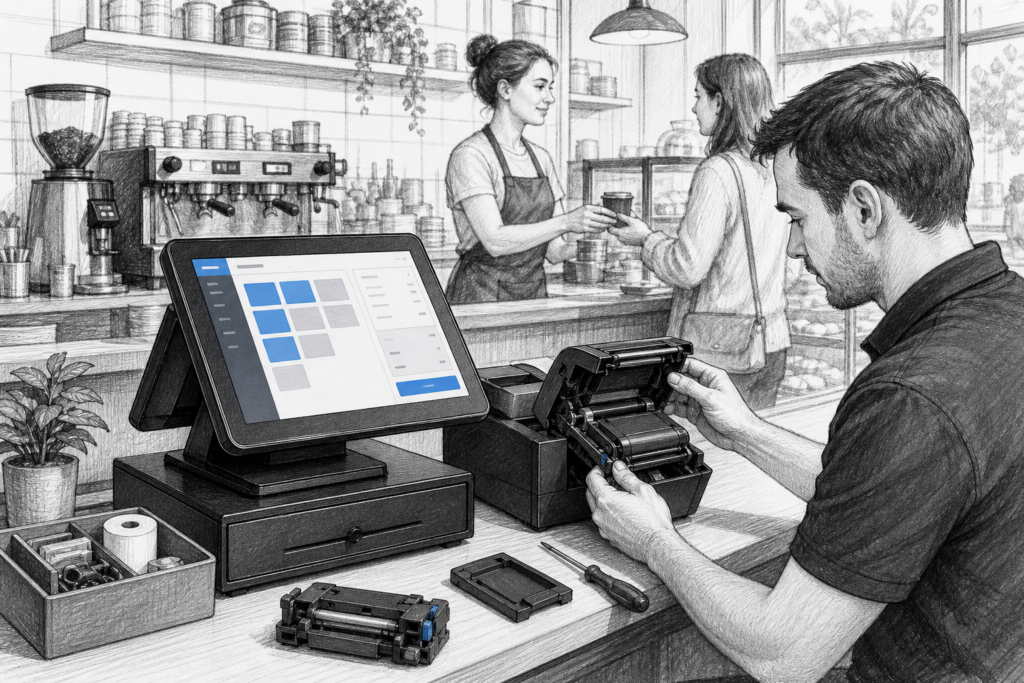
In UK retail and hospitality, point-of-sale hardware does far more than take orders and print receipts. It helps keep queues moving, supports staff during busy periods and plays a key role in how quickly a business can recover when something goes wrong. That is why serviceability matters. A terminal or printer that can be maintained, repaired or upgraded sensibly is often more valuable over time than equipment that has to be replaced at the first sign of trouble.
For EPOS resellers, installers and business owners alike, serviceable hardware can make day-to-day support easier and reduce disruption when a component fails. It is one of the most practical considerations in any POS system UK planning exercise, yet it is still overlooked in favour of headline specifications.
What serviceability really means
Serviceable POS hardware is equipment that can be maintained without unnecessary complexity. In practice, that may mean parts can be accessed more easily, accessories can be replaced without changing the whole unit, and the hardware is designed with long-term use in mind. It also means there is a clearer path for technical support when a terminal, printer or peripheral develops a fault.
This matters because point of sale systems are rarely static. A retailer may add a second till point, a café may need a different printer layout, or a hospitality group may standardise equipment across branches. Hardware that can be supported as the business changes gives more flexibility and helps protect the original installation.
Why it matters in busy businesses
Retail and hospitality environments are unforgiving. A printer fault at the counter or a terminal problem during a lunch rush can affect queues, customer satisfaction and staff confidence. In those moments, the difference between a quick fix and a full replacement is significant.
Serviceable hardware supports faster troubleshooting because installers and support teams can work with equipment that is designed to be understood, accessed and maintained. For a business, that can mean less downtime, easier planning for spares and a longer useful life from the original installation.
Typical benefits for operators
- less disruption when a component fails
- simpler support for EPOS installers and resellers
- better value from existing POS hardware UK investments
- easier standardisation across multiple sites
- more practical planning for spare equipment and replacement parts
Why repairability is increasingly important
Many businesses now expect their point-of-sale hardware to support longer replacement cycles. That is not just about controlling capital spending; it is also about avoiding avoidable disruption. If a printer mechanism, terminal stand or other part can be replaced independently, there is a better chance of keeping the rest of the system in service.
This approach is especially useful for installers supporting long-term customer accounts. Instead of replacing complete systems every time a single part ages, they can often keep an installation running with targeted maintenance. That can be particularly helpful in convenience retail, cafés, pubs and other locations where front-of-house uptime is critical.
The role of printers and spare parts
Receipt printers are a good example of why serviceability matters. They are one of the hardest-working devices in an EPOS setup, yet they are also one of the most likely to need attention over time. Print mechanisms, cutters and internal assemblies can be subject to wear, especially in busy hospitality or retail environments.
Where genuine replacement parts are available and the hardware has been designed with maintenance in mind, a business may be able to restore performance without replacing the whole printer. That is useful for dealers and service companies managing installed estates, as well as for businesses wanting to extend the life of existing equipment.
YCR Distribution supplies POS hardware, printer ranges and components for the UK EPOS trade, helping resellers and installers source products that fit the needs of real-world support and maintenance. For businesses already using an established terminal or printer family, that kind of product continuity can be just as important as the original purchase decision.
Planning for support, not just installation
When choosing EPOS hardware, it is worth thinking beyond the initial setup. Ask how the system will be supported in six months, two years or longer. Can the hardware be maintained easily? Are replacement components available where needed? Can the installer standardise parts across several sites? These questions matter as much as screen size or connectivity.
For multi-site operators, serviceable hardware can also help reduce variation. If branches use similar terminal and printer combinations, support becomes simpler and training is easier to manage. If one site suffers a fault, there is a better chance that a spare unit or component can be used to restore service quickly.
Choosing hardware with the long term in mind
Not every business needs the same level of maintenance planning, but all businesses benefit from equipment that is built to a commercial standard. A touchscreen POS terminal in a café, a receipt printer in a takeaway or a Windows POS terminal in a retail counter all need to survive real trading conditions. The more practical the hardware is to support, the more confidence a business has when it matters most.
For EPOS resellers and installers, serviceability can be a meaningful differentiator. It allows better aftercare, smarter spares planning and more dependable support conversations with customers. For business owners, it helps turn a POS system from a short-term purchase into a longer-term operational asset.
For more information about point-of-sale hardware and EPOS solutions, contact YCR Distribution on 01924 438238 or visit www.ycr.co.uk.