
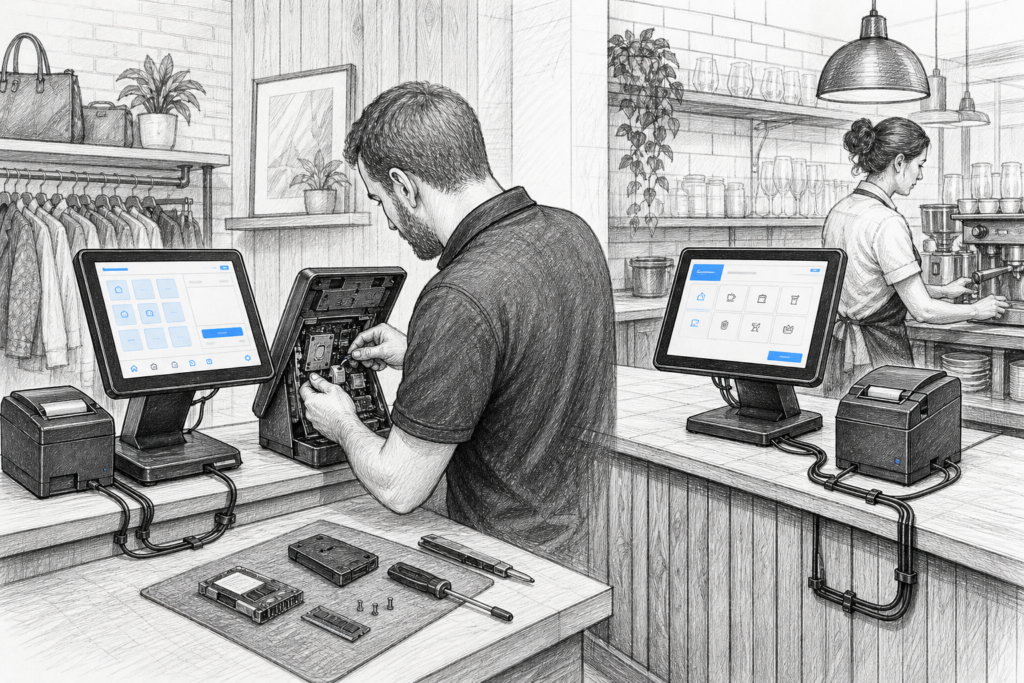
When a till stops working during a busy lunch rush or a retail queue starts building at the checkout, the quality of the hardware suddenly matters far more than its appearance. For many UK retailers, cafés, restaurants and resale channels, the real question is not simply whether a POS terminal looks modern, but whether it can be supported, repaired and kept in service without unnecessary disruption.
That is why serviceability has become an important consideration in point of sale UK projects. Retail EPOS and hospitality EPOS systems are often expected to stay in place for years, sometimes across multiple sites, so businesses need hardware that can be maintained sensibly by dealers, installers and internal support teams. YCR Distribution works with the UK EPOS trade to supply POS hardware that supports those priorities, helping businesses plan for the long term rather than just the initial installation.
What serviceable POS hardware really means
Serviceable hardware is equipment designed with maintenance and replacement in mind. In practical terms, that can mean systems with easier-access components, replacement parts, modular accessories or product families that can be supported consistently over time. It also means choosing hardware that is suitable for commercial use rather than relying on general-purpose office or consumer equipment.
For a retailer, serviceability can help keep checkout operations moving if a stand, power supply, printer mechanism or other component needs attention. For a hospitality operator, it can reduce the amount of time a counter or servery is out of action while a problem is diagnosed. For resellers and installers, it makes post-installation support more manageable because they can work with hardware that is designed for ongoing commercial use, not one-time deployment.
Why repairability matters in EPOS projects
Many businesses are now looking more closely at repairability because downtime at the point of sale is expensive in ways that are not always obvious. A failed terminal can interrupt payments, slow order taking, affect stock updates and frustrate customers. In a café or takeaway, even a short interruption can create a backlog. In a shop, it can mean longer queues and reduced basket conversion.
Repairable hardware helps organisations avoid replacing an entire system when only one part needs attention. That is particularly relevant where terminals, printers and peripherals are installed in multiple locations. A consistent product family can make it easier to hold spares, train staff and standardise support procedures. It can also simplify planning for businesses that expect to expand later, because a known hardware platform is easier to replicate across new sites.
Commercial-grade hardware versus generic alternatives
It can be tempting to compare POS terminals with a standard desktop PC or a consumer tablet, especially when budgets are tight. But EPOS hardware UK buyers usually need something more specific: a device that is intended for daily customer-facing use, can cope with busy environments and can be supported by a dealer or distributor.
Commercial POS hardware is normally chosen for reasons such as:
- better suitability for continuous day-to-day operation
- more straightforward integration with printers, scanners and customer displays
- easier standardisation across sites
- better support for maintenance and replacement planning
- a clearer route to long-term technical assistance
This does not mean every system has to be complex. In fact, simpler hardware is often easier to support if the right product family is chosen from the outset. The key is to balance performance, reliability and maintainability rather than focusing on just one aspect.
How resellers and installers can plan for support
For EPOS resellers and installers, serviceability should be part of the pre-sales conversation. It is worth asking how an installation will be supported if a screen, stand, printer or internal assembly needs replacing later. If the answer is vague, the customer may face avoidable disruption down the line.
Good planning usually includes:
- choosing hardware from a known commercial product range
- standardising models where possible
- keeping key spare parts or replacement units available
- thinking about cable routing, mounting and access points
- making sure the customer understands the support path after installation
This approach is especially useful for multi-site operators, where consistency is just as important as individual device performance. A well-supported hardware platform can help reduce training time and simplify future replacements.
Hardware choices that support longer working life
Serviceability is not only about repairs. It is also about choosing the right type of hardware for the environment in the first place. In busy retail and hospitality settings, customers and staff need equipment that fits the way the business operates. That may include touchscreen POS terminals, receipt printers, customer-facing displays or replacement printer components where appropriate.
YCR Distribution supplies POS and EPOS hardware to resellers, installers and businesses throughout the UK, and product selection often depends on the intended use case rather than a single specification. A counter in a convenience store may need a different setup from a table-service restaurant or a fast-moving takeaway. Choosing the right mix of hardware from the beginning can extend the useful life of an installation and make future maintenance more practical.
Why UK-based support still matters
One of the most valuable parts of a serviceable hardware strategy is access to UK-based product knowledge and distribution support. When a business needs help identifying the right replacement or confirming the most suitable hardware for an existing installation, local support can save a lot of time. It also helps resellers and installers respond more confidently when they are working on tight schedules or across several customer sites.
That is particularly relevant in EPOS, where the hardware is only one part of a wider operational system. The ability to source suitable equipment, plan replacements and keep installations consistent can make a real difference to day-to-day trading.
For more information about point-of-sale hardware and EPOS solutions, contact YCR Distribution on 01924 438238 or visit www.ycr.co.uk.