
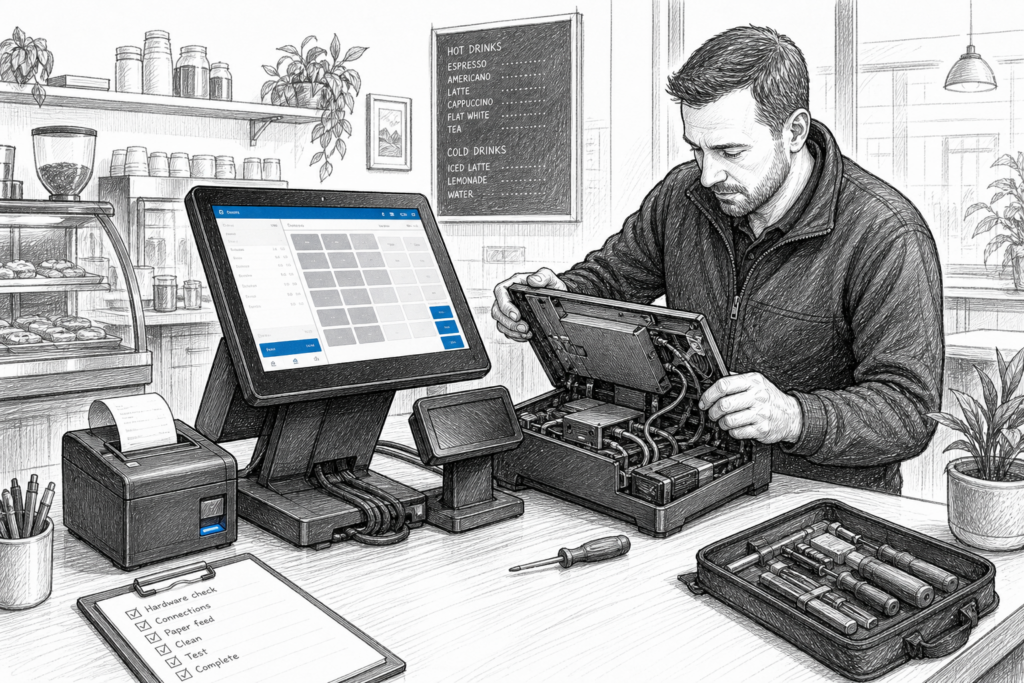
When a till or terminal fails during a busy trading period, the issue is rarely limited to the hardware itself. It can delay sales, frustrate customers and put extra pressure on staff. That is why serviceability has become an important consideration in point of sale UK installations, especially for retailers, cafés, pubs and other hospitality businesses that rely on EPOS systems every day.
In practical terms, a serviceable POS device is one that can be maintained, repaired or refreshed without replacing the whole unit unnecessarily. For EPOS resellers, installers and business owners, that can make a real difference to uptime, lifecycle planning and long-term support.
What serviceability means in a POS environment
In a commercial POS setting, serviceability is about more than whether a machine can be opened up. It is about whether the device has been designed so that common wear points can be accessed, inspected and replaced sensibly. That may include printer mechanisms, cutters, power connections, storage devices, screens, connectors or internal assemblies depending on the product type.
For a retailer or hospitality operator, this matters because the most expensive part of a failed checkout is often not the repair itself. It is the disruption to trading. A terminal that can be supported by an EPOS installer, serviced with appropriate components or swapped in a controlled way can often keep the business moving more effectively than a closed, consumer-style device.
Why UK businesses are paying more attention to repairability
Many UK businesses now expect more from POS hardware than they did a few years ago. The checkout is no longer simply a cash register; it is a working part of the customer journey, the stock process and the reporting workflow. That means the hardware has to be dependable, but it also has to be practical to look after.
- Reduced disruption when a single component fails
- Better value from installed hardware over time
- Less pressure to replace complete systems prematurely
- More consistent support for multi-site operators
- Easier planning for resellers and service partners
This is especially relevant where businesses are running windows POS terminals, Android POS devices, receipt printers or integrated EPOS hardware across several locations. Standardising on equipment that can be supported properly makes it easier to manage spare parts, service procedures and replacement cycles.
How serviceable hardware helps resellers and installers
For EPOS resellers and installers, serviceable hardware can simplify after-sales support. If a product family is well understood and built with maintenance in mind, the support team has a better chance of resolving issues quickly and accurately. That can help reduce site visits, shorten diagnosis times and improve customer confidence.
It also helps with installation planning. When the hardware range is easier to support, dealers can advise customers more confidently on configurations that suit the site layout, the expected trading environment and the likely maintenance requirements. In many cases, that is more useful than focusing only on headline specifications.
Another benefit is continuity. Businesses rarely fail because one item breaks; they struggle when a replacement is slow to source or difficult to integrate into an existing setup. Serviceable POS hardware supports a more practical replacement strategy, especially where the original system has been installed by a trusted local partner.
Where serviceability matters most
Some environments place heavier demands on hardware than others. Busy cafés, quick-service restaurants, pubs and convenience stores often need equipment that can cope with long hours, frequent user interaction and regular cleaning. Retail counters, particularly in seasonal trading periods, also place pressure on terminals and printers.
In these settings, the ability to maintain the system matters as much as the initial installation. A thermal receipt printer might need a replacement cutter after extended use. A touchscreen terminal may require a screen replacement strategy. A customer-facing display may need a practical mounting and cable arrangement so it can be serviced without disturbing the whole counter.
That is why many businesses now look for POS hardware UK suppliers who understand the full lifecycle of the installation, not just the initial sale.
Planning for the full lifecycle of an EPOS installation
When choosing EPOS hardware, it helps to think beyond the first day of use. Questions worth asking include:
- Can the device be maintained without replacing the complete system?
- Are spare parts or replacement assemblies available where relevant?
- Is the hardware suitable for the expected trading environment?
- Will the same model or product family support future site rollouts?
- Can an installer diagnose and support the system efficiently?
These questions are particularly important for multi-site operators and businesses with a growing estate. Standardised, serviceable hardware can reduce support variation between locations and make it easier to train staff or attend faults quickly.
Choosing hardware that fits practical support needs
There is still a place for specification-led decisions, but in many POS systems UK projects, practical support considerations are just as important. A terminal with the right screen size or processing power may still be the wrong choice if it is awkward to maintain. Likewise, a printer that looks suitable on paper may create support issues if replacement components are hard to work with.
For that reason, many retailers and hospitality operators prefer to work with a UK POS distributor or EPOS distributor UK businesses can rely on for product knowledge, hardware guidance and ongoing support. That is where YCR Distribution fits naturally into the picture. YCR works with resellers, installers and end users who need commercially appropriate hardware that can be supported over time. More information on relevant hardware ranges is available at www.ycr.co.uk.
For businesses replacing older tills or planning a new installation, the best approach is often to balance performance, serviceability and future support from the start. That usually leads to better outcomes than choosing equipment only because it is familiar or visually simple.
For more information about point-of-sale hardware and EPOS solutions, contact YCR Distribution on 01924 438238 or visit www.ycr.co.uk.