

The role of resellers in POS systems explained
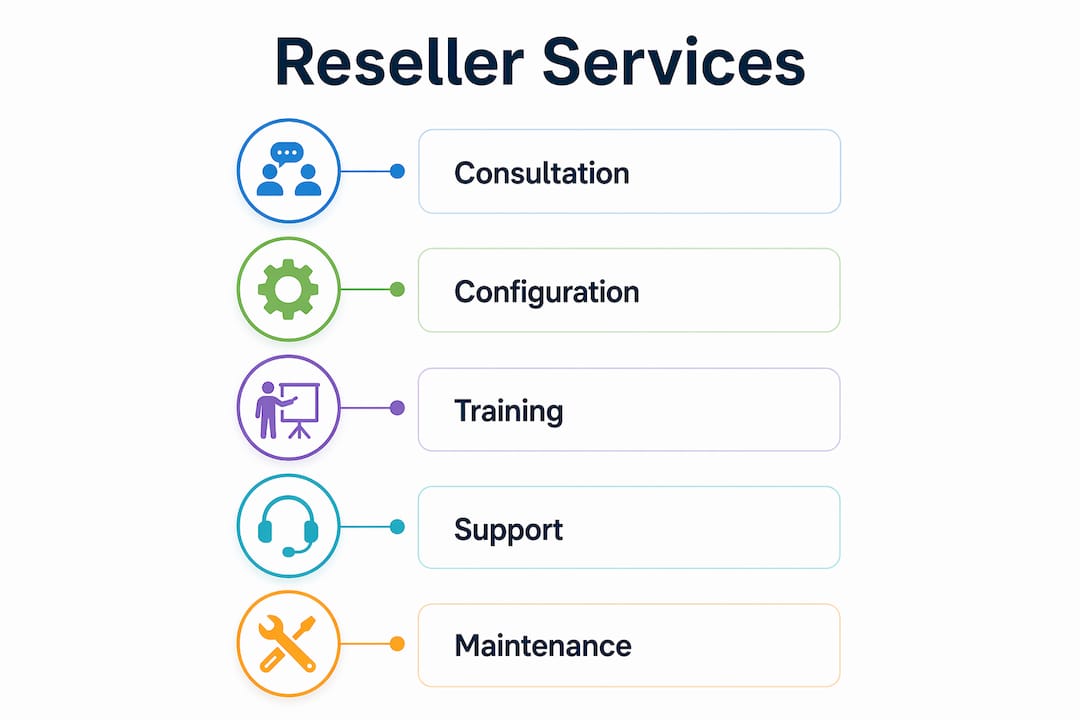

Many business owners assume that buying a point of sale system directly from a vendor is the smartest move. It feels simpler, cheaper on the surface, and more direct. But this view misses something significant. The role of resellers in POS is not fading. If anything, it is becoming more nuanced and more valuable as POS technology grows in complexity. This article unpacks what resellers actually do, why they still matter for retail and hospitality operators, and how to work with them effectively so your system genuinely serves your business.
Key takeaways
| Point | Details |
|---|---|
| Resellers go beyond sales | POS resellers provide configuration, training, and ongoing support that vendors alone rarely offer. |
| Specialisation matters | Resellers with vertical expertise match POS features to specific retail or hospitality workflows far more accurately. |
| Limitations exist | Dependency on vendors for updates and restricted data access can affect service speed and depth. |
| Selection needs strategy | Evaluating a POS upgrade means assessing workflow fit and integration impact, not just price or features. |
| The model is evolving | Resellers are shifting from transactional sellers to long-term consultative partners as the market matures. |
The role of resellers in POS ecosystems
Before assessing what resellers contribute, it helps to understand what a modern POS system actually involves. Most people picture a till and a card reader. The reality is considerably more layered.
A POS system comprises both hardware and software working together to process transactions while managing inventory, financial reporting, and accounting integrations in real time. In a busy restaurant, that means table management, kitchen display routing, and loyalty programme tracking. In a convenience store, it means barcode scanning, supplier integration, and age verification prompts. These are not plug-and-play setups.
This is precisely where resellers earn their place. As authorised intermediaries between POS developers and end-users, they handle:
- System configuration tailored to a specific business type and size
- Hardware selection and compatibility checks across terminals, printers, and scanners
- Physical installation and network setup on-site
- Initial staff training so teams can operate the system from day one
- First-line technical support when something breaks or behaves unexpectedly
POS is integral far beyond payment processing. It touches staff management, loyalty schemes, and financial reporting. Each of those functions requires thoughtful setup. A vendor’s generic onboarding process rarely accounts for a café that runs table service, takeaway orders, and a retail shelf simultaneously. A reseller who knows that sector does.
For anyone considering which system suits their operation, the best POS systems for resellers in 2026 are those that support strong reseller enablement alongside solid core functionality.
Value-added services resellers provide
Calling a reseller a “sales channel” undersells what the better ones actually do. The shift is significant and worth understanding if you are choosing between buying direct and working with a reseller.
Here is what a thorough reseller engagement typically looks like in practice:
- Pre-sales consultancy. A reseller maps your existing workflow before recommending anything. They identify gaps, exceptions, and integration requirements that a vendor’s generic demo would never surface.
- Configuration and setup. Rather than shipping a box with a manual, resellers configure the system to your menu structure, product catalogue, pricing tiers, and tax rules before installation.
- Compatibility testing. They verify that the POS hardware and software work correctly with your existing payment provider, accounting platform, and any third-party delivery integrations.
- Staff training. Resellers train your team, not just your IT contact. That means front-of-house staff, supervisors, and managers each understand the system at the level they need.
- Ongoing support. When an issue arises during a Friday night service, a good reseller has a support line, not a ticket queue with a three-day response window.
Channel vendors now treat resellers as extensions of their own teams, with pre-sales consultancy and compatibility testing built into the relationship. This means the reseller you work with should have direct lines into the vendor’s technical team when escalation is needed.
One practical benefit that often goes unacknowledged: resellers reduce operational burden by handling the interface between merchant and developer, letting business owners focus on running their operation rather than chasing software fixes.

Pro Tip: Ask any prospective reseller to walk you through a real configuration they have completed for a business similar to yours. A confident, specific answer tells you far more than a sales pitch.
Challenges within the reseller model
A balanced view requires honesty about where the reseller model creates friction. Understanding these limitations helps you ask better questions and set realistic expectations before signing anything.
- Dependency on the original developer. Resellers depend on POS vendors for product updates and bug fixes. If the vendor is slow to release a patch, the reseller cannot speed that up. Your problem waits in the vendor’s queue regardless of how responsive your reseller is.
- Support escalation delays. Customer service quality in this model depends heavily on vendor SLAs and the reseller’s escalation process. A reseller with poor vendor relationships can turn a minor issue into a days-long outage.
- Restricted data access. Resellers often lack full access to merchant data, which limits their ability to proactively identify issues or offer deeper performance insights based on your actual trading patterns.
- Limited product flexibility. Most resellers work with a defined catalogue of solutions. If none of those precisely fits your workflow, you may face compromises. The off-the-shelf nature of many POS products can restrict how far a reseller can adapt the system to genuinely unusual requirements.
- Variable reseller quality. Not all resellers invest equally in training, support infrastructure, or technical expertise. The gap between an excellent reseller and a mediocre one is significant, and it directly affects your day-to-day experience.
The practical mitigation here is straightforward. Verify support SLAs in writing. Ask who owns the relationship with the vendor and how escalations are handled. Check whether the reseller has certified technicians or simply front-line sales staff who reroute calls.
Choosing the right POS with reseller expertise
Selecting a POS system is not a features comparison exercise. It is a workflow and data project. Treating a POS rollout as a simple hardware swap rather than a workflow redesign is one of the most common reasons implementations fail.
A skilled reseller maps your exceptions before your standard processes. That means they ask: what happens when a customer returns a product bought online? What happens when a supplier delivers short? What happens when a staff member needs to apply a manual discount? These edge cases are where generic POS systems fall apart and where specialised solutions shine.
| Evaluation criterion | Generic POS | Specialised POS with reseller guidance |
|---|---|---|
| Workflow alignment | Basic; requires manual workarounds | Configured to match your specific operation |
| Integration depth | Limited to popular platforms | Tested against your actual tech stack |
| Staff training | Self-service documentation | Hands-on training from the reseller |
| Ongoing support | Vendor ticket system | Direct reseller contact with escalation path |
| Upgrade management | Automatic but untested | Reviewed and staged by reseller |
Specialised POS solutions configured by resellers can confirm stock in real time, apply loyalty rules automatically, prompt add-on sales at the point of transaction, and trigger stock replenishment. These are not features you configure yourself from a settings menu. They require someone who understands both the software and your business.
POS upgrade evaluations should measure reduced manual admin, safeguarded profit margins, and operational impact. Not just price. A system that saves two hours of manual stock reconciliation per day pays for itself quickly. Measuring that saving is part of what a good reseller should help you do.
For hospitality operations in particular, the restaurant POS setup process involves enough variables that reseller-led implementation is genuinely worth the investment over self-installation.
Pro Tip: Before committing to a POS system, ask your reseller to run a structured pilot for two to four weeks in a live environment. Measure transaction speed, error rates, and staff confidence. Real numbers beat any demo.
Emerging trends reshaping the reseller’s role
The reseller model is not static. Several forces are changing what resellers do and how they create value in 2026.
- From transactional to consultative. Distribution is shifting away from simply moving products through a channel towards providing insights, enablement, and extended team support. Resellers who adapt to this model become genuine business partners rather than glorified delivery agents.
- Cloud-based POS reduces some burdens. Cloud systems handle updates remotely and reduce on-site maintenance demands. This frees resellers to concentrate on configuration, integration, and consultancy rather than hardware troubleshooting.
- Lifecycle services are gaining importance. Resellers are increasingly expected to manage the full customer lifecycle, from initial scoping through to renewal and upgrade planning, rather than disappearing after installation.
- Direct-to-consumer and ISV-led models create pressure. Some POS vendors now sell directly to merchants, and independent software vendors are building vertically integrated solutions. This compresses reseller margins and demands genuine expertise to justify the intermediary position.
- Reseller community and knowledge sharing. The better distributors now provide resellers with structured enablement, peer learning networks, and direct access to vendor product teams. This raises the quality floor across the channel.
The resellers who will thrive are those who treat every merchant engagement as a long-term partnership rather than a one-time sale. Expertise and customer-centricity are the only genuine differentiators left in a market where product parity is increasingly common.
Understanding how POS systems integrate with wider retail and hospitality operations is central to the value resellers now need to deliver. Integration knowledge is no longer optional.
My take on resellers in 2026
I have worked closely with retailers and hospitality operators across the UK for long enough to have watched the reseller conversation go in circles. Every few years, someone announces that resellers are finished because vendors are selling direct. And every time, the businesses that cut resellers out of the process come back having learned an expensive lesson.
What I have seen consistently is this: the technology itself is rarely the problem. The problems come from implementation, from staff who were never properly trained, from integrations that were assumed to work rather than tested, and from no one available at 8pm on a Saturday when the system stops accepting payments.
The resellers I trust are not the ones with the longest product list. They are the ones who ask difficult questions before they recommend anything. They push back when a merchant wants a system that will not fit their operation. They have an honest conversation about what a POS can and cannot do.
My advice to any business owner engaging with a reseller: treat the first meeting as an interview. Ask them about a deployment that went wrong and how they handled it. Ask about their vendor relationships. Ask what happens when you need support outside business hours. The answers will tell you whether you are dealing with a knowledgeable partner or someone who is simply processing orders.
The retail POS best practices that consistently produce good outcomes all share one thing: a reseller who stayed engaged after installation day.
— John
How Ycr supports your POS journey
Ycr has spent over three decades supplying and supporting POS hardware and software for retail and hospitality businesses across the UK. Whether you are a reseller looking for a reliable distribution partner or a business owner trying to find the right system for your operation, Ycr provides the product range, technical knowledge, and account support to make it work.
From POS hardware including SAM4S and iMin terminals, barcode scanners, and receipt printers, through to purpose-built POS software such as SAMTOUCH and EZEEPOS, Ycr offers complete solutions backed by same-day dispatch and next-day delivery. Credit accounts, dedicated support, and a team that understands the specific demands of restaurants, cafés, convenience stores, and retail outlets make Ycr a practical first call. Explore the full range at ycr.co.uk or get in touch to discuss your requirements directly with the team.
FAQ
What is the role of resellers in POS systems?
POS resellers act as intermediaries between system developers and business owners, handling configuration, installation, training, and ongoing support. They translate complex technology into operational solutions tailored to specific retail or hospitality environments.
How do resellers enhance POS systems for businesses?
Resellers add value through pre-sales consultancy, workflow mapping, compatibility testing, and hands-on training. These services mean a POS system is configured to your business rather than set up as a generic default.
What are the main limitations of using a POS reseller?
The key limitations include dependency on the original vendor for software updates, potential delays in technical escalation, and restricted access to your full merchant data. Verifying support SLAs and escalation processes before committing mitigates most of these risks.
Why choose a POS reseller over buying direct from a vendor?
A reseller brings sector expertise, local support, and configuration capability that vendor direct sales rarely include. For businesses with complex workflows or integration requirements, a reseller provides measurably better implementation outcomes.
How is the role of distributors in POS changing?
Distributors are moving away from purely transactional product supply towards enabling resellers with training, insights, and deeper vendor relationships. This shift means the best distributors now function as knowledge partners as much as logistics providers.