
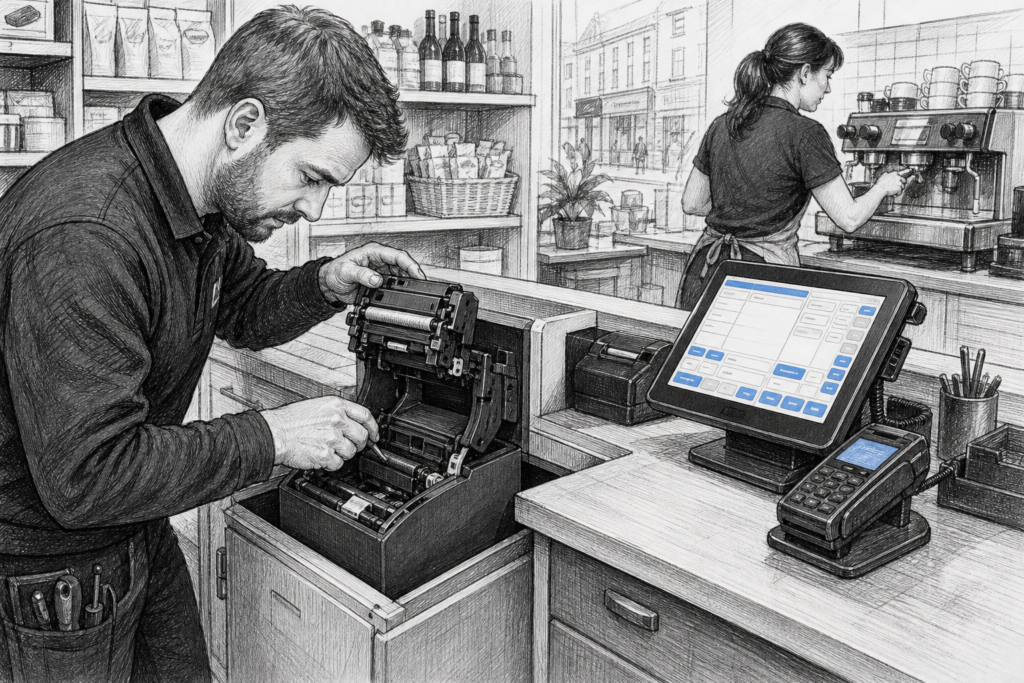
Receipt printers sit at the heart of many point-of-sale setups, especially in retail, cafés, takeaways and busy hospitality venues where a print failure can quickly slow down service. For EPOS resellers, installers and business owners, the conversation is not only about choosing a printer in the first place, but also about how easy it is to maintain, repair and support over time.
That is where printer components become important. Rather than treating every fault as a reason to replace the entire device, it can be far more practical to understand the role of key parts such as mechanisms, cutters, print heads, electronic assemblies and other internal components where they are available and appropriate. This approach can help extend the working life of installed hardware and reduce disruption for the customer.
Why serviceability matters in receipt printing
Thermal receipt printers are often used heavily throughout the day. In a restaurant, a printer might be producing order tickets as well as customer receipts. In retail, it may be operating constantly at peak times. Over months and years, wear is inevitable. Paper paths collect dust, cutters become less effective, and print quality can decline because of general use.
In these environments, the ability to replace a component instead of the whole unit can make practical and commercial sense. It gives installers and support teams another option when dealing with a fault, particularly if the printer model is still otherwise suitable for the site. For businesses with multiple tills or lanes, this can help keep the overall EPOS estate more consistent.
What printer components typically do
Different printer parts serve different functions, and the value of a component depends entirely on how the printer is designed. In general:
- Thermal print heads create the image on the paper using heat.
- Cutter assemblies help produce a clean receipt or ticket edge where a printer has a cutter fitted.
- Printer mechanisms move paper through the device and support the printing process.
- Electronic assemblies manage the control and communication functions inside the printer.
Understanding these parts is useful because not every printing problem points to the same cause. A faint receipt may be a print head issue, while paper jams or partial cuts may involve the mechanism or cutter assembly. For EPOS professionals, being able to think in terms of components improves fault diagnosis and helps decide whether repair or replacement is the more sensible route.
When replacing a component is the right approach
Component-level repair is not suitable for every situation, but it can be a good option when the printer body, power setup and connectivity are all still acceptable. This is particularly relevant in carefully planned POS installations where the printer is built into a larger workflow and changing the whole unit would create unnecessary work.
For example, a café may have a counter printer linked to the front-of-house POS and a second printer used for kitchen routing. If one device develops a fault that can be resolved through a genuine or appropriate replacement part, the business may avoid reconfiguring the full station. In a retail environment, keeping the same printer family in use can also reduce retraining and simplify spares management.
Benefits for EPOS resellers and installers
For resellers and installers, printer components can support a more flexible service model. Instead of always quoting a full replacement, a support team can assess whether the issue is isolated to one part. That can help with:
- reducing unnecessary equipment changes
- supporting older but still suitable installations
- keeping common printer models in service longer
- helping customers plan maintenance more effectively
This is especially useful where businesses have standardised on a specific receipt printer across several sites. A consistent hardware estate is easier to support, and components can play a part in maintaining that standardisation.
Buying printer components with support in mind
When sourcing printer components, accuracy matters. Compatibility should never be assumed from a similar model or from appearance alone. The exact printer family, revision and component type all need to be checked carefully before specifying a replacement part. This is one reason why product information from a trusted POS distributor is so valuable.
YCR Distribution works with the UK point-of-sale channel to supply hardware and related technology to resellers, installers and businesses. For printer spares, that means helping customers think beyond the immediate fault and towards the longer-term maintainability of the installation. Where an approved part is available, it can be a practical way to keep a printer in service without disrupting the wider EPOS setup.
Planning for the full lifecycle of POS hardware
Receipt printers are often expected to run quietly in the background, but they deserve the same planning as terminals, scanners and customer displays. Businesses that treat printers as serviceable assets rather than disposable peripherals are usually better placed to manage downtime and support costs over time.
That mindset is particularly relevant in hospitality, where order flow depends on accurate printing, and in retail, where a failed receipt printer can slow the checkout and frustrate customers. In both settings, having access to the right replacement parts can be part of a sensible business continuity plan.
For more information about point-of-sale hardware and EPOS solutions, contact YCR Distribution on 01924 438238 or visit www.ycr.co.uk.
If you are reviewing a current installation, the YCR store can also help you explore related printer categories and hardware options as part of a wider EPOS strategy.