
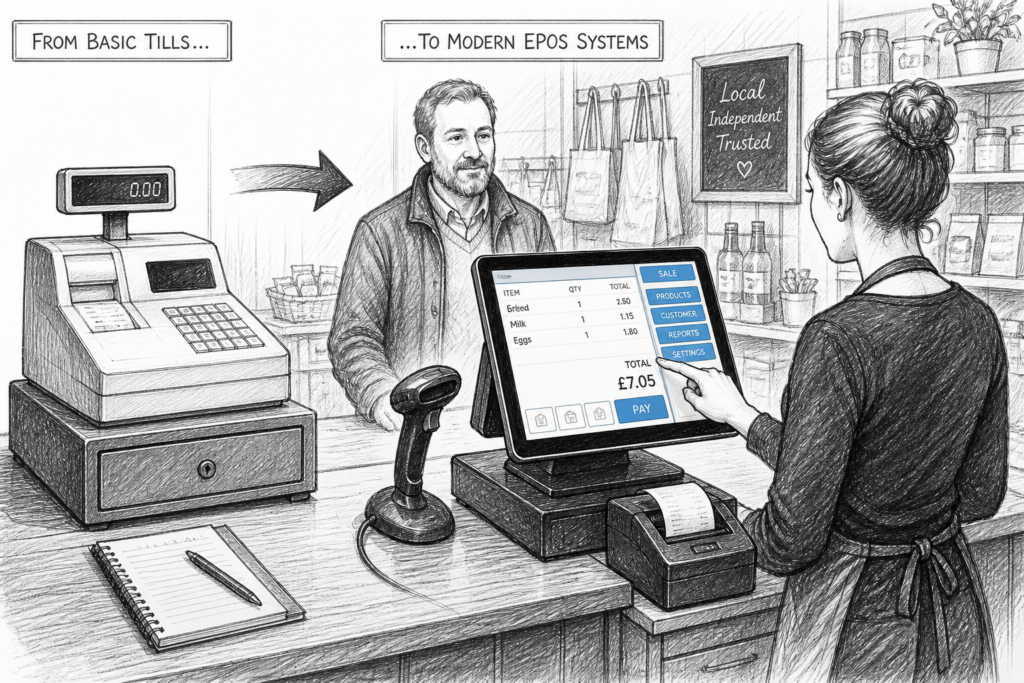
For many UK retailers, the change from a basic till to a modern EPOS system is no longer just about taking payments. It is about running the whole checkout area more efficiently, reducing admin and giving staff the tools they need to work faster and more accurately.
That shift is happening across convenience stores, specialist shops, garden centres, farm shops and multi-site retail businesses. The old style cash register still has a place in some environments, but it often struggles to keep up with modern expectations around reporting, stock visibility, customer service and flexible payment workflows.
What a basic till no longer does well
A traditional till is usually designed for simple transactions. It can record a sale, open a cash drawer and print a receipt, but that often leaves retailers with extra work elsewhere. Staff may need to look up products manually, manage price changes by hand or pull sales figures from separate systems.
In a busy shop, that can slow the checkout down and increase the chance of errors. If pricing is updated centrally, or if the business wants better visibility of sales by product, department or location, a basic till can quickly become a limitation rather than a help.
Modern POS systems UK businesses choose today usually bring several functions together in one place. That includes touchscreen operation, product lookup, sales reporting, user permissions and integration with peripherals such as barcode scanners and customer-facing displays.
Why EPOS makes day-to-day retail work easier
One of the biggest advantages of retail EPOS is speed. A well-designed system can reduce training time for new staff, speed up transactions and make it easier to serve customers during busy periods. That matters in shops that see sudden footfall, such as seasonal retail sites or businesses with short trading windows.
EPOS systems also make it easier to keep control of the business side of the checkout. Managers can review sales performance, see which products are moving and spot patterns across the working week. For retailers with several branches, that can be particularly useful because it gives a clearer picture of what is happening across the estate rather than just at one till.
Other practical benefits include:
- faster product lookup at the point of sale
- clearer sales reporting for managers and owners
- better control over staff permissions and till actions
- reduced manual administration at the end of the day
- easier support for barcode scanning and promotional pricing
Touchscreen POS and the move to modern hardware
The change is not only about software. POS hardware UK retailers install today is usually more robust and more flexible than the equipment found in older setups. Touchscreen POS terminals make it easier for staff to navigate the system, especially when the screen layout is designed around common tasks rather than a fixed keypad.
That is one reason many businesses are replacing ageing hardware at the same time as they review their software. Older equipment may still work, but it can be slower, harder to support and less suited to modern retail requirements. A standard office computer can be adapted for some uses, but it is not always the best choice for a high-traffic checkout where reliability matters.
For resellers and installers, this is where specifying the right commercial POS hardware becomes important. The goal is not just to add a screen and software, but to build a dependable checkout that suits the way the business actually trades.
When a retailer should consider upgrading
There are some common signs that a business has outgrown a basic till or older EPOS setup. These include repeated delays at the checkout, difficulty finding sales information, manual price management, or staff relying on workarounds to complete everyday tasks.
Another sign is when the checkout area no longer matches the pace of the business. A shop that processes more transactions than it did a few years ago may need a POS terminal that can keep up, especially if it is also handling barcode scanning, returns and customer queries at the same time.
Retailers should also think about the user experience. If staff find the system awkward, they will naturally slow down or make mistakes. Modern EPOS systems UK businesses deploy are often chosen because they simplify the transaction flow and reduce unnecessary steps.
Questions worth asking before an upgrade
- Is the current till slowing transactions at busy times?
- Do managers need better sales visibility?
- Are staff still entering too much information manually?
- Is the existing hardware becoming difficult to support?
- Would touchscreen operation improve usability?
Why UK-based support matters
For retailers, resellers and installers, local support can make the difference between a smooth rollout and avoidable disruption. When a checkout is under pressure, businesses need practical advice on suitable hardware, peripherals and deployment planning, not just a box of equipment.
This is where a UK point of sale distributor such as YCR Distribution is relevant. YCR works with EPOS dealers, resellers, installers and businesses across the UK, helping them source hardware that fits the application rather than forcing a one-size-fits-all approach. If a retailer is replacing old hardware, planning a new site or expanding across multiple locations, that technical and product knowledge can save time during setup and support later maintenance.
It also helps when replacement hardware is needed quickly or when a reseller wants to standardise on a reliable product range. In practical terms, that means fewer delays, better planning and a more consistent checkout experience for the end customer.
Planning the move from till to EPOS
A successful upgrade starts with understanding how the checkout is used. A convenience store may prioritise speed and barcode scanning, while a gift shop may need clearer product lookup and easier promotional pricing. A garden centre or farm shop may need a more flexible setup that can support a broad mix of products and transaction types.
Businesses should also think beyond the terminal itself. Receipt printing, cash drawer integration, customer-facing displays and possible future expansion all affect the final choice. A well-planned EPOS upgrade should make the checkout easier to operate now while leaving room for the business to grow.
For retailers that are still relying on a traditional cash register, the move to modern EPOS can feel like a significant step. In practice, though, it is often a straightforward way to improve speed, control and day-to-day efficiency at the point of sale.
For more information about point-of-sale hardware and EPOS solutions, contact YCR Distribution on 01924 438238 or visit www.ycr.co.uk.